How to Implement K-Means Clustering in Python
TL;DR
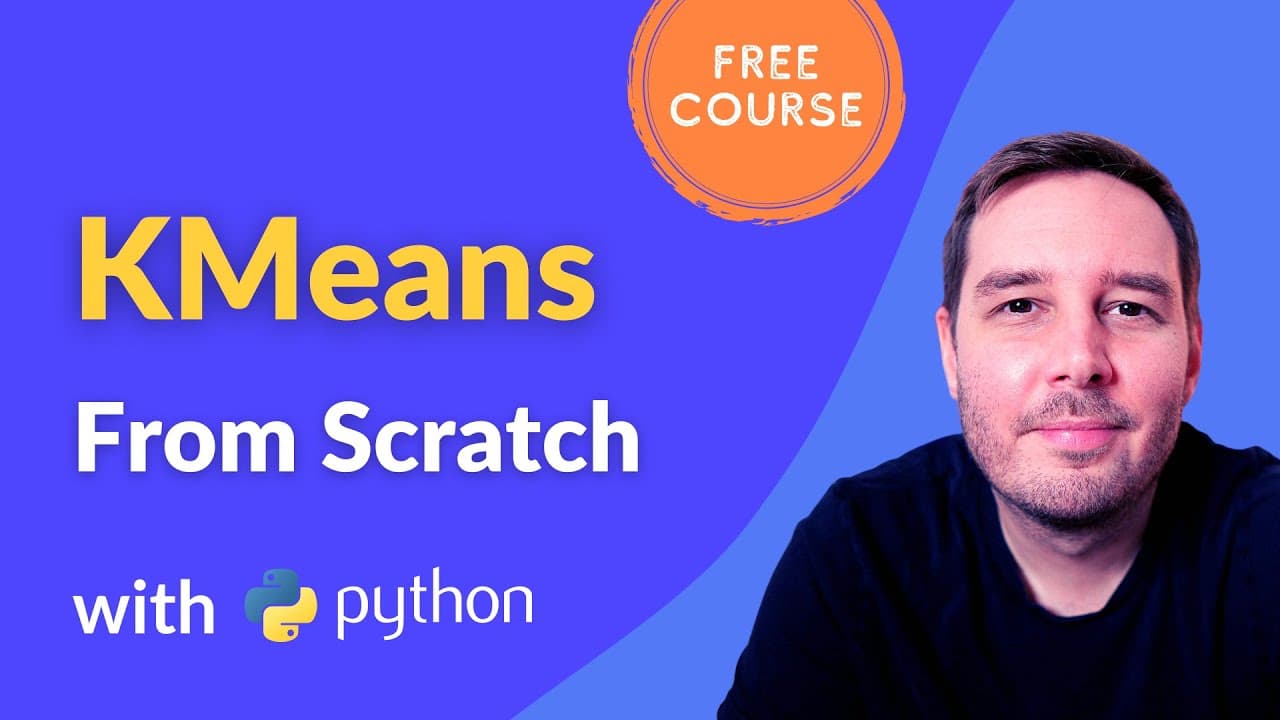
To implement K-Means clustering in Python, initiate by randomly selecting cluster centroids. Then, iteratively assign data points to the nearest centroid based on Euclidean distance and update the centroids with the means of their respective clusters until no changes occur, signaling convergence.
Transcript
welcome to the last video of the machine learning from scratch course presented by assembly ai in this series we implement popular machine learning algorithms using only built in python functions and numpy in this lesson we learn about k means so first we start with a short theory section and then we jump to the code so let's get started so k-means... Read More
Key Insights
- 👌 K-means is an unsupervised learning algorithm used for clustering unlabeled data.
- 🏷️ The algorithm iteratively updates the cluster labels and centroids until convergence.
- ❓ The Euclidean distance is used to find the nearest centroid to each sample.
- 👌 Implementation of the K-means algorithm can be done using Python and Numpy.
- 😚 The process involves initializing cluster centers, assigning samples to the closest centroids, and updating the centroids based on the mean of each cluster.
- 🏷️ Convergence is reached when there is no change in the cluster labels and centroids.
- 👌 The K-means algorithm can be visualized by plotting the clusters and centroids at each iteration.
Install to Summarize YouTube Videos and Get Transcripts
Explore YouTube Video Summarizer or Get YouTube Transcript Extractor
Questions & Answers
Q: What is the main objective of the K-means algorithm?
The main objective of the K-means algorithm is to cluster unlabeled data into k different clusters based on the mean of each cluster.
Q: How does the K-means algorithm initialize the cluster centers?
The cluster centers are randomly initialized by choosing k random samples from the dataset.
Q: What is the iterative optimization process of the K-means algorithm?
The iterative optimization process includes two steps: updating the cluster labels by assigning each sample to the nearest centroid, and updating the centroids by calculating the mean of each cluster.
Q: How does the K-means algorithm determine convergence?
Convergence is determined by checking if there is no change in the cluster labels and centroids between iterations.
Summary & Key Takeaways
-
K-means is an unsupervised learning algorithm that clusters a dataset into k different clusters based on the mean of each cluster.
-
The algorithm starts by randomly initializing cluster centers and iteratively updates the cluster labels and centroids until convergence.
-
The Euclidean distance is used to find the nearest centroid to each sample.
Read in Other Languages (beta)
Share This Summary 📚
Summarize YouTube Videos and Get Video Transcripts with 1-Click
Try YouTube Summary with ChatGPT & Claude or YouTube Transcript Generator
Explore More Summaries from AssemblyAI 📚





Summarize YouTube Videos and Get Video Transcripts with 1-Click
Try YouTube Summary with ChatGPT & Claude or YouTube Transcript Generator