How Could a Horse Seem to Do Complex Math?
TL;DR
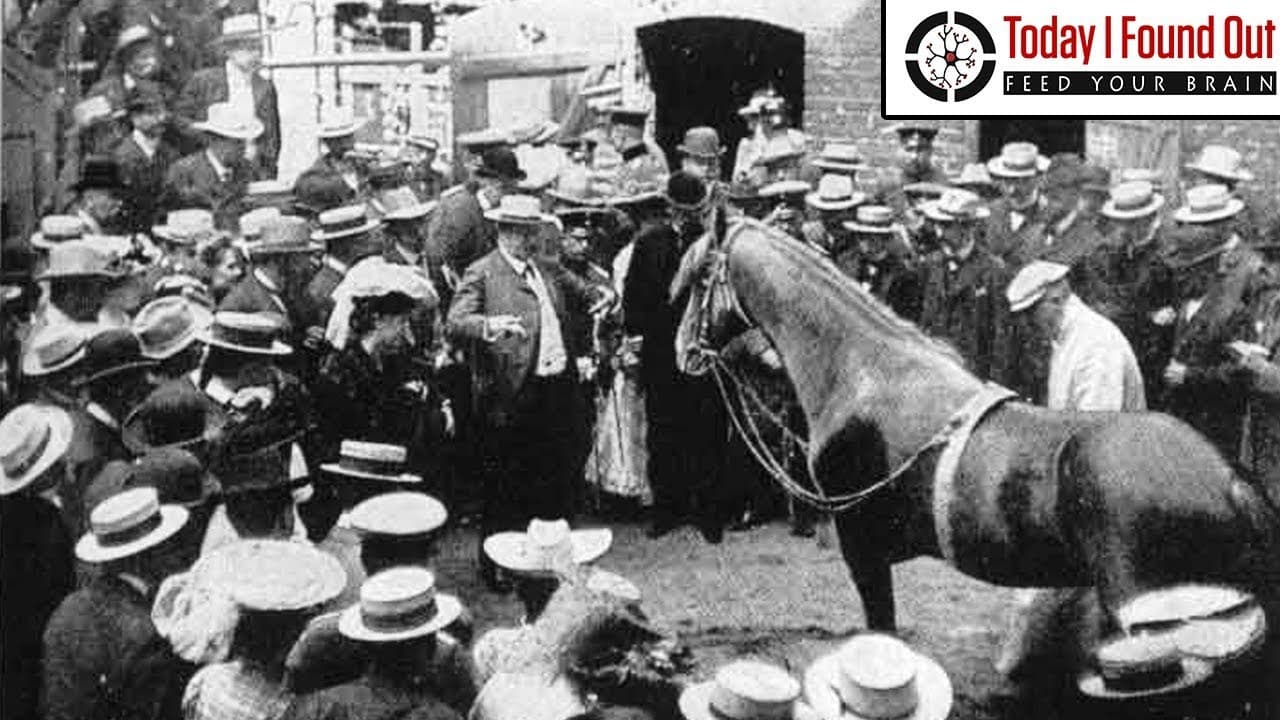
Clever Hans, a horse trained by Wilhelm Von Osten, appeared to perform complex mathematical calculations, but was actually responding to unconscious cues from humans. Research by psychologist Oskar Pfungst revealed that Hans only succeeded when he could see the questioner and when they knew the correct answers, leading to the discovery of what's now called the 'Clever Hans Effect.'
Transcript
Move over Mr. Ed, Clever Hans was the original horse who could communicate with humans in complex ways. Well, at least it seemed that way at the time. This phenomenon began in the late 19th century with a German mathematics teacher by the name of Wilhelm Von Osten. He was a student of phrenology, which meant that he adhered to the belief that a per... Read More
Key Insights
- 🏇 Clever Hans was a horse who appeared to possess remarkable math and language skills.
- ⛑️ The Hans Commission initially believed in Hans' abilities, but later studies by Pfungst revealed that he was responding to unconscious cues from his questioners.
- ❓ This phenomenon became known as the "Clever Hans Effect."
Install to Summarize YouTube Videos and Get Transcripts
Explore YouTube Video Summarizer or Get YouTube Transcript Extractor
Questions & Answers
Q: How did Wilhelm Von Osten teach the horse Hans math?
Von Osten started by having Hans tap numbers written on a blackboard and gradually progressed to basic mathematical problems and recognition of symbols.
Q: What conclusions did the Hans Commission reach?
The Hans Commission initially concluded that there was nothing fraudulent about Hans' abilities and that he was a gifted horse.
Q: How did psychologist Oskar Pfungst discover the truth about Clever Hans?
Pfungst conducted experiments where he changed certain environmental factors during questioning and observed how Hans' accuracy changed. He found that Hans was responding to unconscious cues from his questioners.
Q: Why did Von Osten agree to the investigation if he knew Hans was responding to cues?
Pfungst continued his studies and focused on the questioners' behavior, realizing that they were unknowingly giving cues to Hans. Von Osten was unaware of this and genuinely believed in Hans' abilities.
Summary & Key Takeaways
-
In the late 19th century, a German mathematics teacher named Wilhelm Von Osten tried to teach animals math and other skills, with the most successful being a horse named Hans.
-
Hans could tap out numbers, recognize symbols, spell names, tell time, and work out dates.
-
The Hans Commission investigated Hans' abilities and initially concluded that he was a gifted horse, but later studies by psychologist Oskar Pfungst revealed that Hans was responding to subtle cues from his questioners.
Read in Other Languages (beta)
Share This Summary 📚
Summarize YouTube Videos and Get Video Transcripts with 1-Click
Try YouTube Summary with ChatGPT & Claude or YouTube Transcript Generator
Explore More Summaries from Today I Found Out 📚





Summarize YouTube Videos and Get Video Transcripts with 1-Click
Try YouTube Summary with ChatGPT & Claude or YouTube Transcript Generator