What Is Markovnikov's Rule in Organic Chemistry?
TL;DR
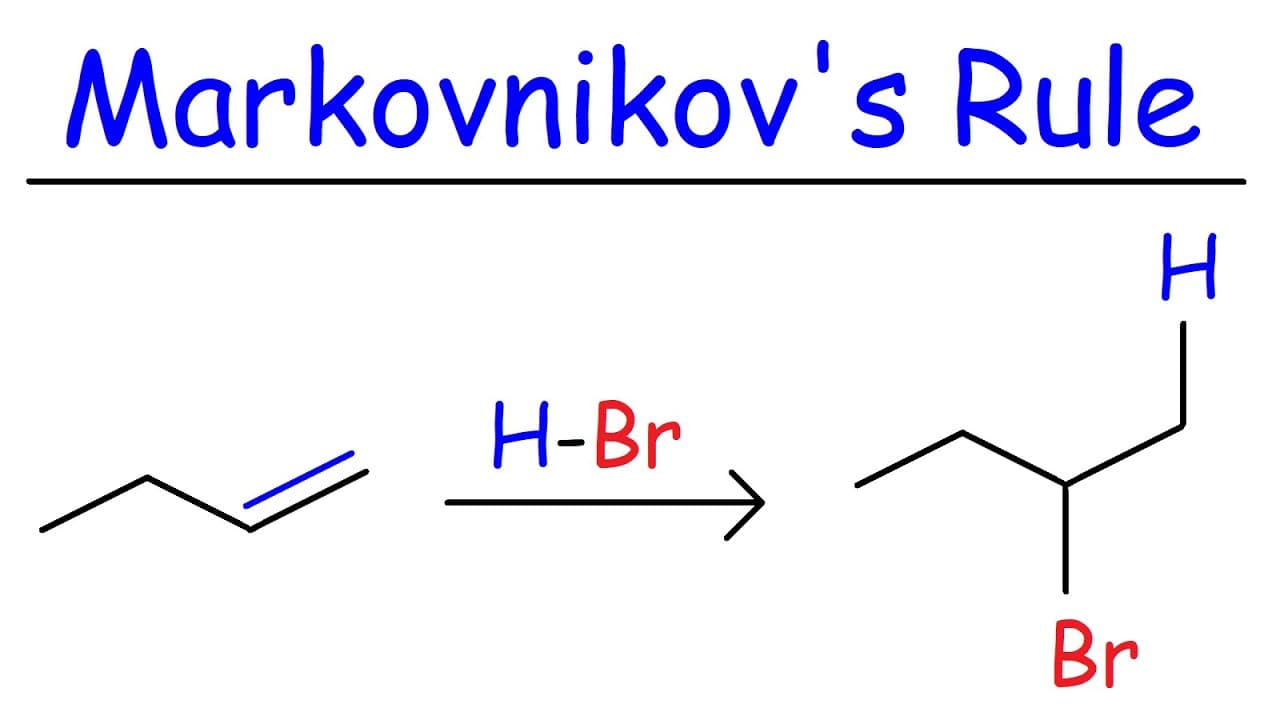
Markovnikov's Rule states that when adding an electrophile to an alkene, the more stable carbocation is favored, leading to the electrophile attaching to the more substituted carbon. Reactions can exhibit either Markovnikov addition, where the electrophile goes to the more substituted carbon, or anti-Markovnikov addition, where it attaches to the less substituted carbon, depending on the reagents used.
Transcript
in this video we're gonna focus on mark on the clouds roll so let's say we have this alkane two pentane and we react it with hydrobromic acid what will be the products of that reaction and let's compare it to if we have let's say 1 butene if we react that with hbr what will be the major product of that reaction now for the first reaction above we g... Read More
Key Insights
- ❓ Markovnikov's Rule determines the regioselectivity of organic chemistry reactions, favoring the addition of an electrophile to the more substituted carbon.
- 🇦🇬 Oxymercuration-demercuration and hydroboration-oxidation reactions follow Markovnikov's Rule, while HBr alone or with peroxides follows anti-Markovnikov addition.
- ❓ Stability of carbocation intermediates and the possibility of rearrangements influence the regioselectivity of reactions.
- 💁 Tertiary carbocations are more stable than secondary carbocations and can form through rearrangements.
- ❓ Hyperconjugation and the inductive effect contribute to the stability of carbocations.
- 🥺 The addition of an electrophile to an alkene can lead to the formation of different products depending on the regioselectivity of the reaction.
Install to Summarize YouTube Videos and Get Transcripts
Explore YouTube Video Summarizer or Get YouTube Transcript Extractor
Questions & Answers
Q: What is Markovnikov's Rule?
Markovnikov's Rule states that in the addition of an electrophile to an alkene, the electrophile adds to the more substituted carbon, resulting in the formation of a more stable carbocation intermediate.
Q: How does Markovnikov's Rule apply to the reaction of alkynes with HBr?
In the reaction of alkynes with HBr, the hydrogen atom adds to the carbon with the most hydrogen atoms (sp2 carbon), following Markovnikov's Rule. The halogen (bromine) adds to the other carbon, resulting in a more stable carbocation intermediate.
Q: What is the difference between regioselectivity and stereoselectivity in organic chemistry reactions?
Regioselectivity refers to the preference for the addition of an electrophile to a specific position on a molecule, while stereoselectivity refers to the preference for the formation of a specific stereoisomer.
Q: Why do some reactions, like oxymercuration-demercuration, proceed with more Markovnikov addition compared to others?
The regioselectivity of a reaction depends on factors such as stability of carbocation intermediates and the presence of rearrangement possibilities. In oxymercuration-demercuration, rearrangements are less likely, leading to more Markovnikov addition.
Summary & Key Takeaways
-
Markovnikov's Rule states that in the addition of an electrophile to an alkene, the reaction favors the formation of a more stable carbocation intermediate, leading to the addition of the electrophile on the more substituted carbon.
-
Reactions can proceed with either Markovnikov (more substituted carbon) or anti-Markovnikov (less substituted carbon) addition.
-
Oxymercuration-Demercuration and hydroboration-oxidation reactions follow Markovnikov's Rule, while HBr alone or in the presence of peroxides follows anti-Markovnikov addition.
Read in Other Languages (beta)
Share This Summary 📚
Summarize YouTube Videos and Get Video Transcripts with 1-Click
Try YouTube Summary with ChatGPT & Claude or YouTube Transcript Generator
Explore More Summaries from The Organic Chemistry Tutor 📚


Summarize YouTube Videos and Get Video Transcripts with 1-Click
Try YouTube Summary with ChatGPT & Claude or YouTube Transcript Generator