How to Use Obsidian and Claude Code for Life Management
TL;DR
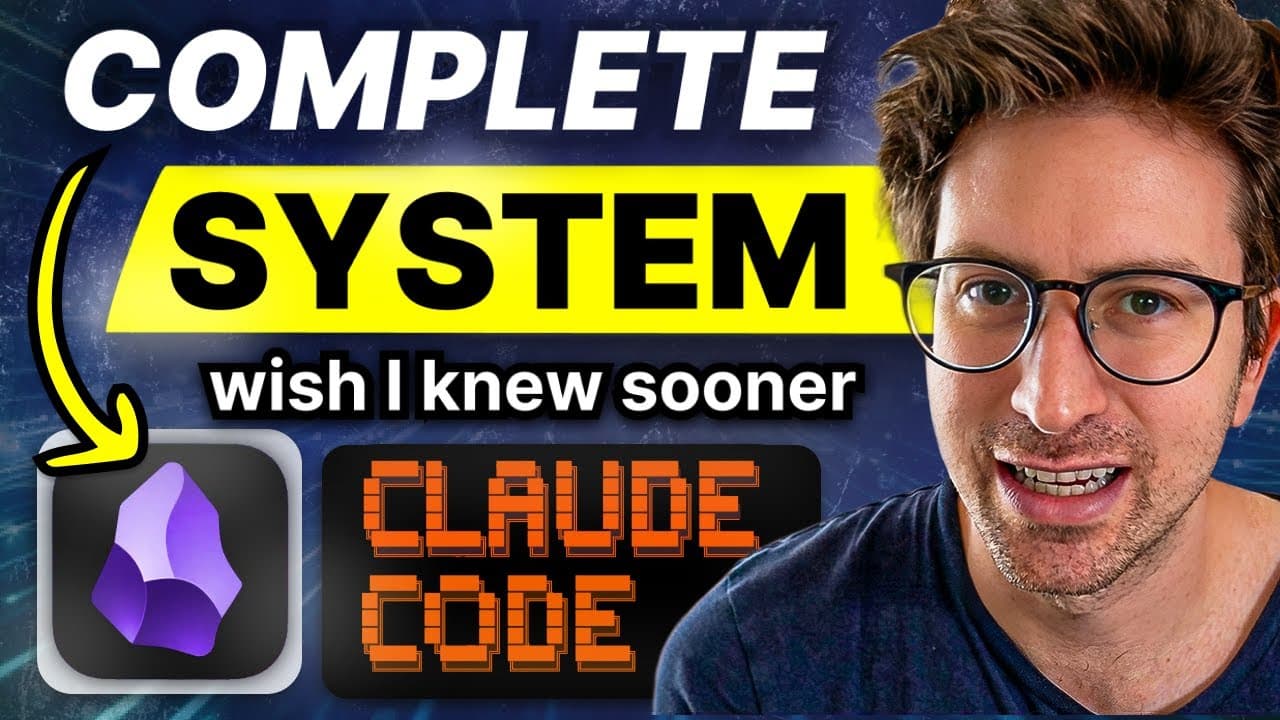
Using Obsidian with Claude Code transforms personal notes into actionable insights. By leveraging Obsidian's markdown-based system and Claude Code's command-line capabilities, users can surface latent patterns and generate ideas. This approach enhances productivity by turning writing and reflection into a powerful personal operating system.
Transcript
This is Obsidian. And Obsidian is this little tool that people are using as their second brain. But what's really cool about it is they're pairing it with Claw Code and they're getting crazy results out of it. It's literally a gamecher. Now, I've been slow to adopt Obsidian cuz to me, it's been a little daunting to look at. So, I had my friend Vin ... Read More
Key Insights
- Claude Code is a command-line agent that controls your computer via natural language, enhancing productivity with persistent context files.
- Obsidian organizes interlinked markdown files, and its CLI allows Claude Code to understand both files and their relationships.
- Custom slash commands in Claude Code, like /trace and /connect, help uncover patterns and ideas not visible through manual analysis.
- Writing and daily reflection fuel the system, providing context that empowers the agent to offer meaningful insights.
- Markdown files act as perfect memory for LLMs, offering a reliable foundation for building a personal operating system.
- Obsidian's backlinks create associations between notes, mimicking the brain's way of connecting ideas.
- The Obsidian CLI enables Claude Code to reveal cross-domain patterns, connecting seemingly unrelated ideas.
- A centralized markdown-based note-taking system is essential for maximizing the potential of LLMs in personal productivity.
Install to Summarize YouTube Videos and Get Transcripts
Explore YouTube Video Summarizer or Get YouTube Transcript Extractor
Questions & Answers
Q: How to use Claude Code with Obsidian for productivity?
Claude Code can be integrated with Obsidian to enhance productivity by using custom commands that leverage the interlinked markdown files in Obsidian. This setup allows users to surface patterns, generate ideas, and track the evolution of thoughts over time, turning personal notes into actionable insights.
Q: What is the role of Obsidian CLI?
Obsidian CLI plays a crucial role by granting Claude Code access to both the files and their interrelationships within the Obsidian vault. This enables the agent to understand connections between notes, facilitating the discovery of cross-domain patterns and insights that might otherwise remain hidden.
Q: Why are markdown files important in using LLMs?
Markdown files serve as a perfect memory for LLMs, providing a reliable and unbiased foundation for storing information. They allow users to maintain a centralized note-taking system that is essential for maximizing the potential of LLMs, enabling effective context management and idea generation.
Q: What are custom slash commands in Claude Code?
Custom slash commands in Claude Code, such as /trace, /connect, and /ideas, are designed to enhance productivity by surfacing latent patterns and generating actionable insights. These commands transform Claude Code into a personalized thinking partner, leveraging the user's written reflections for deeper analysis.
Q: How does writing and reflection contribute to this system?
Writing and reflection provide the raw material that fuels the entire system. By consistently documenting thoughts and ideas, users create a rich context that Claude Code can draw upon to generate insights and suggestions, making the system more effective in enhancing personal productivity.
Q: What makes Obsidian different from a regular folder of files?
Obsidian differs from a regular folder of files by allowing users to create backlinks between notes, forming a network of interrelated ideas. This structure mimics the brain's associative processes, enabling users to visualize and explore connections between different concepts and projects.
Q: How can Claude Code surface cross-domain patterns?
With access to the Obsidian vault and its interrelationships via the CLI, Claude Code can identify connections between seemingly unrelated notes. This capability allows the agent to reveal cross-domain patterns and insights, offering users a deeper understanding of their own ideas and projects.
Q: What is the significance of a centralized markdown-based note-taking system?
A centralized markdown-based note-taking system is significant because it provides a consistent and reliable framework for storing and organizing information. This system is foundational for using LLMs effectively, as it ensures that the agent has access to comprehensive and up-to-date context for generating insights.
Summary & Key Takeaways
-
Obsidian serves as an interlinked knowledge base, connecting markdown files through backlinks, allowing users to visualize relationships between different notes. This setup mirrors the brain's associative processes.
-
The Obsidian CLI bridges your vault and Claude Code, enabling the agent to access files and their interrelationships. This allows for the discovery of cross-domain patterns and insights that might otherwise go unnoticed.
-
Custom slash commands transform Claude Code into a personalized thinking partner, providing tools for context loading, idea evolution tracking, and belief pressure-testing. These commands leverage the full potential of the user's written reflections.
Read in Other Languages (beta)
Share This Summary 📚
Summarize YouTube Videos and Get Video Transcripts with 1-Click
Try YouTube Summary with ChatGPT & Claude or YouTube Transcript Generator
Explore More Summaries from Greg Isenberg 📚






Summarize YouTube Videos and Get Video Transcripts with 1-Click
Try YouTube Summary with ChatGPT & Claude or YouTube Transcript Generator