The Questionable Engineering of Oceangate
TL;DR
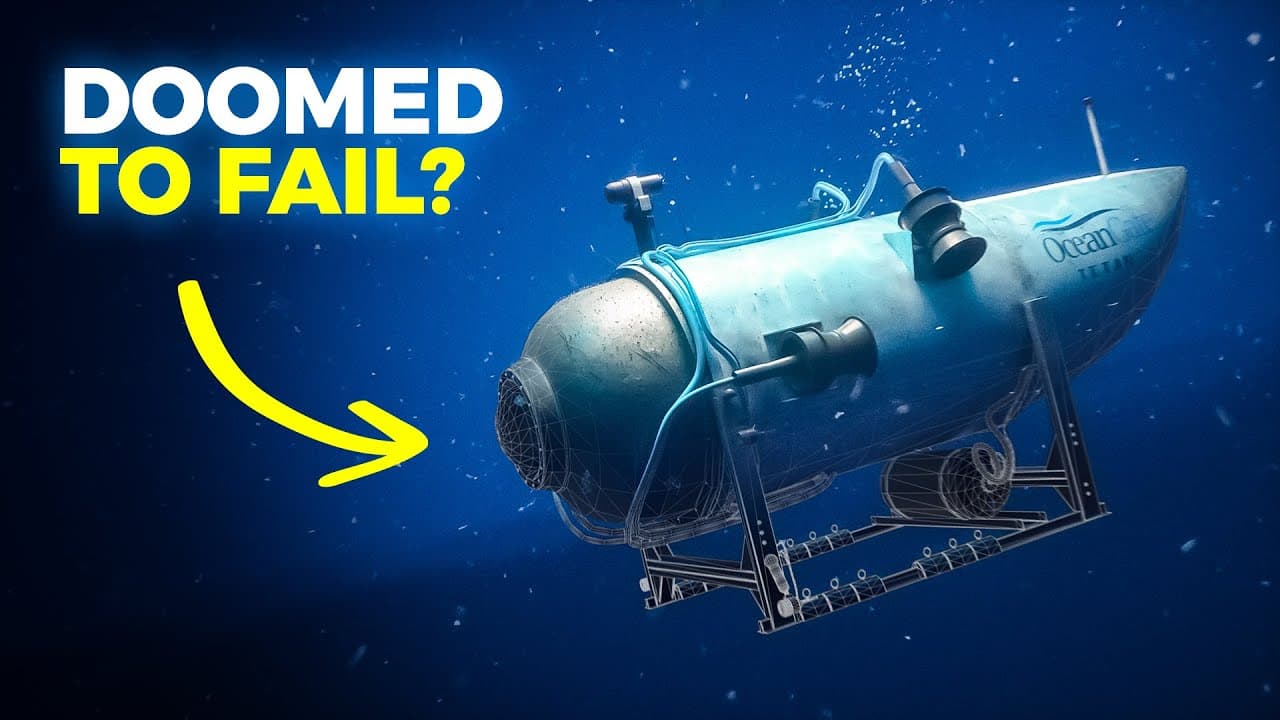
Oceangate's submersible imploded due to engineering failures.
Transcript
On the 19th of June the oceangate submersible began its descent to the Titanic’s fractured remains here, in the north western atlantic. With a descent rate of 55 metres per minute it would take the submersible 70 minutes to reach its destination. With each passing minute the equivalent of 5.3 atmospheres of pressure would be added to the subs hull.... Read More
Key Insights
- The Oceangate submersible used carbon fiber composites, which are not ideal for compressive strength required in deep-sea applications, leading to its catastrophic failure.
- Oceangate's decision to skip rigorous testing and industry-standard classification for their submersible was a critical oversight that contributed to the disaster.
- The company prioritized cost-saving over safety by opting out of using foam layers and autoclave curing, which could have mitigated risks associated with voids and delamination.
- Oceangate ignored warnings from experts about the submersible's structural integrity and relied on inadequate acoustic monitoring systems for safety assurance.
- The failure mode of snap buckling, unique to composite materials in deep-sea environments, was not fully understood or tested by Oceangate, increasing the risk of implosion.
- The engineering community is cautioned against the 'move fast and break things' mentality, which can lead to dangerous oversights in safety-critical designs.
- Oceangate's approach to innovation lacked the necessary real-world testing and validation, relying too heavily on computer modeling for complex composite materials.
- The video emphasizes the need for engineers to prioritize safety and thorough testing, especially in high-risk industries, to prevent tragic outcomes.
Install to Summarize YouTube Videos and Get Transcripts
Explore YouTube Video Summarizer or Get YouTube Transcript Extractor
Questions & Answers
Q: What material was used for the Oceangate submersible's hull, and why was it problematic?
The Oceangate submersible's hull was made from carbon fiber composites. This material choice was problematic because carbon fiber is not known for its compressive strength, which is crucial for withstanding the immense pressures at deep-sea levels. This oversight in material selection contributed to the submersible's implosion.
Q: Why did Oceangate skip industry-standard testing for their submersible?
Oceangate skipped industry-standard testing and certification to reduce costs and expedite their development process. They believed that traditional classification was unnecessary, focusing instead on operational risks. However, this decision overlooked critical safety validations, resulting in a failure to identify potential catastrophic failure modes.
Q: What is snap buckling, and how did it affect the Oceangate submersible?
Snap buckling is a failure mode unique to composite materials in deep-sea applications, where internal layers of a pressure vessel delaminate, leading to structural collapse. This phenomenon was not fully understood or tested by Oceangate, making their submersible vulnerable to implosion under deep-sea pressures.
Q: How did Oceangate's approach to innovation contribute to the disaster?
Oceangate's approach to innovation prioritized cost-saving and rapid development over safety. They skipped crucial safety tests, relied on inadequate computer modeling, and used insufficient monitoring systems. This approach ignored established engineering practices, ultimately leading to the submersible's catastrophic failure.
Q: What role did the acoustic monitoring system play in the submersible's safety?
The acoustic monitoring system was intended to detect structural failures by listening for fracture sounds. However, this system was inadequate as it could only provide minimal warning before catastrophic failure. It created a false sense of security for passengers, as it was more of a marketing tool than a reliable safety measure.
Q: Why was the decision not to use an autoclave significant?
Not using an autoclave for curing the composite hull was significant because autoclaves help eliminate voids in the material, which can lead to structural weaknesses. By opting for a cheaper curing method, Oceangate increased the risk of voids and delamination, contributing to the submersible's vulnerability under pressure.
Q: What warning signs were ignored by Oceangate before the disaster?
Oceangate ignored multiple warning signs, including expert advice about the submersible's structural integrity and audible cracking sounds during test dives. These signs indicated accumulating damage, but the company chose to dismiss these concerns, prioritizing their schedule and cost-saving measures over passenger safety.
Q: What does the video suggest about the future of engineering practices?
The video suggests that engineering practices must prioritize safety and thorough testing, especially in high-risk industries. It warns against the trend of rapid innovation without proper validation and emphasizes the importance of adhering to established safety protocols to prevent future tragedies like the Oceangate disaster.
Summary & Key Takeaways
-
Oceangate's Titan submersible imploded due to poor engineering choices, primarily the use of carbon fiber composites unsuitable for deep-sea pressure, and a lack of rigorous testing and certification.
-
The company's decision to forego industry-standard safety testing and rely on inadequate monitoring systems contributed significantly to the submersible's catastrophic failure.
-
The video highlights the dangerous trend of prioritizing rapid innovation over safety, urging engineers to focus on thorough testing and validation to prevent future disasters.
Read in Other Languages (beta)
Share This Summary 📚
Summarize YouTube Videos and Get Video Transcripts with 1-Click
Try YouTube Summary with ChatGPT & Claude or YouTube Transcript Generator
Explore More Summaries from Real Engineering 📚






Summarize YouTube Videos and Get Video Transcripts with 1-Click
Try YouTube Summary with ChatGPT & Claude or YouTube Transcript Generator