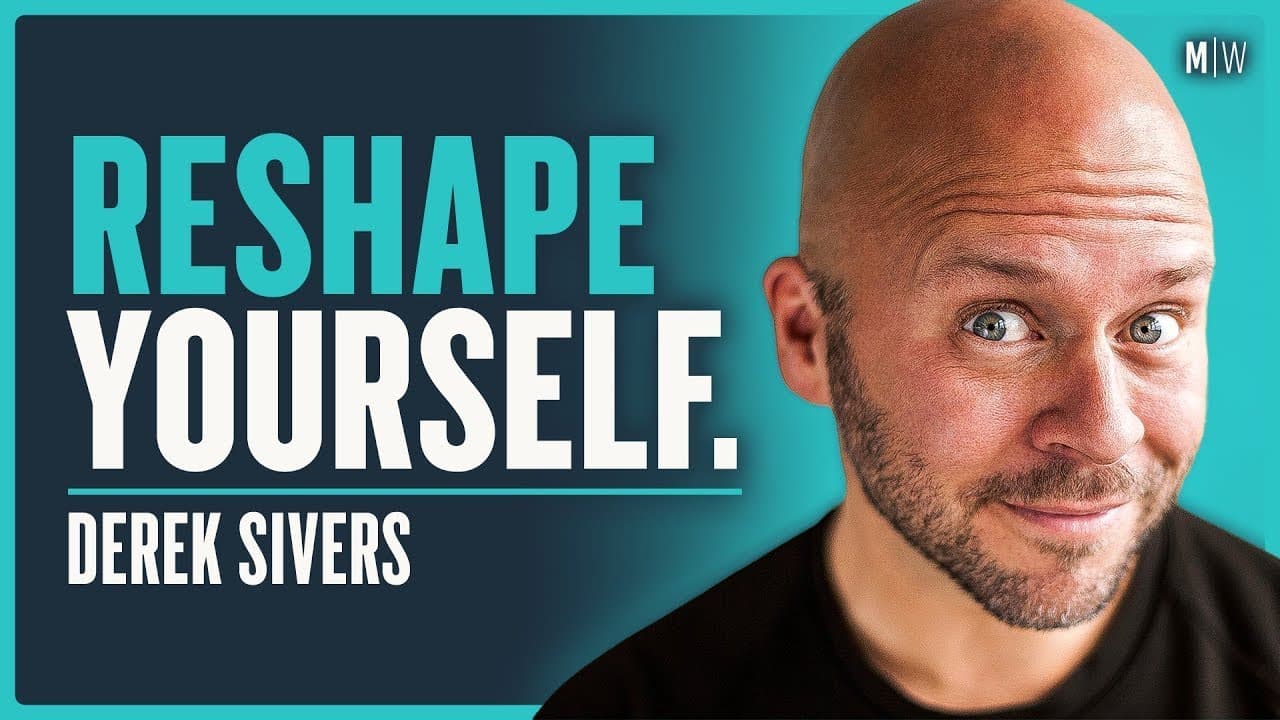
What Does Useful Not True Mean? Derek Sivers Explains
TL;DR
Choose beliefs for their usefulness rather than their literal truth. Derek Sivers deliberately adopts beliefs like "men and women are the same" as a countermeasure against his own tendencies, the same way a habitually late person leaves unreasonably early. Reframing is the core skill: detach from your first reaction, brainstorm past the obvious two or three alternatives, and a smarter strategy or unique insight appears.
Transcript
what do you mean when you talk about useful not true oh diving right in um for years I write things that are sharing my point of view on something I share a point of view I find useful and I state it as a fact I say for example uh men and women are the same and I choose that belief for example uh to counterbalance my tendency to think of men and wo... Read More
Key Insights
- Choosing a belief as a countermeasure works like leaving early when you tend to run late. Sivers picks the belief "men and women are the same" specifically to counterbalance his own tendency to think of them as more different than they actually are.
- The objection "that's not true" misses the point of a useful belief. When told marketing is not always another way of being considerate, Sivers agreed, then argued it beats thinking about how to annoy and spam people, so the frame is more useful even if inaccurate.
- Functionally true but literally false beliefs are protective. Pigs carry a higher pathogen load on average, so avoiding their flesh in a warm Middle Eastern climate during the Middle Ages without good sanitation was adaptive, regardless of any claim about moral dirtiness.
- Literally true but functionally false beliefs are much harder to find. The host's main candidate is that free will does not exist: a deterministic view that smarter people find plausible, but that in practice leaves people nihilistic, fatalistic, apathetic, or just sad.
- The value of reframing is detaching from your instinctual reflexive reaction and naming it as merely a first reaction. Old-fashioned brainstorming that refuses to stop after two or three alternatives and pushes into radically different views produces a smarter strategy or a unique insight.
- Tim Ferriss's book-selection method is to ignore praise and read the top rated critical review on Amazon. The reframe is asking whether you are looking for encouragement or for discouragement strong enough that pushing through it means something.
- Ferriss also hires a journalist when brainstorming a book, because journalists and lawyers push back on ideas best. He does not want to be told an idea is great; he wants someone arguing it is a bad idea to write about, plus counter ideas.
- Things are not what they are, they are what we think they are, and people confuse the two. We spot fallibility, manipulation, and bias easily in others while assuming our own first impressions of the world are always correct, a kind of mass individual solipsism.
Install to Summarize YouTube Videos and Get Transcripts
Explore YouTube Video Summarizer or Get YouTube Transcript Extractor
Questions & Answers
Q: What does 'useful not true' mean?
It means choosing a belief because of what it does for you rather than because it is factually accurate. Derek Sivers spent years writing points of view he found useful and stating them as fact. When people objected that a claim was not true, his answer was that truth is not the point. He picks beliefs deliberately, often as a countermeasure to his own tendencies, and that theme sat underneath his previous four books before he wrote a short book making it explicit.
Q: How do you choose a belief as a countermeasure?
Identify the tendency you want to correct, then pick a belief that pulls in the opposite direction. Sivers chooses to believe men and women are the same to counterbalance his tendency to think of them as more different than they actually are. He compares this to someone who is habitually late leaving at what seems like an unreasonably early time, which is what gets them there on time. The belief does not have to be accurate; it has to move you toward the behavior you want.
Q: What is an example of something functionally true but literally false?
The host offers three. Porcupines cannot throw their quills, since they are not darts players, but treating them as if they can means you stay away from them. Walking under a ladder is not actually bad luck, yet avoiding ladders lowers your chance of paint cans, plant pots, and humans landing on your head. And the idea that pigs are morally dirty is not defensible, but their flesh carries a higher pathogen load on average, so avoidance was protective in a warm climate without good sanitation.
Q: Why is reframing important according to Derek Sivers?
Sivers says reframing is everything. It is not just a way to feel better about things outside your control; it shapes concrete strategy in business, in what you choose to do with your life, and in how you approach anything at all. He credits the best things in his life, including new approaches to business, to where he lives in the world, and to parenting, to moments where he thought harder and pushed past his first reaction through deliberate conscious reframing.
Q: How do you actually reframe a situation?
Start by recognising that your default instinctual reflexive reaction is not the only way to see the situation, and detach from it by naming it as just your first reaction. Then use old-fashioned brainstorming to list other ways of looking at it, and crucially do not stop after the first two or three. Push yourself to the edges and generate radically different views. What comes out is either a smarter strategy or a unique insight that most people miss because it is not intuitive.
Q: What is Tim Ferriss's method for choosing a book to read?
Ferriss goes to Amazon, looks at the well-rated books, and then deliberately skips the positive reviews. Instead he finds the top rated critical review, because he does not want to hear praise for the book, he wants to hear criticism against it. Amazon sorts reviews into praise and critical, which makes this easy. Sivers describes using this exact technique himself while searching for a book an hour before the recording, and calls it an approach that does not come instinctually.
Q: Why does Tim Ferriss hire a journalist when brainstorming a book?
Because he wants pushback rather than encouragement. Ferriss has found that journalists and lawyers are the two groups best at pushing back on an idea and challenging it. When considering a new book, he does not want someone telling him it is a great idea; he wants someone arguing it might be a bad idea to write about, and offering counter ideas. Sivers cites it as an example of an approach that only arrives after deeper thought rather than instinct.
Q: Is there anything that is literally true but functionally false?
The host says these are much harder to find, at least in his opinion. His candidate is the claim that free will does not exist, a deterministic view that the laws of physics and some philosophy suggest to people he considers smarter than himself. The problem is what happens when you try to use it. Functionally applying determinism tends to leave people nihilistic, fatalistic, apathetic, or just a bit sad, so the belief may be accurate and still fail you in practice.
Summary & Key Takeaways
-
Sivers wrote for years sharing points of view he found useful and stating them as fact. When readers objected that "men and women are the same" or "marketing is just another way of being considerate" were not true, he answered that truth was never the point. He picks beliefs because they help him, and that theme sat underneath his previous four books.
-
The host maps this onto a framework he and George Mack had discussed for two and a half years: things functionally true but literally false. Porcupines cannot throw their quills, but treating them as if they can keeps you away. Walking under a ladder is not bad luck, but avoiding it lowers your odds of paint cans landing on your head.
-
Reframing, Sivers argues, is not just a way to feel better about things outside your control. It drives concrete strategy in business and in life. Your default reaction to any situation is only your first reaction, not the only way to see it, and pushing brainstorming to the edges yields approaches most people never consider because they are not intuitive.
Read in Other Languages (beta)
Share This Summary 📚
Summarize YouTube Videos and Get Video Transcripts with 1-Click
Try YouTube Summary with ChatGPT & Claude or YouTube Transcript Generator
Explore More Summaries from Chris Williamson 📚





Summarize YouTube Videos and Get Video Transcripts with 1-Click
Try YouTube Summary with ChatGPT & Claude or YouTube Transcript Generator