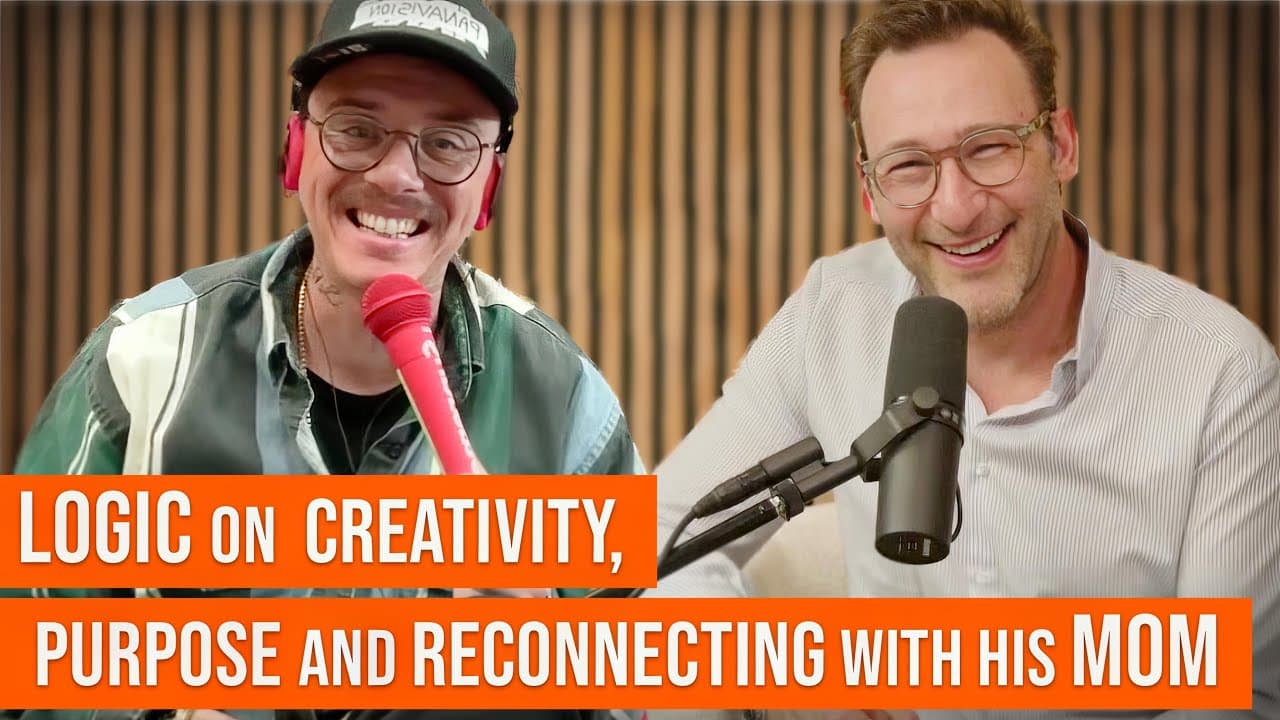
What Is Confident Ignorance? Rapper, Novelist, and Filmmaker Logic on Asking for Help | A Bit of Optimism Podcast
TL;DR
Confident ignorance means pursuing an ambitious creative vision while admitting what you do not know and asking others for help. Logic also explains why mainstream pop success left him empty, how he separated self-worth from work, and why he reconnected with his mother after 15 years. Read on for his insights about purpose, forgiveness, fatherhood, creativity, and self-imposed pressure.
Transcript
I'm purposefully not making pop music anymore because that doesn't really make me happy and when I reached the height of that pop mainstream success I was left a bit empty and I think finding finding your purpose is really important but I had found mine so young that by the time I finally hit the goal and reached that goal of like essentially every... Read More
Key Insights
- Purpose is an ongoing direction rather than a finish line. A number one hit or becoming a pop star is a goal that can be achieved, while purpose is something a person continually lives, advances toward, and builds upon.
- Self-worth becomes healthier when it is not equated with work. Logic says reaching the height of mainstream pop success left him feeling empty, while separating identity from professional output made him happier, even though he still struggles with that distinction every day.
- Forgiveness can begin by understanding the conditions behind harmful behavior. Logic views his mother’s abuse through her history of assault, PTSD, trauma, addiction, and mental decline, while still acknowledging that what happened to him was serious and damaging.
- Addiction can change how past harm is interpreted without erasing its consequences. Logic describes his father ruining his credit when he was 10, yet he now sees the act as behavior driven by an internally broken person seeking escape through a substance.
- Fatherhood can transform painful experience into a guide for different behavior. Logic looks at his children, recognizes what he could never do to them, and uses detailed memories of his own childhood to become the most supportive father he can be.
- Creativity can function as a refuge from instability. Logic says that having little to do or distract him during childhood led him into creative work, eventually contributing to a pattern of constant production across music, novels, scripts, and films.
- Overwork can be self-imposed even when the projects are meaningful. After listing his albums, novels, movies, and scripts, Logic recognized that he was adding much of the stress and weight himself, while also admitting that he likes working intensely.
- Creative vision matters more than possessing every required skill. When a project becomes too large for one person, asking for help allows the creator to bring the vision to life while honestly accepting that they do not know how to do everything.
- "I'm purposefully not making pop music anymore because that doesn't really make me happy" (0:00)
- "you can advance towards it you can build upon it you can live it you can't achieve a purpose" (0:50)
- "because she was very abusive and mentally unstable when I was a child" (1:36)
- "she has PTSD and Trauma and a lot of that stuff that I had to deal with like when I was a kid" (2:33)
- "needless to say it was a crazy conversation was super positive and very nice and and great" (4:54)
Install to Summarize YouTube Videos and Get Transcripts
Explore YouTube Video Summarizer or Get YouTube Transcript Extractor
Questions & Answers
Q: What does confident ignorance mean for creators?
It means having confidence in a creative vision without pretending to possess every skill needed to realize it. When an idea becomes too large for one person, asking others for help can supply the missing abilities.
Q: What is the difference between purpose and a goal?
A goal is an outcome that can be achieved, such as becoming a pop star or having a number one hit. Purpose cannot be completed, but it can be lived, advanced toward, and built upon.
Q: Why did mainstream pop success leave Logic feeling empty?
Logic had reached essentially everything a musician could dream of attaining, but he had confused that goal with his purpose. He also realized that making pop music did not make him happy, so separating his self-worth from his work helped him feel happier.
Q: Why did Logic speak with his mother after 15 years?
Logic had tried to reconnect over the years, and his mother's age made him conscious that their remaining time was limited. He had already begun forgiving her, and their eventual phone conversation was positive, kind, and meaningful.
Q: How did Logic come to forgive his mother?
Logic says maturity helped him view her behavior in the context of abuse, PTSD, trauma, mental instability, and addiction. He came to see her as a broken person while still acknowledging the serious harm she caused him.
Q: What childhood experiences did Logic describe?
Logic said his mother was abusive and once almost choked him to death. He also described growing up around violence, drugs, guns, killers, murderers, and robbers, while both parents struggled with addiction.
Q: How did fatherhood change Logic's perspective on his childhood?
Looking at his children showed Logic that he could never treat them as he had been treated. He uses detailed memories of his childhood as guidance for becoming the most supportive father he can be.
Q: Why does Logic describe his workload as self-imposed?
Logic recognized that his many albums, novels, films, and scripts created much of his own stress. He also admitted that he likes intense work and sometimes writes 30 script pages around midnight on a supposed day off.
Summary & Key Takeaways
-
Logic recounts speaking with his mother for the first time in 15 years after a childhood marked by abuse, addiction, violence, and instability. Their conversation was positive. His ability to reconnect grew from maturity and from viewing her behavior in the context of trauma, PTSD, mental health struggles, and substance addiction.
-
Professional success left Logic feeling empty because he had treated mainstream pop achievement as his purpose. Simon distinguishes goals, which can be completed, from purpose, which can only be lived and advanced. Logic became happier after separating his personal worth from his output, though he says maintaining that distinction remains a daily human struggle.
-
Logic describes creativity as both refuge and compulsion. Childhood hardship pushed him toward imaginative work, but his many albums, novels, films, and scripts also create self-imposed stress. The broader lesson is that vision matters more than mastering every skill personally, and ambitious creative work becomes possible when creators honestly ask others for help.
Read in Other Languages (beta)
Share This Summary 📚
Summarize YouTube Videos and Get Video Transcripts with 1-Click
Try YouTube Summary with ChatGPT & Claude or YouTube Transcript Generator
Explore More Summaries from Simon Sinek 📚

Summarize YouTube Videos and Get Video Transcripts with 1-Click
Try YouTube Summary with ChatGPT & Claude or YouTube Transcript Generator