What Is Inductive Reactance and How Does It Affect AC Circuits?
TL;DR
Inductive reactance is the opposition an inductor presents to an AC signal, calculated as 2πfL, affecting current flow. Impedance combines resistance and reactance, determining total opposition in the circuit. The power consumed is primarily by resistors, not inductors, which store and release energy, making them effective for filtering specific frequencies.
Transcript
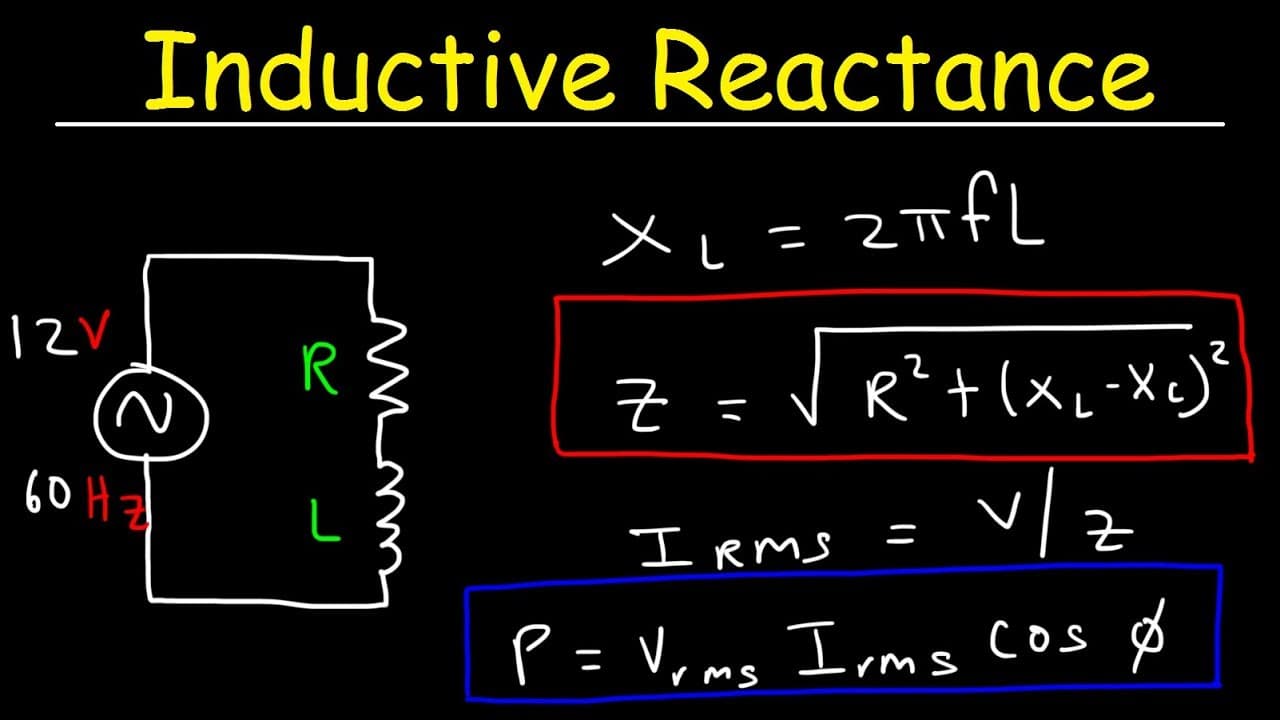
let's start with this problem a 100 milli Henry inductor is in series with a 50 ohm resistor and a 12 volt AC source with a frequency of 60 Hertz what is the inductive reactance and a circuit so let's draw the circuit so let's say this is the AC signal and this is the resistor and the inductor so we have a 12 volt signal and the frequency of 60 Her... Read More
Key Insights
- ❓ Inductive reactance is influenced by both the frequency and inductance of the circuit.
- 🥡 Impedance takes into account both resistance and reactance, providing a comprehensive measure of the opposition to an AC signal.
- ⚡ The voltage across the resistor and inductor can be calculated using the RMS current and their respective resistance and reactance values.
- ⚡ The total voltage of the source can be determined by using an equation involving the voltage across the resistor and inductor.
- ✊ Power can be consumed by the resistor in a circuit, while the inductor absorbs and releases energy without net gain or loss.
- ✊ Power consumed by the circuit can be calculated using the power absorbed by the resistor or by considering the voltage, current, and power factor.
- 👻 Inductors can be used as filters to allow or block specific frequencies in an AC circuit.
Install to Summarize YouTube Videos and Get Transcripts
Explore YouTube Video Summarizer or Get YouTube Transcript Extractor
Questions & Answers
Q: How is inductive reactance calculated, and what does it indicate in a circuit?
Inductive reactance is calculated using the formula 2πFL, where F is the frequency and L is the inductance. Inductive reactance tells us how much the inductor resists the flow of an AC signal in a circuit.
Q: How is impedance calculated, and what does it represent in a circuit?
Impedance is calculated using the equation √(R^2 + XL^2), where R is the resistance and XL is the inductive reactance. Impedance represents the overall opposition to an AC signal in a circuit due to both resistance and reactance.
Q: How is the RMS current flowing in the circuit determined?
The RMS current is calculated by dividing the source voltage by the impedance of the circuit. It represents the effective current flowing through the circuit.
Q: What is the power factor, and how is it calculated?
The power factor, represented by cosine, is calculated by dividing the resistance by the impedance. It indicates the relationship between the real power (consumed by the circuit) and the apparent power (product of voltage and current).
Summary & Key Takeaways
-
The analysis starts by calculating the inductive reactance in the circuit, which measures how much the inductor opposes an AC signal.
-
Next, the impedance of the circuit is calculated using the resistance and inductive reactance, providing the overall opposition to the AC signal.
-
The RMS current flowing in the circuit is determined by dividing the source voltage by the impedance.
-
The voltage across the resistor and inductor is then calculated separately using the RMS current and their respective resistance and reactance values.
-
The total voltage of the source is confirmed using an equation involving the voltage across the resistor and inductor.
-
Finally, the power consumed by the circuit is calculated by considering the power absorbed by the resistor, and the power factor is introduced to aid in the calculation.
Read in Other Languages (beta)
Share This Summary 📚
Summarize YouTube Videos and Get Video Transcripts with 1-Click
Try YouTube Summary with ChatGPT & Claude or YouTube Transcript Generator
Explore More Summaries from The Organic Chemistry Tutor 📚


Summarize YouTube Videos and Get Video Transcripts with 1-Click
Try YouTube Summary with ChatGPT & Claude or YouTube Transcript Generator