How to Improve Cooling with Peltier Coolers Using Arduino
TL;DR
To enhance cooling efficiency in a Peltier system, integrate a high-performance fan controlled by Arduino via PWM. This setup can achieve temperatures as low as -20 degrees Celsius by optimizing fan RPM and utilizing evaporative cooling techniques, demonstrating the principles of thermodynamics in practical applications.
Transcript
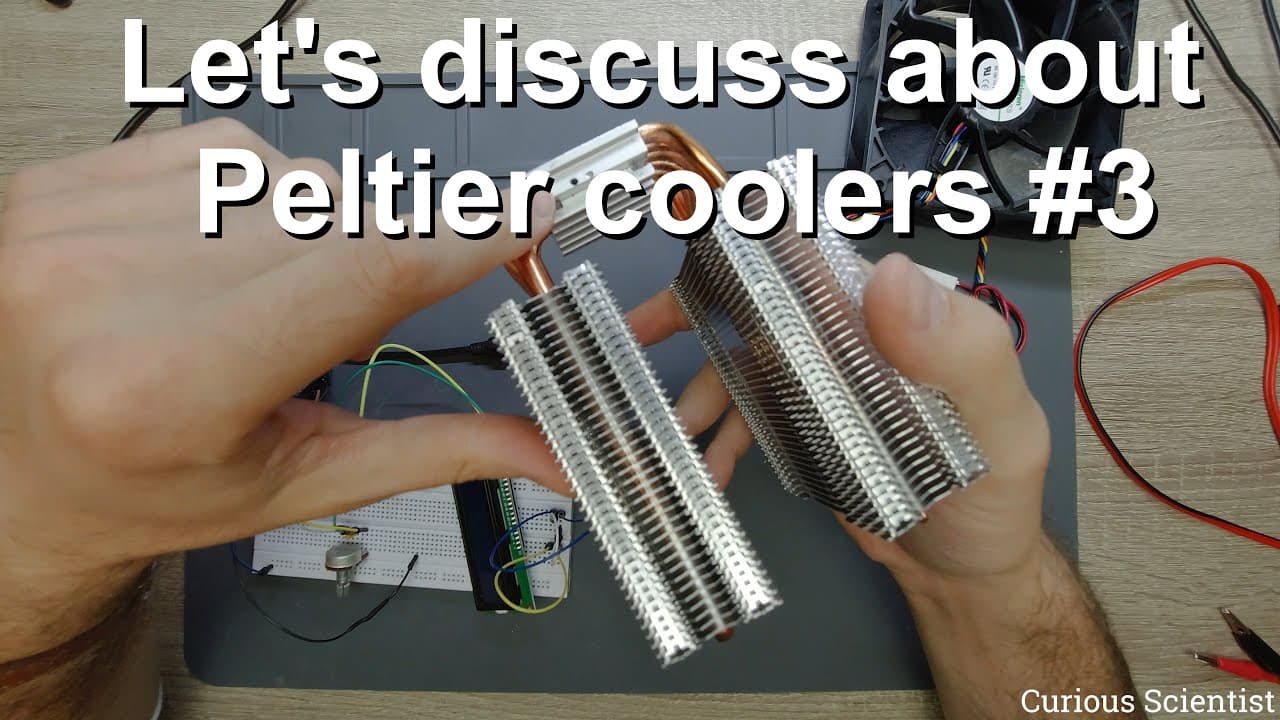
welcome everyone in this video I would like to test some patio cooling again I got some new stuff and I also made some modifications to some of my other things and I want to show them to you so we can learn these things together so as you can see we have a few fans here and Arduino circuit an 8 ampere unit so here I will use the 8 ampere unit so Te... Read More
Key Insights
- 😎 Integrating a powerful fan with PWM control can enhance cooling performance significantly in small systems.
- 🪭 Proper frequency adjustments are vital for effective fan operation when using an Arduino, ensuring compatibility with fan specifications.
- 😎 Evaporative cooling techniques can lead to substantial temperature reductions in experimental setups, demonstrating practical applications of physics principles.
- ✊ The setup's performance is closely linked to ambient temperature, affecting both power requirements and efficiency.
- 🥺 Challenges in DIY projects often lead to valuable learning experiences and adjustments in the approach and methodology.
- 💦 Future enhancements should prioritize safety and robust design to better mitigate risks associated with water and electricity.
- 🛩️ Observations from the experiment can inspire similar cooling applications in different contexts, such as electronics cooling or small air conditioning units.
Install to Summarize YouTube Videos and Get Transcripts
Explore YouTube Video Summarizer or Get YouTube Transcript Extractor
Questions & Answers
Q: What modifications were made to the patio cooling system?
The video outlines the replacement of a weak fan with a higher-performance ant miner fan, which has a better design and stronger airflow. Additionally, an Arduino circuit was integrated for PWM control to adjust the RPM of the fan, enhancing the cooling capabilities of the system.
Q: Why is the PWM controlling wire significant in this setup?
The PWM controlling wire allows for frequency adjustments between 21 to 28 kHz, essential for operating the fan efficiently. Since the Arduino operates at lower frequencies, modifications are necessary to ensure compatibility. This enables precise control over the fan speed, thereby improving cooling performance.
Q: How did the addition of water impact the cooling performance?
Sprinkling water on the heat sink fins facilitated evaporative cooling, which removed heat more effectively. This method lowers the temperature, as the evaporation process absorbs heat energy, similar to how sweat cools the body, thus improving overall cooling efficiency.
Q: What temperature extremes did the cooling system achieve in the experiments?
The cooling system successfully reached temperatures as low as -20 degrees Celsius under optimal testing conditions. The creator noted fluctuations with increases or decreases in cooling power and fan RPM adjustments, showcasing the system's responsiveness to changes in input power.
Q: How does ambient temperature influence the cooling system's performance?
The hot side's temperature closely mirrored room temperature, implying that ambient conditions significantly affect cooling efficiency. As currents increased, the temperature differential (DT) between the hot and cold sides also varied, illustrating the system's dependency on external environmental factors.
Q: What challenges were faced during the setup process?
The creator encountered issues such as drilling poorly centered holes and initially using inadequate tools. They also dealt with voltage drop issues attributed to contact quality, which could hinder measurements. These challenges highlight iterative learning and problem-solving in experimental setups.
Q: What future improvements are planned for the cooling system?
The creator plans to design a more sophisticated and safer setup, isolating electronics from potential water exposure. They intend to develop a better cooling system utilizing similar principles, focusing on enhanced safety and efficiency without compromising cooling performance.
Q: Why should viewers be cautious with water and electronics?
The creator cautions against combining water and electricity, as it poses serious safety risks. They highlight that the demonstration is conducted with some experience and advise viewers not to replicate the experiment without proper safety precautions in place, reinforcing a commitment to safety in DIY projects.
Summary & Key Takeaways
-
The video showcases modifications to a patio cooling unit, involving the integration of a powerful fan and Arduino to manage temperature effectively.
-
The creator emphasizes the importance of the fan's RPM control via PWM, noting that the Arduino requires adjustments to match the fan's specifications for optimal performance.
-
Experimental observations highlight the cooling efficiency achieved, with claims of reaching temperatures as low as -20 degrees Celsius while demonstrating evaporation's role in enhancing cooling performance.
Read in Other Languages (beta)
Share This Summary 📚
Summarize YouTube Videos and Get Video Transcripts with 1-Click
Try YouTube Summary with ChatGPT & Claude or YouTube Transcript Generator
Explore More Summaries from Curious Scientist 📚



![Building a Peltier cooler-based cooling box - First iteration, improvements [Part 2/6] thumbnail](/_next/image?url=https%3A%2F%2Fi.ytimg.com%2Fvi%2F0YlNw0EGnzI%2Fhqdefault.jpg&w=750&q=75)


Summarize YouTube Videos and Get Video Transcripts with 1-Click
Try YouTube Summary with ChatGPT & Claude or YouTube Transcript Generator