How Does Error Correction Work?, Computerphile
TL;DR
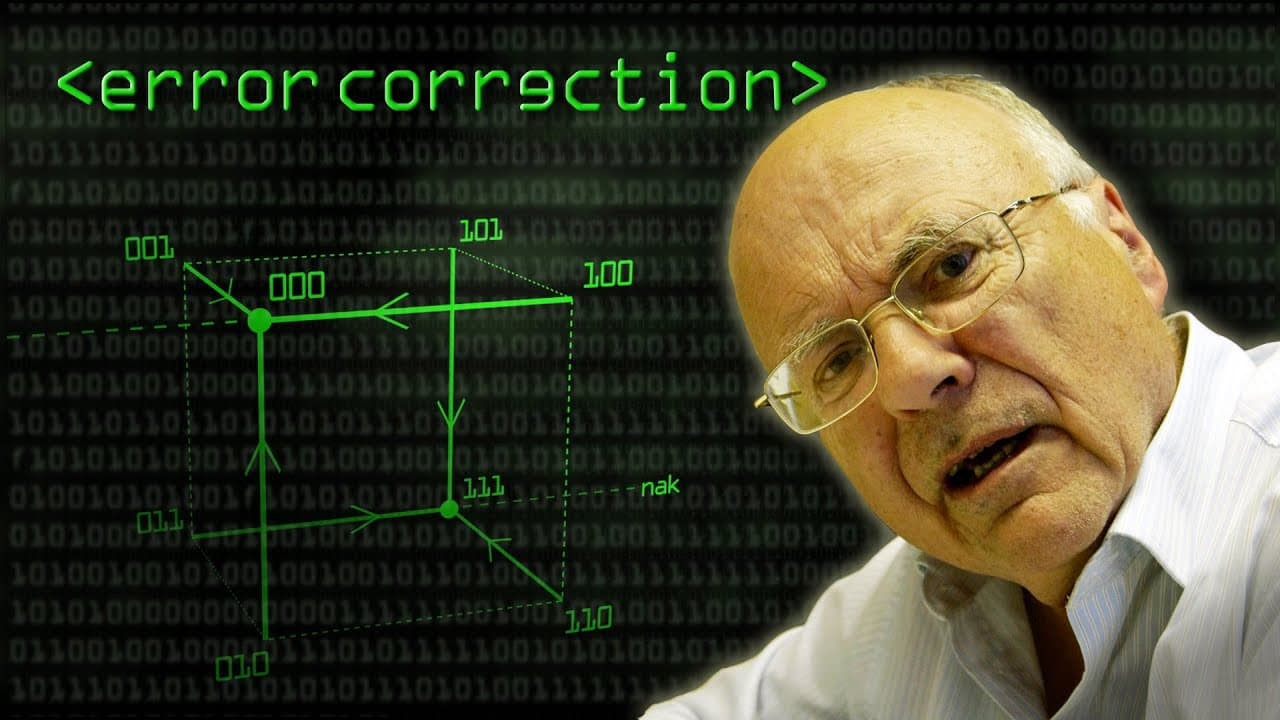
Error correction works by adding redundancy so a received pattern can be mapped back to the nearest valid codeword. The example sends 000 for an acknowledgement and 111 for a negative acknowledgement, creating eight possible three-bit patterns; when single-bit errors are relatively infrequent, nearest-neighbor correction can recover the intended signal. Read on to see how checksums, acknowledgements, and Hamming codes build from error detection to correction.
Transcript
we've done a lot of work so far on weather scenarios for San Francisco and for Los Angeles I've put forward to you this um probability model some of you say it's not very realistic quite right this is a teaching example these are the probabilities because they suit me and that's what I say they are but what we did last time was to say if you're wor... Read More
Key Insights
- ☀️ Weather scenarios require accurate data transmission, and using probabilities and checksum digits can help ensure this.
- 👨💻 Hamming codes offer a more sophisticated approach to error detection and correction in data transmission.
- 😒 Hamming codes use nearest neighbor correction algorithms to compare received patterns to predetermined patterns and correct errors.
- 🫦 Hamming codes are most effective for single-bit error detection and correction but become more complex when dealing with multiple bit errors in larger patterns.
- 🫦 Understanding field theory, rings, groups, and co-sets is crucial when working with larger bit patterns and correcting multiple bit errors.
- 👨💻 Hamming codes can be represented visually as corners of a cube, with each corner representing a valid pattern.
- 👨💻 Hamming codes provide a reliable method for error detection and correction, ensuring data accuracy in various scenarios.
Install to Summarize YouTube Videos and Get Transcripts
Explore YouTube Video Summarizer or Get YouTube Transcript Extractor
Questions & Answers
Q: How do Hamming codes detect and correct transmission errors?
The example treats 000 and 111 as the only valid three-bit codewords. If noise changes one bit, the receiver uses maximum-likelihood, or nearest-neighbor, correction to choose the closest valid codeword.
Q: What is the difference between error detection and error correction?
A checksum can reveal that a received pattern is not in the set of valid codes, so the receiver knows an error occurred. It may not reveal how the error happened, while the three-bit Hamming-code example can map a corrupted pattern back to a valid codeword.
Q: How does a checksum digit help detect transmission errors?
A checksum digit is added to the end of the data to create valid code patterns. As long as only one of the three bits is distorted, a received pattern outside the valid list shows that an error occurred, although it does not necessarily identify the original pattern.
Q: What are acknowledgement and negative-acknowledgement signals?
An acknowledgement tells the sender that the received three-bit code made sense, while a negative acknowledgement, or NACK, reports that it did not match the allowed codes. The initial example represents acknowledgement with 0 and NACK with 1.
Q: Why can single-bit acknowledgement signals be unreliable?
The acknowledgement or NACK bit can itself be altered while traveling back to San Francisco. A corrupted 0 or 1 could therefore communicate the opposite result, creating another transmission problem.
Q: Does repeating acknowledgement bits twice correct errors?
Using 00 for acknowledgement and 11 for NACK allows a one-bit alteration to produce 01 or 10, revealing that an error occurred. However, the receiver still cannot determine whether the corrupted signal began as 00 or 11.
Q: Why does the example use 000 and 111 for error correction?
Adding a third bit separates the valid acknowledgement codeword 000 from the valid NACK codeword 111. If errors are relatively infrequent and usually affect one binary digit, a corrupted pattern is closest to the codeword that was most likely transmitted.
Q: Why are the possible three-bit patterns represented as a cube?
Three bits have 2 to the power of 3, or eight, possible combinations. These eight patterns can be represented as the cube’s corners, making their relationships to the valid 000 and 111 codewords easier to compare.
Summary & Key Takeaways
-
The content explains the concept of using probabilities and checksum digits to ensure accurate data transmission in weather scenarios.
-
It introduces the idea of using acknowledgment signals to indicate if data was received correctly.
-
The video discusses how Hamming codes offer a more sophisticated system for error detection and correction, allowing for not only error detection but also correction.
Read in Other Languages (beta)
Share This Summary 📚
Summarize YouTube Videos and Get Video Transcripts with 1-Click
Try YouTube Summary with ChatGPT & Claude or YouTube Transcript Generator
Explore More Summaries from Computerphile 📚






Summarize YouTube Videos and Get Video Transcripts with 1-Click
Try YouTube Summary with ChatGPT & Claude or YouTube Transcript Generator