How Can Neural Networks Learn to Hack Apps?
TL;DR
Neural networks can improve application security testing by learning patterns and adapting more like human hackers than database-driven scanners. Traditional scanners often produce false positives, miss findings, and generate oversized reports, while learning systems can filter security events, identify meaningful signals, and reduce the volume of cases requiring human analysis.
Transcript
Thank you everyone. And, uh, just so you know, I was informed that if you hear a short fire alarm, it means the bar is opening early. All right, so, uh, my talk's called Mr. NeuralNet, just because, you know, it's gonna be season three of Mr. Robot, so why not, right? But, uh, I'll be talking about artificial intelligence, and basically the scary i... Read More
Key Insights
- Narrow artificial intelligence is specialized for a limited purpose, while general artificial intelligence aims to learn, understand situations, and interact across broader contexts. An AI hacker occupies an intermediate position because hacking is focused, but effective performance requires adaptable reasoning rather than fixed responses.
- The Turing test is a method for asking whether a person interacting with an artificial intelligence from another room can distinguish it from a human. Early reactions to ELIZA showed that even simple conversational patterns could sometimes persuade people that a machine displayed human-like behavior.
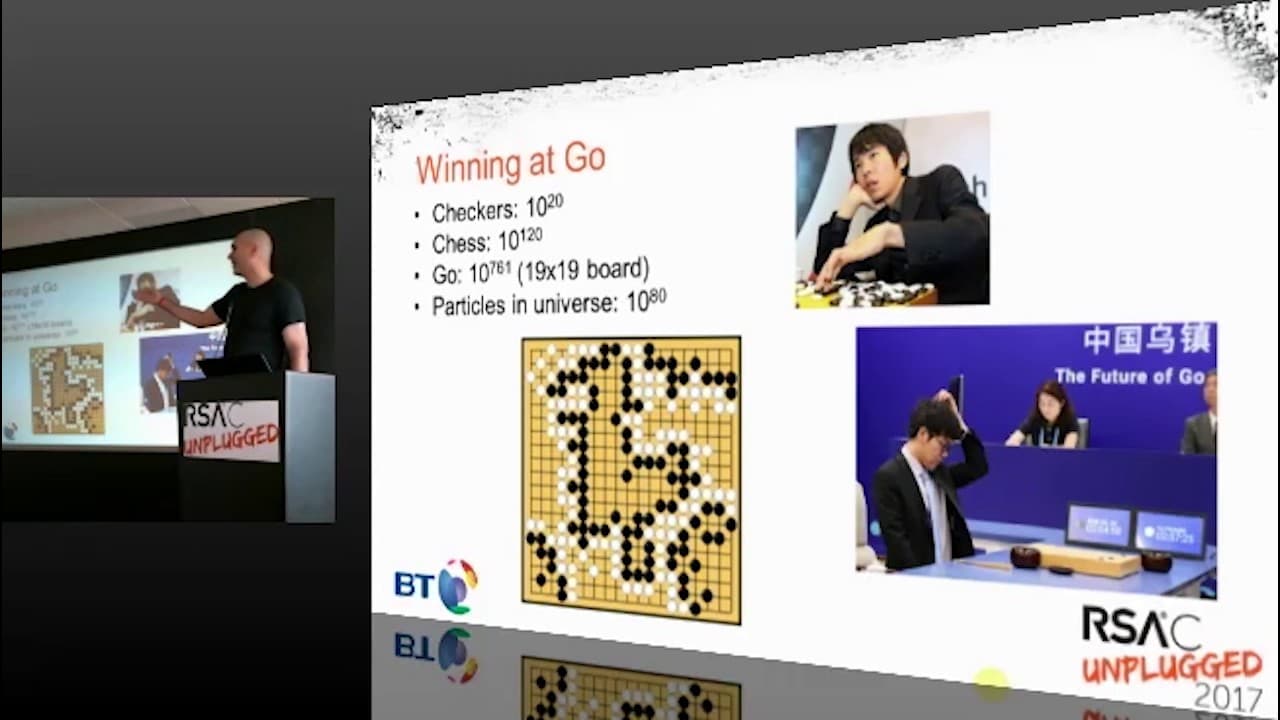
- Gaming systems demonstrate capabilities relevant to security because games and hacking both involve interpreting conditions and selecting actions. Deep Blue specialized in chess, while Watson combined natural-language understanding, massive parallel processing, and rapid searching to outperform human competitors on Jeopardy.
- Watson processed 500 gigabytes of data per second during its Jeopardy application, according to the presentation. Its ability to search a large body of stored information faster than human competitors could respond illustrated how computational scale can support artificial intelligence in structured decision environments.
- Security monitoring is difficult because an average organization receives about 200,000 pieces of security event data each month. Artificial intelligence can analyze part of that volume, judge whether events are genuine or false, learn from prior cases, and produce fewer tickets requiring human attention.
- Traditional vulnerability scanners are unreliable substitutes for human hackers because they can produce false positives, miss findings, and generate large reports. Analysts must validate scanner output instead of treating every listed high or medium issue as an accurate account of an application or network.
- Database-driven application scanning is limited because matching observed behavior against known vulnerability tables does not provide genuine understanding. AppScan, for example, may encounter the words "log out," incorrectly conclude that its session ended, and stop scanning because it cannot interpret the surrounding context.
- Neural networks work by receiving signals through multiple inputs, assigning different importance to those signals, and strengthening useful paths over time. Signals pass through connected processing units, creating learned networks that resemble the reinforced pathways associated with human skills and muscle memory.
Install to Summarize YouTube Videos and Get Transcripts
Explore YouTube Video Summarizer or Get YouTube Transcript Extractor
Questions & Answers
Q: What is the difference between narrow and general AI?
Narrow artificial intelligence performs a focused and specialized function, such as processing spoken requests in a service like Siri. General artificial intelligence is intended to possess broader knowledge, learn across situations, understand what is happening, and interact flexibly. An AI designed for hacking sits between them because its mission is narrow, but its learning and decision-making must be more general.
Q: How can artificial intelligence help security teams manage alerts?
Artificial intelligence can process large collections of security events, evaluate whether individual signals are real or false, and improve its judgments through experience. The presentation says an average organization receives about 200,000 pieces of security event data monthly, which is nearly impossible for people to examine manually. Learning systems can reduce that volume to a manageable set of tickets for human review.
Q: Why do vulnerability scanners produce misleading results?
Vulnerability scanners search networks and applications for patterns associated with known weaknesses, but they do not necessarily understand the systems they test. Consequently, they can report vulnerabilities that are not present, overlook genuine findings, and produce long lists of high and medium issues. Human analysts must investigate and validate the results instead of simply delivering the generated report.
Q: Why is database matching insufficient for intelligent hacking?
Database matching is a top-down approach that compares observations with tables of known vulnerabilities, but it cannot reliably interpret application context. The presentation illustrates this limitation with AppScan, which may see the words "log out," assume that it has been logged out, and stop scanning. Intelligent hacking requires learning and contextual reasoning beyond predefined pattern matching.
Q: How do neural networks imitate basic brain functions?
A biological neuron receives signals through many dendrites, and those inputs can carry different levels of importance. Reinforced signals pass through the nucleus and continue along the axon to other neurons, forming a network. Artificial neural networks simplify this process by weighting inputs, strengthening useful connections over time, and propagating results through connected processing units.
Q: Why are gaming systems relevant to AI hacking?
Gaming systems are relevant because games and hacking can both require interpreting an environment, evaluating possible actions, and responding to changing conditions. Deep Blue demonstrated specialized decision-making in chess, while Watson interpreted natural-language clues and searched stored information during Jeopardy. These systems show how focused artificial intelligence can perform complex tasks that involve more than simple lookup rules.
Q: What role did Watson play in artificial intelligence development?
Watson demonstrated that artificial intelligence could combine natural-language interpretation, massive parallel computation, and rapid information retrieval in a competitive setting. The presentation states that it processed 500 gigabytes of data per second and defeated human Jeopardy competitors. Its capabilities were later applied to illness research, support for doctors, analytics, and the analysis of security events.
Q: Why must an AI hacker learn more like a human?
An AI hacker must adapt to application behavior, interpret context, and decide what to try when rigid rules are insufficient. Traditional scanners rely heavily on known vulnerability data and therefore make mistakes or stop when they misread an interface. Neural networks offer a different model by adjusting the importance of inputs and reinforcing successful pathways through learning, closer to human reasoning.
Summary & Key Takeaways
-
Artificial intelligence ranges from narrow systems designed for specialized tasks to general systems capable of broader learning and interaction. An application-hacking system falls between these categories because it has a focused security purpose while still needing to understand changing conditions, learn from experience, and choose actions beyond rigid conditional rules.
-
Security teams receive volumes of event data that are difficult for people to examine manually. Learning systems such as Watson can process events, distinguish meaningful warnings from false positives, and improve over time. This defensive application can reduce hundreds of thousands of events to a small collection of tickets for human investigation.
-
Traditional vulnerability scanners search for known weaknesses but frequently report nonexistent problems, miss real findings, and misunderstand application behavior. A more capable hacking system must approximate human reasoning. Neural networks support that goal by weighting inputs, strengthening useful pathways through learning, and passing resulting signals across connected processing units.
Read in Other Languages (beta)
Share This Summary 📚
Summarize YouTube Videos and Get Video Transcripts with 1-Click
Try YouTube Summary with ChatGPT & Claude or YouTube Transcript Generator
Explore More Summaries from RSAC Cybersecurity 📚






Summarize YouTube Videos and Get Video Transcripts with 1-Click
Try YouTube Summary with ChatGPT & Claude or YouTube Transcript Generator