Why Do Predictions Often Fail in Statistics?
TL;DR
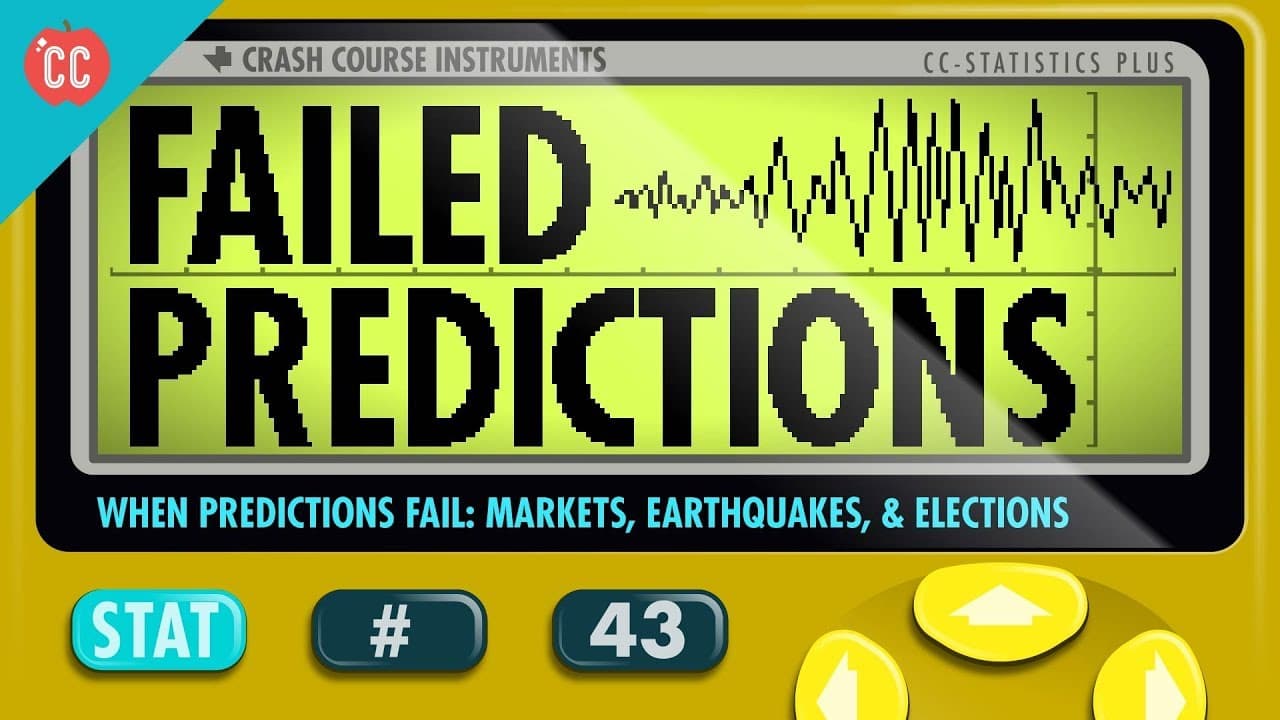
Predictions often fail due to limitations in data and models, which can lead to flawed outcomes. For instance, the 2008 financial crisis resulted from overestimating the independence of loan failures. Additionally, events like earthquakes showcase the challenges of predicting complex occurrences, emphasizing the need for accurate data and comprehensive models.
Transcript
Hi, I’m Adriene Hill, and Welcome back to Crash Course Statistics. We’ve learned a lot about how statistics can help us understand the world better, make better decisions, and guess what will happen in the future. Prediction is a huge part of how modern statistical analysis is used, and it’s helped us make improvements to our lives. Big AND small. ... Read More
Key Insights
- Predictions are educated guesses based on available data and models, but they are not foolproof and can fail.
- The 2008 financial crisis highlighted the issue of overestimating the independence of loan failures and the limitations of economic models.
- Earthquake prediction is difficult due to the complexity of factors involved, though forecasting can help mitigate damage.
- The 2016 U.S. presidential election demonstrated how low-probability events can still occur, challenging the certainty of predictions.
- Good predictions require accurate, unbiased data and comprehensive models that consider all important variables.
- Biases in polling, such as non-response bias, can lead to inaccurate election predictions, as seen in the 2016 U.S. election.
- Recognizing the limitations of prediction models and the data used is crucial for improving future predictions.
- Understanding what cannot be accurately predicted is as important as making accurate predictions to guide decision-making.
Install to Summarize YouTube Videos and Get Transcripts
Explore YouTube Video Summarizer or Get YouTube Transcript Extractor
Questions & Answers
Q: What were the prediction issues related to the 2008 financial crisis?
The 2008 financial crisis prediction issues included overestimating the independence of loan failures and economists' inability to foresee the crisis. Banks packaged mortgages into securities, assuming independence of defaults, but failed to account for market conditions affecting loan repayment probabilities, leading to widespread economic impact.
Q: Why is earthquake prediction particularly challenging?
Earthquake prediction is challenging due to the complexity of factors involved and the lack of sufficient data. While clusters of smaller quakes can precede larger ones, predicting exact timing, location, and magnitude remains difficult. The unpredictability of earthquakes makes accurate prediction elusive, though forecasting can aid in damage mitigation.
Q: How did prediction models fail during the 2016 U.S. presidential election?
Prediction models failed during the 2016 U.S. presidential election due to biases in polling data and the misunderstanding of low-probability events. Polls overemphasized responses from college-educated voters, skewing predictions towards Clinton. The election highlighted that low probabilities do not equate to impossibility, challenging the perceived certainty of predictions.
Q: What are the key components of making accurate predictions?
Accurate predictions require good, unbiased data and comprehensive models that consider all relevant variables. Data must be accurate and plentiful, while models need to account for important factors to approximate real-world scenarios. Recognizing model and data limitations is crucial for improving prediction accuracy and guiding decision-making.
Q: What role does data play in the accuracy of predictions?
Data plays a crucial role in prediction accuracy, as it forms the basis of models used to forecast future events. Accurate, unbiased, and comprehensive data is necessary to build reliable models. Inadequate or skewed data can lead to flawed predictions, emphasizing the need for robust data collection and analysis.
Q: Why is it important to recognize the limitations of predictions?
Recognizing the limitations of predictions is important because it helps manage expectations and guides decision-making. Understanding what can and cannot be accurately predicted allows for better preparation and response to unforeseen events. Acknowledging these limitations also fosters improvements in prediction models and data usage.
Q: How can biases in polling affect election predictions?
Biases in polling, such as non-response bias, can significantly affect election predictions by skewing data towards certain demographics. For example, if well-educated voters are more likely to respond to surveys, predictions may overestimate their influence, leading to inaccurate forecasts. Addressing these biases is crucial for improving prediction reliability.
Q: What lessons can be learned from prediction failures?
Prediction failures teach us the importance of robust data collection, comprehensive models, and understanding the inherent uncertainties in forecasting. They highlight the need to continuously refine models and address biases. Learning from past failures can improve future predictions and decision-making processes, acknowledging that unexpected events can still occur.
Summary & Key Takeaways
-
Predictions, while useful, are not guarantees, as they are based on data and models that can be flawed or incomplete. The 2008 financial crisis and 2016 U.S. election serve as examples of prediction failures due to these limitations.
-
Earthquake prediction illustrates the challenges of forecasting complex events with insufficient data. Despite difficulties, forecasting helps mitigate potential damage, emphasizing the need for good data and models.
-
The 2016 U.S. presidential election shows that low-probability events can happen, highlighting the importance of understanding the limitations of predictions. Recognizing these limitations aids in making better future predictions.
Read in Other Languages (beta)
Share This Summary 📚
Summarize YouTube Videos and Get Video Transcripts with 1-Click
Try YouTube Summary with ChatGPT & Claude or YouTube Transcript Generator
Explore More Summaries from CrashCourse 📚
Summarize YouTube Videos and Get Video Transcripts with 1-Click
Try YouTube Summary with ChatGPT & Claude or YouTube Transcript Generator