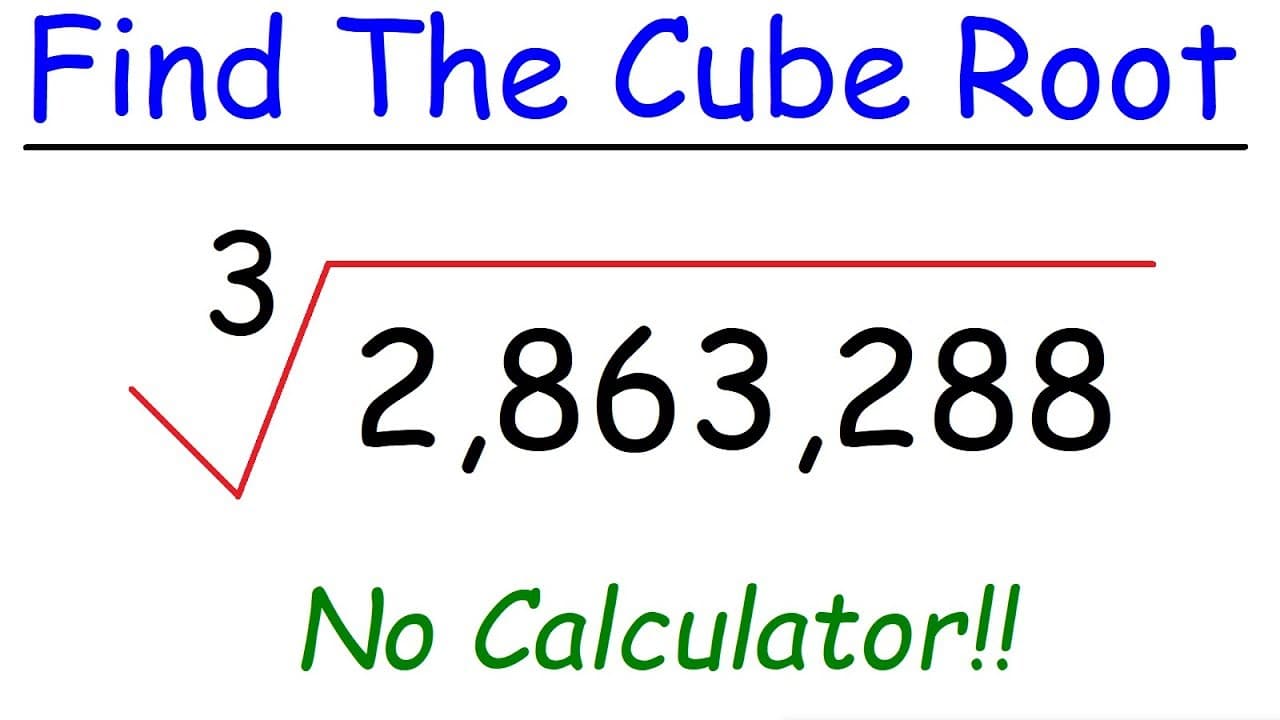
How To Find The Cube Root of a Large Number
TL;DR
To find the cube root of a large perfect cube, identify the root’s last digit from known cube patterns, remove the number’s last three digits, and compare the remaining leading part with nearby perfect cubes. For example, 17,576 ends in 6 and its leading 17 lies between 8 and 27, giving a cube root of 26. Read on for more worked examples and checks.
Transcript
in this video we're going to talk about how to find the cube root of a large number but first we need to go over some basics notice the pattern one to the third is equal to one two to the third is equal to eight three to the third is equal to twenty seven you need to know these values up to ten five to the third is one twenty five six to the third ... Read More
Key Insights
- 🧊 The cube of numbers follows a pattern where the last digit determines the last digit of the cube root.
- 🥺 By focusing on the last digit and the leading digit, you can determine both digits of the cube root.
- 🧊 The cube root of a perfect cube will always be a whole number.
- 🫚 This process provides a shortcut for finding the cube root of large numbers without complex calculations.
- 💦 The method works for numbers with up to seven digits.
- 🧊 Checking the answer by cubing it ensures accuracy.
- 🫚 The process is based on understanding the relationship between cubes and their roots.
Install to Summarize YouTube Videos and Get Transcripts
Explore YouTube Video Summarizer or Get YouTube Transcript Extractor
Questions & Answers
Q: How do you find the cube root of a large number?
First, use the number’s last digit and known cube patterns to determine the last digit of its cube root. Then ignore the last three digits, compare the remaining leading part with nearby perfect cubes, and choose the smaller corresponding root as the first digit.
Q: How can the last digit reveal the last digit of a cube root?
Known cubes create repeatable last-digit patterns. For example, 216 ends in 6 and is the cube of 6, while 343 ends in 3 and is the cube of 7, so a target ending in 6 has a cube root ending in 6, and one ending in 3 has a root ending in 7.
Q: Why do you ignore the last three digits when finding the first digit?
Removing the last three digits isolates the leading part used to estimate the cube root’s range. For 17,576, focusing on 17 shows that it lies between 8 and 27, whose cube roots are 2 and 3.
Q: What is the cube root of 17,576?
The cube root is 26. The final 6 gives the root’s last digit, while 17 lies between 8 and 27, so the first digit is the smaller corresponding root, 2.
Q: What is the cube root of 50,653?
The cube root is 37. The final 3 corresponds to a root ending in 7, and 50 lies between 27 and 64, so the first digit is 3.
Q: What is the cube root of 91,125?
The cube root is 45. The target ends in 5, and its leading part, 91, lies between 64 and 125, whose cube roots are 4 and 5.
Q: What is the cube root of 328,509?
The cube root is 69. The last digit 9 corresponds to a root ending in 9, while 328 lies between 216 and 343, giving 6 as the first digit.
Q: How can you check a calculated cube root?
Cube the proposed answer by multiplying it by itself three times. For example, multiplying 37 by 37 by 37 gives 50,653, confirming that its cube root is 37.
Summary & Key Takeaways
-
The pattern of cubing numbers from 1 to 10 is discussed, highlighting the last digit and its relation to the original number.
-
A step-by-step method for finding the cube root of a large number is explained, involving identifying the last digit and determining the range of possible first digits.
-
Examples of finding the cube root of large numbers are provided to illustrate the process.
Read in Other Languages (beta)
Share This Summary 📚
Summarize YouTube Videos and Get Video Transcripts with 1-Click
Try YouTube Summary with ChatGPT & Claude or YouTube Transcript Generator
Explore More Summaries from The Organic Chemistry Tutor 📚



Summarize YouTube Videos and Get Video Transcripts with 1-Click
Try YouTube Summary with ChatGPT & Claude or YouTube Transcript Generator