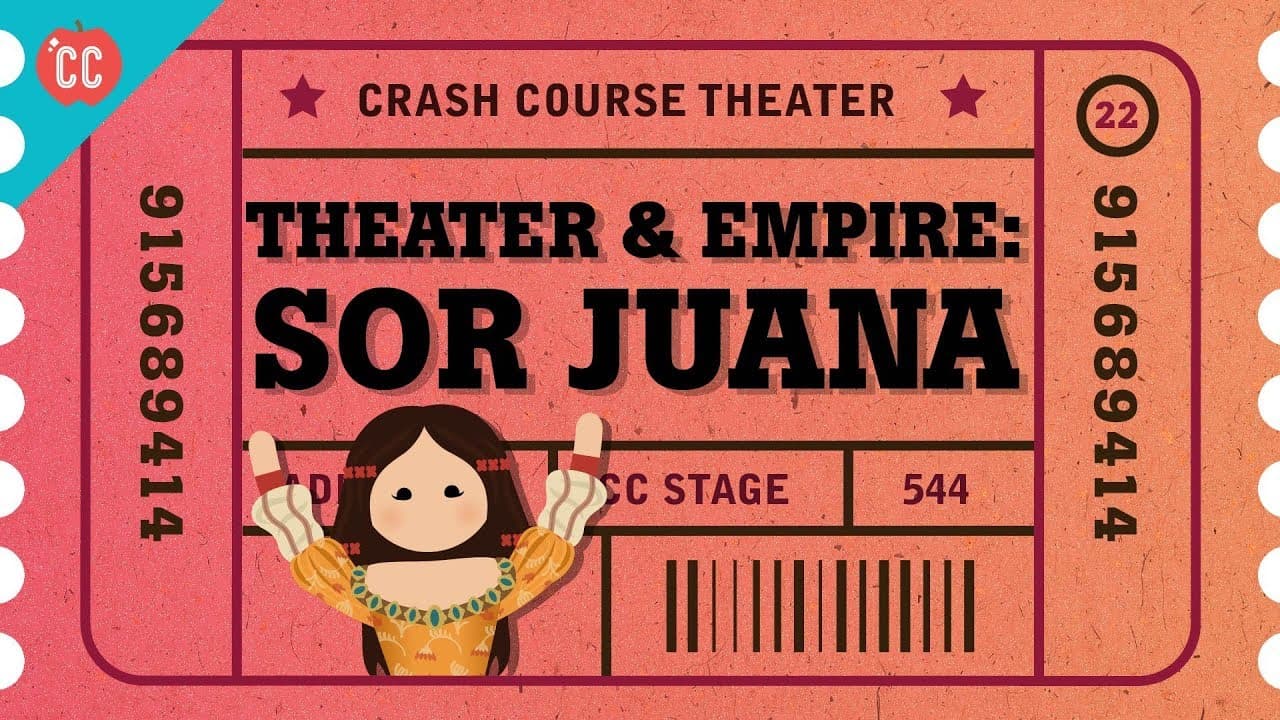
How Did Pre-Columbian Theater, the Spanish Empire, and Sor Juana Shape Theater in the Americas? | Crash Course Theater #22
TL;DR
Pre-Columbian theater combined religious ritual, festivals, costumes, parades, comic sketches, and dance, while Spanish colonizers reshaped performance into an instrument of conversion and imperial propaganda. Sor Juana Inez de la Cruz later blended European and Indigenous traditions while defending women’s intellectual freedom; she wrote across many genres, including 27 plays. Read on to see how theater became a site of cultural suppression, adaptation, and resistance.
Transcript
hey there i'm mike rugnetta this is crash course theater and today we head to the americas at a time when broadway was just another unpaved part of not yet even new amsterdam so we're gonna head to mexico to learn about a woman who brought the spanish golden age to the so-called new world and guess what she was a nun why is it always the nuns yoric... Read More
Key Insights
- Pre-Columbian theater was intertwined with religious rituals and festivals, often involving costumes and comedic performances.
- Spanish colonization led to the suppression of native religious practices and the introduction of European-style religious dramas.
- Missionaries used theater as a tool for religious conversion and colonial propaganda, often involving indigenous actors in these performances.
- Sor Juana Inez de la Cruz was a significant figure in Mexican theater, known for her feminist views and literary contributions.
- Sor Juana's works often critiqued colonial rule and incorporated indigenous cultural elements, challenging the dominant narratives.
- The loa of the divine narcissus is one of Sor Juana's notable works, blending Christian teachings with Aztec rituals.
- Sor Juana's writings advocated for women's intellectual freedom and critiqued the limitations imposed on them by society.
- Despite challenges, Sor Juana's legacy endures as a symbol of resistance and cultural synthesis in the Americas.
Install to Summarize YouTube Videos and Get Transcripts
Explore YouTube Video Summarizer or Get YouTube Transcript Extractor
Questions & Answers
Q: What were Pre-Columbian and Spanish colonial theater?
Pre-Columbian theater in Central America was closely connected to religious rituals and festivals, using costumes, parades, comic performances, and dances. After the Spanish arrived, missionaries introduced European-style biblical dramas and historical pageants, often using Indigenous actors to promote conversion and Spanish imperial narratives.
Q: How did Pre-Columbian theater function in religious festivals?
Performances formed part of religious celebrations and could accompany sacrifices, costumes, parades, animals, comedy, and dance. At a festival for Quetzalcoatl, actors portrayed people seeking health and creatures such as beetles, toads, and lizards before joining in a concluding dance.
Q: How did Spanish colonization change Indigenous theater traditions?
The Spanish violently suppressed Native Aztec rituals and practiced forced conversion. Missionaries had Indigenous people perform Bible stories and colonial historical pageants, although recorded games and acrobatics suggest that elements of earlier Indigenous performance survived.
Q: How was theater used as Spanish religious and imperial propaganda?
Missionaries used performance to spread Christianity and impose preferred accounts of history. Indigenous actors appeared in Bible stories and battle reenactments, sometimes effectively acting out their own defeat while Spanish conquerors were presented as honorable heroes.
Q: How did Spanish colonial theater develop in Mexico during the 16th century?
Colonial authors first translated Spanish religious dramas into Indigenous languages and then wrote local-language plays for proselytizing. Spanish became the dominant theatrical language by the century’s end; Mexico City established a prize for the best Corpus Christi play in 1565 and became the Spanish Empire’s theatrical center.
Q: Who was Sor Juana Inez de la Cruz, and what did she contribute to theater?
Sor Juana Inez de la Cruz was a Mexican nun described as the first feminist of the Americas and the last great writer of the Spanish Golden Age. She wrote philosophy, theology, poetry, carol sequences, and 27 plays, including introductions to autos sacramentales and full-length comedies.
Q: What is The Loa of the Divine Narcissus about?
The Loa of the Divine Narcissus blends Christian teaching with Aztec ritual and acknowledges the dignity of Indigenous traditions. Its treatment of religious conversion critiques coercion and demonstrates how Sor Juana combined European theatrical forms with Native cultural elements.
Q: How did Sor Juana defend women’s intellectual freedom?
Sor Juana chose convent life partly because it allowed her to direct her own intellectual life rather than become subservient to a husband. In Reply to Sister Filotea, she answered a bishop’s criticism that women should not concern themselves with writing and philosophy, arguing that intellectual activity was compatible with women’s lives.
Summary & Key Takeaways
-
Pre-Columbian theater in the Americas was closely linked to religious rituals, featuring elaborate costumes and comedic performances. The arrival of the Spanish dramatically changed these traditions, introducing European religious dramas and using theater as a tool for colonial propaganda. Sor Juana Inez de la Cruz, a Mexican nun, played a significant role in adapting and critiquing these influences through her writings.
-
Sor Juana Inez de la Cruz, known as the first feminist of the Americas, used her writings to challenge colonial rule and advocate for women's intellectual freedom. Her works, such as the loa of the divine narcissus, blended Christian teachings with indigenous cultural elements, offering a critique of forced conversions and highlighting the dignity of native traditions.
-
Theater served as a medium for both cultural suppression and resistance during the Spanish colonization of the Americas. While missionaries used it to enforce religious conversion and colonial narratives, figures like Sor Juana Inez de la Cruz subverted these efforts by incorporating indigenous elements and promoting intellectual freedom, leaving a lasting impact on the cultural landscape.
Read in Other Languages (beta)
Share This Summary 📚
Summarize YouTube Videos and Get Video Transcripts with 1-Click
Try YouTube Summary with ChatGPT & Claude or YouTube Transcript Generator
Explore More Summaries from CrashCourse 📚





Summarize YouTube Videos and Get Video Transcripts with 1-Click
Try YouTube Summary with ChatGPT & Claude or YouTube Transcript Generator