How Open Source AI Outperforms Closed Models
TL;DR
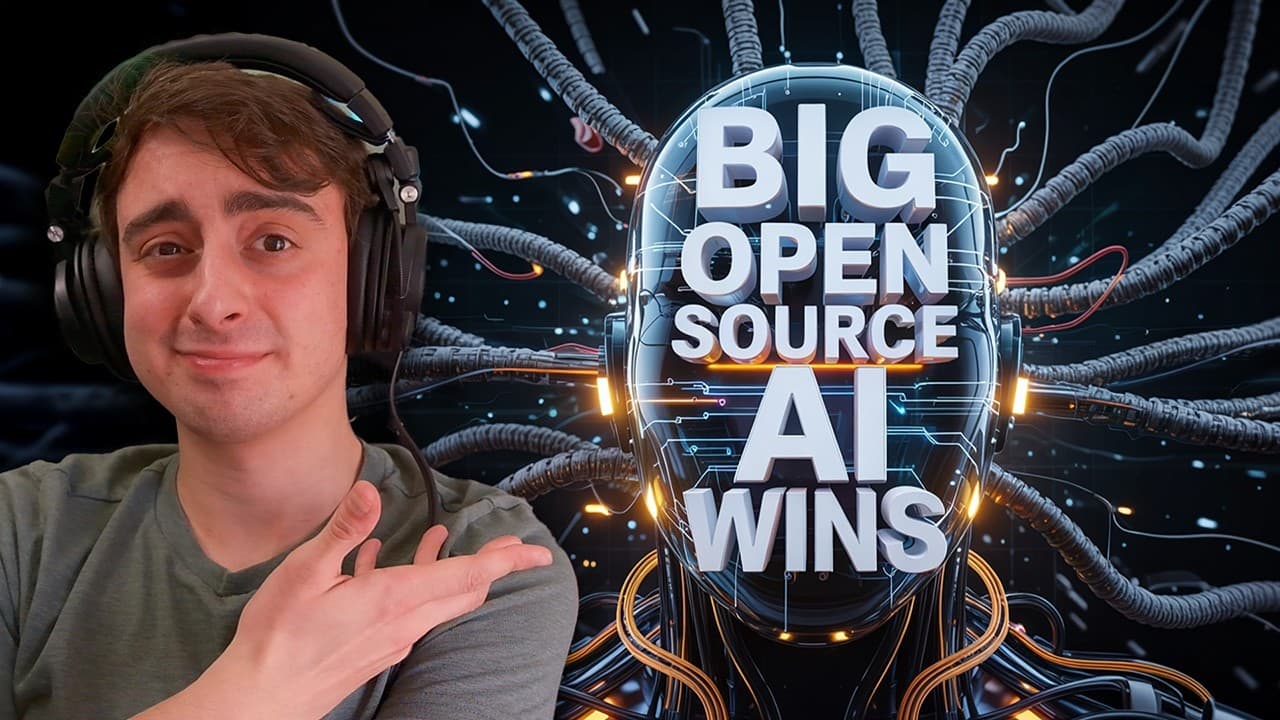
Open-source AI models are rapidly closing the gap with closed-source counterparts, often outperforming them in various niches. Key developments include Deepseek R2's anticipated release, Framepak's video generation capabilities, and Qwen 3's reasoning models. These advances illustrate the potential of open-source AI to democratize access and innovation in AI technologies.
Transcript
Open source AI versus closed source AI. What do you think's better? This has been a big debate in the AI space since I can remember to be honest with you. And well, the longer I sit back and watch AI develop, the more I feel like this intellectual debate about which is better doesn't really matter because it seems like open- source AI is just going... Read More
Key Insights
- Open-source AI is increasingly outperforming closed-source models in various niches.
- Deepseek R2 is rumored to be a massive 1.2 trillion parameter model, significantly cheaper than current models.
- Framepak can generate high-quality videos up to 2 minutes long using only 6GB of VRAM.
- Dia is an open-source text-to-speech model that offers high emotion and tone control.
- RealisDance builds on existing models to generate realistic human motion in videos.
- WAN offers free, unlimited AI video generation, showcasing the benefits of open-source models.
- The ART-E email research agent is faster and cheaper than proprietary models for specific tasks.
- Qwen 3 is a new open-source model that outperforms many established models, highlighting the rapid progress in open-source AI.
Install to Summarize YouTube Videos and Get Transcripts
Explore YouTube Video Summarizer or Get YouTube Transcript Extractor
Questions & Answers
Q: What is the significance of Deepseek R2 in the AI landscape?
Deepseek R2 is rumored to be a massive 1.2 trillion parameter model, which is significantly cheaper than current models. If these rumors are true, it could represent a major leap in open-source AI capabilities, potentially closing the gap with closed-source models in terms of performance and cost-efficiency.
Q: How does Framepak enhance video generation capabilities?
Framepak allows for the generation of high-quality videos up to 2 minutes long using only 6GB of VRAM. This capability showcases significant advancements in open-source video generation, offering high-quality output with relatively low computational requirements, making it accessible to more users.
Q: What makes Dia a notable text-to-speech model?
Dia stands out as an open-source text-to-speech model that offers high emotion and tone control, features that are typically challenging for closed-source models. It provides users with the ability to generate speech with varied emotional expressions, enhancing the realism and versatility of AI-generated speech.
Q: How does RealisDance improve AI-generated human motion?
RealisDance builds on existing models to generate more realistic human motion in videos. It addresses the challenge of producing believable human movements, which is often difficult for AI models, by using open-source technology to enhance the realism and accuracy of generated motion.
Q: What are the benefits of WAN's free AI video generation?
WAN offers free, unlimited AI video generation, demonstrating the advantages of open-source models. Unlike many closed-source options that limit free usage or require credits, WAN provides unrestricted access, allowing users to explore and utilize AI video generation without financial barriers.
Q: How does the ART-E email research agent compare to proprietary models?
The ART-E email research agent is designed to search inboxes and answer questions more accurately, faster, and cheaper than proprietary models like OpenAI's 03. While it may not offer the same breadth of capabilities, it excels in its specific task, showcasing the potential of open-source models in niche applications.
Q: What advancements does Qwen 3 bring to open-source AI?
Qwen 3 is a new open-source model that outperforms many established models, such as Meta's Llama 4, in various benchmarks. Its release under the Apache 2.0 license highlights the rapid progress in open-source AI, offering high performance and accessibility for a wide range of applications.
Q: Why is open-source AI gaining ground against closed-source models?
Open-source AI is gaining ground due to its ability to rapidly innovate and improve through community collaboration. By building on existing models and sharing advancements openly, open-source AI can quickly close performance gaps and offer cost-effective, high-quality alternatives to closed-source models.
Summary & Key Takeaways
-
Open-source AI models are rapidly closing the gap with closed-source counterparts. Key developments include Deepseek R2's anticipated release, Framepak's video generation capabilities, and Qwen 3's reasoning models. These advances illustrate the potential of open-source AI to democratize access and innovation in AI technologies.
-
Deepseek R2 is rumored to be a massive 1.2 trillion parameter model, significantly cheaper than current models. Framepak can generate high-quality videos up to 2 minutes long using only 6GB of VRAM. Dia is an open-source text-to-speech model that offers high emotion and tone control.
-
RealisDance builds on existing models to generate realistic human motion in videos. WAN offers free, unlimited AI video generation, showcasing the benefits of open-source models. Qwen 3 is a new open-source model that outperforms many established models, highlighting the rapid progress in open-source AI.
Read in Other Languages (beta)
Share This Summary 📚
Summarize YouTube Videos and Get Video Transcripts with 1-Click
Try YouTube Summary with ChatGPT & Claude or YouTube Transcript Generator
Explore More Summaries from MattVidPro 📚




Summarize YouTube Videos and Get Video Transcripts with 1-Click
Try YouTube Summary with ChatGPT & Claude or YouTube Transcript Generator