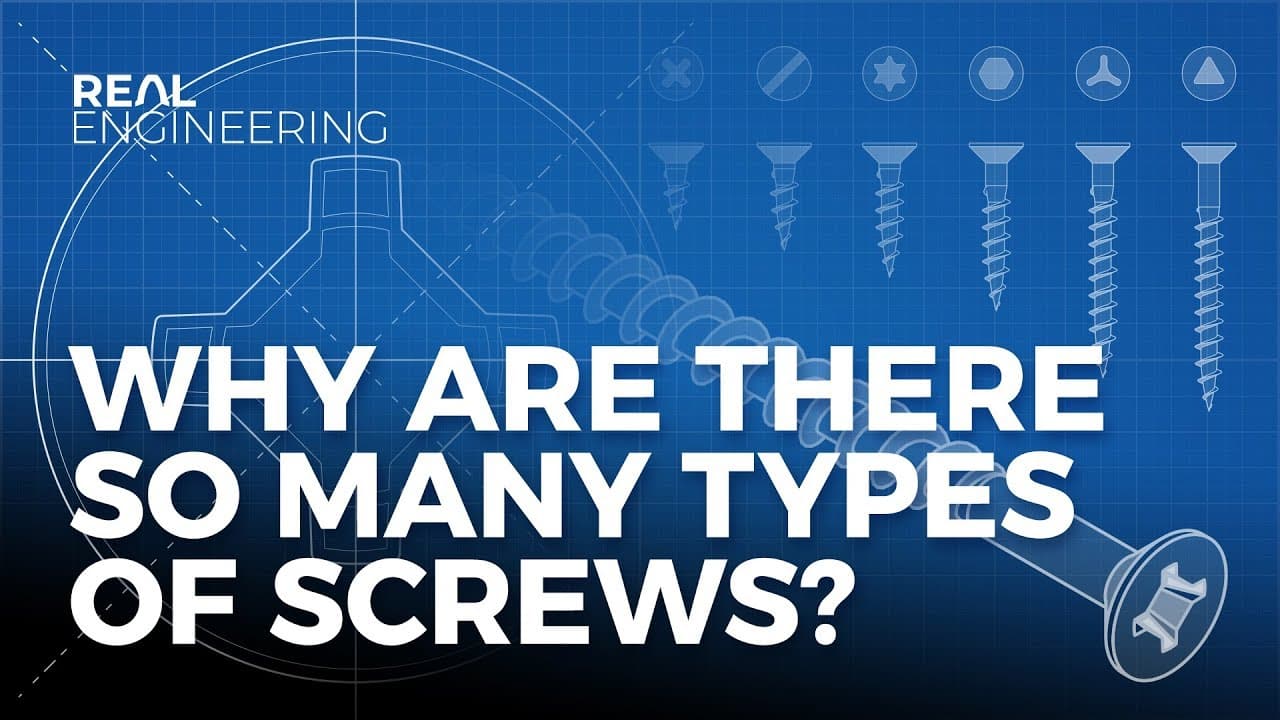
Why Are There Different Types of Screws?
TL;DR
Different types of screws exist to serve specific purposes and manufacturing needs. The design variations, such as slot, Phillips, and Torx, address issues like ease of use, torque application, and prevention of slippage. However, proprietary designs can limit access for repairs, raising concerns about consumer rights.
Transcript
This episode of Real Engineering is brought to you by CuriosityStream, watch over 2,400 documentaries for free for 31 days at curiositystream.com/realengineering. We have all been there, visiting your local hardware store like a kid in a candy shop. You arrive at the pick and mix screw section and you are just overcome with excitement. How could yo... Read More
Key Insights
- The screw is an ancient technology, possibly invented by Archimedes, used initially for tasks like pumping water and pressing grapes.
- Mass production of screws began in 1797 with Henry Maudsley's invention of a metal cutting lathe, establishing a standard screw thread geometry.
- Incompatibility of screw standards historically caused significant issues, such as the Boston fire of 1872, where fire hoses didn't fit hydrants.
- Simple slotted screw heads are easy to manufacture but have drawbacks, including the tendency to slip and drive screws off-center.
- Robertson's square bit screw-head design was efficient and reduced manufacturing time, but it wasn't widely adopted due to licensing issues.
- Phillips screw design became popular for its self-centering feature and torque-limiting capability, though it's now considered outdated.
- Hex and Torx screw designs emerged to prevent cam-out, offering better torque application without damaging the screw or tool.
- Proprietary screw designs, like those used by Apple, aim to restrict access to devices, raising issues about the right to repair.
Install to Summarize YouTube Videos and Get Transcripts
Explore YouTube Video Summarizer or Get YouTube Transcript Extractor
Questions & Answers
Q: Why was the Phillips screw design widely adopted?
The Phillips screw design was widely adopted due to its self-centering feature and the ability to limit torque, preventing over-tightening and damage to the workpiece. Its licensing strategy allowed it to spread rapidly across various industries, particularly in the automotive sector during World War II.
Q: What problem did Robertson's screw design solve?
Robertson's screw design solved the problem of screwdriver slippage and damage to the workpiece. Its square bit head allowed for quick and easy driving without slipping, which significantly reduced assembly time and improved manufacturing efficiency, as seen in its use in the Model T production.
Q: How did screw standardization impact historical events?
Screw standardization, or the lack thereof, significantly impacted historical events like the Boston fire of 1872, where incompatible fire hose fittings prevented effective firefighting. This highlighted the need for consistent standards to ensure compatibility and functionality across different regions and industries.
Q: What are the advantages of Torx screws over hex screws?
Torx screws offer advantages over hex screws by providing a near-perpendicular angle of contact, which allows for more torque to be applied without damaging the screw or tool. This design reduces the likelihood of cam-out, making it more efficient and reliable for high-torque applications.
Q: Why do proprietary screws raise concerns about the right to repair?
Proprietary screws raise concerns about the right to repair because they are designed to restrict access to devices, making it difficult for consumers to perform repairs. This practice limits consumer autonomy, increases repair costs, and contributes to electronic waste by discouraging self-repair.
Q: What historical figure is credited with the mass production of screws?
Henry Maudsley is credited with the mass production of screws due to his invention of a metal cutting lathe in 1797. This innovation allowed for the consistent and precise cutting of screw threads, paving the way for standardized screw production and widespread industrial use.
Q: How did Archimedes contribute to the development of screws?
Archimedes contributed to the development of screws by utilizing the helical screw's ability to convert rotational motion into linear force. This principle was initially used for tasks such as pumping water and pressing grapes, laying the groundwork for the screw's evolution as a fastening device.
Q: What are the drawbacks of simple slotted screw heads?
Simple slotted screw heads have drawbacks, such as the tendency for screwdrivers to slip out of the slot, especially when driven by machines. This can lead to off-center driving, damaging the material, and making them unsuitable for precise or high-torque applications, limiting their use in modern manufacturing.
Summary & Key Takeaways
-
The video delves into the history of screws, tracing their origins to Archimedes and their evolution through various design improvements. It highlights the challenges of standardization and the impact of different screw head designs on manufacturing processes and user convenience.
-
The narrative explains how different screw designs, such as Robertson and Phillips, emerged to address specific manufacturing needs, like reducing assembly time and preventing over-tightening. It also discusses how these designs became widespread due to strategic licensing agreements.
-
Recent screw designs, like hex and Torx, offer better performance by reducing cam-out, while proprietary screws are used to limit device access. The video critiques these practices, emphasizing the importance of the right to repair in today's technological landscape.
Read in Other Languages (beta)
Share This Summary 📚
Summarize YouTube Videos and Get Video Transcripts with 1-Click
Try YouTube Summary with ChatGPT & Claude or YouTube Transcript Generator
Explore More Summaries from Real Engineering 📚





Summarize YouTube Videos and Get Video Transcripts with 1-Click
Try YouTube Summary with ChatGPT & Claude or YouTube Transcript Generator