How to Improve User Compliance With Security Policies
TL;DR
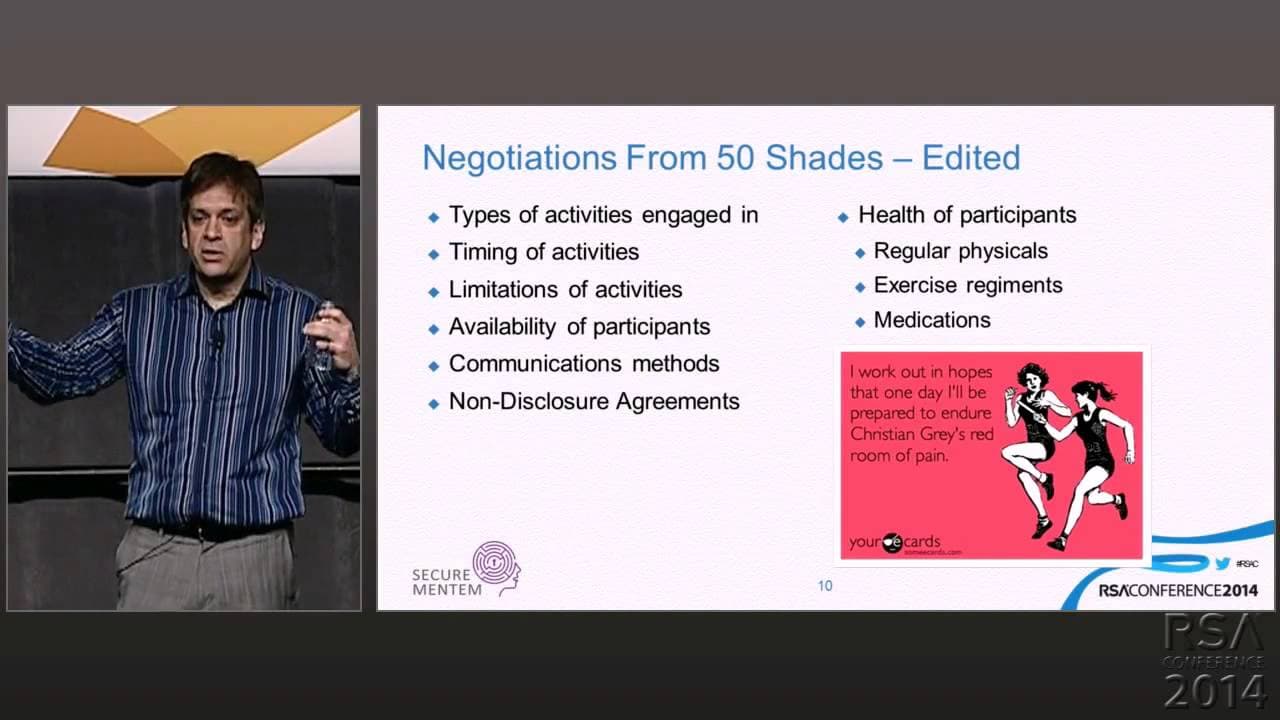
Security programs improve user compliance by clearly defining expected behavior, acknowledging that both employees and organizations make compromises, and creating a mutual sense of agreement and security. The presentation uses negotiated dominant and submissive relationships as an analogy for balancing control, consent, restrictions, and practical needs when establishing workplace security policies.
Transcript
Okay, so Fifty Shades of Grey is a phenomenon. I gotta admit, you know, I started reading about this, I'm like, "Wow, I've heard a lot of women like this," but I've never really thought ab-- you know, it's like all of a sudden, it's like I started hearing about the book and everything, and it was like, okay, let's pick it up and read it. And I was ... Read More
Key Insights
- Security-policy compliance is presented as a negotiated relationship in which organizations define restrictions and users agree to modify their behavior. The comparison emphasizes that effective control depends on clearly communicating expectations, boundaries, and the conditions under which participation occurs.
- Perfect security is described as incompatible with many practical workplace needs. An organization might ideally prohibit mobile devices or place them in lockers outside secure areas, but operational reality often requires accepting devices and managing the resulting risk through compromise.
- Both organizations and users accept conditions that can conflict with their preferred interests. Security teams surrender some ideal controls to support work, while employees accept limitations on what they may do inside the company and, in certain cases, outside it.
- A mutual feeling of security and agreement is identified as the basis for balancing organizational controls with user needs. The presentation suggests that restrictions become more workable when both parties understand the arrangement instead of treating compliance as unexplained obedience.
- Clear terms are central to the presentation's analogy. The fictional relationship is discussed as involving an explicit contract, and that contract becomes a model for security programs that need to state permitted behavior, prohibited behavior, obligations, and boundaries without ambiguity.
- Security programs are portrayed as imperfect participants rather than neutral authorities. Just as individual users have preferences and limitations, programs have idealized goals and internal issues that must be recognized when designing rules people can realistically follow.
- Conscientiousness is connected with honoring agreements and adhering to defined conditions. The presentation cites studies described in the talk to argue that participants in negotiated relationships can be conscientious and better adjusted when they accept themselves and their desires.
- Agreeableness is connected with a greater likelihood of following policies, procedures, rules, and regulations. The presentation contrasts this tendency with less agreeable behavior to illustrate why different users may respond differently to the same security requirements.
Install to Summarize YouTube Videos and Get Transcripts
Explore YouTube Video Summarizer or Get YouTube Transcript Extractor
Questions & Answers
Q: How can organizations improve user compliance with security policies?
Organizations can improve compliance by stating expected behavior clearly, defining boundaries, and creating a sense of mutual agreement and security. Policies should recognize that users must perform real work and that security teams cannot always impose their ideal controls. A workable program balances necessary restrictions with practical needs, making each participant's obligations understandable rather than relying on unexplained demands.
Q: Why should security policies define expectations clearly?
Clear expectations tell users which behaviors are permitted, which are restricted, and what they are agreeing to when they participate in a security program. The presentation uses an explicit relationship contract as its analogy. When terms and boundaries are laid out directly, employees can understand their responsibilities, while the organization can apply controls according to an established and mutually understood arrangement.
Q: Why does effective security require compromise?
Effective security requires compromise because ideal controls can interfere with normal workplace needs. The presentation gives mobile devices as an example: perfect security might prohibit them or require lockers outside the doors, yet organizations often allow employees to bring them inside. Security teams therefore accept additional exposure, while users accept behavioral limits, producing a balance that supports both protection and practical work.
Q: How does the presentation compare security programs with negotiated relationships?
The comparison focuses on control, boundaries, agreement, and behavior that participants might otherwise consider contrary to their interests. Security programs want strong restrictions but must concede some freedom to users. Employees want autonomy but accept limitations. A negotiated relationship provides the model for expressing these terms clearly and creating enough mutual security for both sides to participate.
Q: What role does mutual agreement play in workplace security?
Mutual agreement helps reconcile the organization's desire for stronger controls with employees' need to perform their jobs. The presentation argues that both sides give something up: security programs accept practices they might ideally forbid, and users accept limits on their conduct. A shared understanding of those concessions can create a more balanced and sustainable security arrangement.
Q: How do mobile devices illustrate practical security tradeoffs?
Mobile devices show the difference between ideal security and operational reality. The presentation suggests that a theoretically perfect environment might prohibit devices entirely or place them in lockers outside the doors. Organizations nevertheless allow devices in many situations. That decision represents a concession by the security program and requires corresponding rules that limit how employees use those devices.
Q: How are conscientiousness and security compliance connected?
The presentation connects conscientiousness with respecting agreements and adhering to established terms. It refers to studies indicating that practitioners of the relationship behaviors being discussed tend to be more conscientious and can be better adjusted when they accept themselves and their desires. The security analogy is that conscientious people may be more dependable when policies and obligations are explicitly defined.
Q: How can agreeableness affect adherence to security rules?
Agreeableness is presented as a trait associated with following policies, procedures, rules, and regulations. The talk states that people taking the submissive role tend to be more agreeable, while dominant participants tend to be less agreeable. Within the security analogy, this contrast illustrates why some employees may readily accept requirements while others may resist the same controls.
Summary & Key Takeaways
-
The presentation compares security-policy compliance with a negotiated dominant and submissive relationship. Both arrangements restrict behavior and require participants to accept conditions that may conflict with their immediate preferences. Clear expectations, mutual agreement, and a shared feeling of security can help the organization and its users reach a workable balance.
-
Perfect security is portrayed as impractical because organizations must accommodate real working practices. An idealized program might prohibit mobile devices or require devices to remain in lockers, yet companies often permit them. Employees likewise accept limits on their behavior inside the company and, in some circumstances, outside it as part of security participation.
-
The analogy emphasizes that security programs have their own issues and cannot simply demand unconditional submission. The presentation connects conscientiousness and agreeableness with honoring agreements, following procedures, and adapting to restrictions. Its central practical lesson is that compliance improves when obligations and boundaries are explicit rather than assumed or imposed without negotiation.
Read in Other Languages (beta)
Share This Summary 📚
Summarize YouTube Videos and Get Video Transcripts with 1-Click
Try YouTube Summary with ChatGPT & Claude or YouTube Transcript Generator
Explore More Summaries from RSAC Cybersecurity 📚




Summarize YouTube Videos and Get Video Transcripts with 1-Click
Try YouTube Summary with ChatGPT & Claude or YouTube Transcript Generator