How to Estimate Area Under a Curve with Midpoint Rule
TL;DR
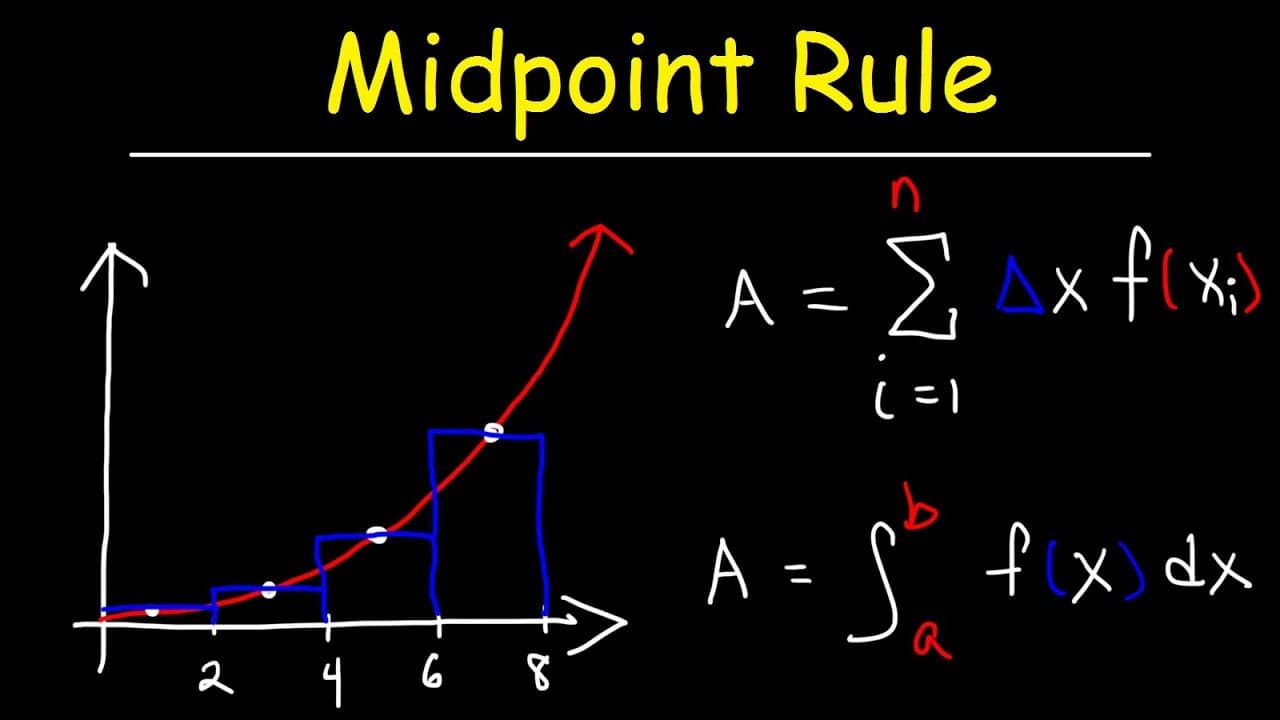
To estimate the area under a curve using the midpoint rule, divide the interval into equal subintervals, calculate the midpoints, and use the corresponding y-values to form rectangles. Multiply the height of each rectangle by the width of the subinterval and sum the areas. This method provides a good approximation compared to the actual area determined by the definite integral.
Transcript
in this video we're going to go over some examples dealing with the midpoint rule so let's begin so let's say if we have the graph y equals x squared and let's graph it so it looks something like this we're just going to focus on the right side of this graph now let's determine the area under the curve from 0 to 8. let's see if we can estimate it u... Read More
Key Insights
- 🗂️ The midpoint rule is a method used to estimate the area under a curve by dividing the interval into subintervals and using the midpoints.
- ☺️ The width of each rectangle is calculated using the formula delta x = (b-a)/n, where a and b are the endpoints of the interval and n is the number of subintervals.
- 😀 The height of each rectangle is determined by the y-value corresponding to the midpoint of each subinterval.
- 👋 The estimated area using the midpoint rule is a good approximation of the actual area under the curve, as demonstrated by comparing it to the value obtained through the definite integral.
- ↔️ The midpoint rule is more accurate than using left or right endpoints to estimate the area under a curve.
- 🗯️ It is recommended to watch the video on Riemann sums, left endpoints, and right endpoints for a deeper understanding of the concepts discussed.
- 📏 The midpoint rule can be applied to different functions and intervals, providing reliable estimations of the area under the curve.
Install to Summarize YouTube Videos and Get Transcripts
Explore YouTube Video Summarizer or Get YouTube Transcript Extractor
Questions & Answers
Q: What is the midpoint rule in calculus?
The midpoint rule is a method used to approximate the area under a curve by dividing the interval into subintervals and using the midpoints to calculate the width and height of each rectangle.
Q: How is the area of each rectangle calculated using the midpoint rule?
To calculate the area of each rectangle, you multiply the width (delta x) by the height, which is the y-value corresponding to the midpoint of each subinterval.
Q: How does the midpoint rule compare to using left endpoints and right endpoints?
The midpoint rule provides a better approximation of the area under the curve compared to using left or right endpoints, as it takes the midpoint of each subinterval into account.
Q: How close is the estimated area using the midpoint rule to the actual area?
The estimated area using the midpoint rule is generally close to the actual area calculated through the definite integral, making it a reliable approximation method.
Summary & Key Takeaways
-
The video demonstrates how to estimate the area under a curve using the midpoint rule by dividing the interval into subintervals and calculating the width and height of each rectangle.
-
By drawing rectangles using the midpoints of each subinterval, the video shows how the midpoint rule can approximate the area under the curve.
-
The video also compares the estimated area using the midpoint rule to the actual area obtained through the definite integral.
Read in Other Languages (beta)
Share This Summary 📚
Summarize YouTube Videos and Get Video Transcripts with 1-Click
Try YouTube Summary with ChatGPT & Claude or YouTube Transcript Generator
Explore More Summaries from The Organic Chemistry Tutor 📚



Summarize YouTube Videos and Get Video Transcripts with 1-Click
Try YouTube Summary with ChatGPT & Claude or YouTube Transcript Generator