How To Tell If The Limit Exists
TL;DR
A two-sided limit exists when the left-sided and right-sided limits approach the same value; if they differ, the limit does not exist. For example, as x approaches −1, both sides approach −1, so the limit is −1. For the given piecewise function at x = 3, both sides approach 10. Read on for graph, infinity, and piecewise-function examples.
Transcript
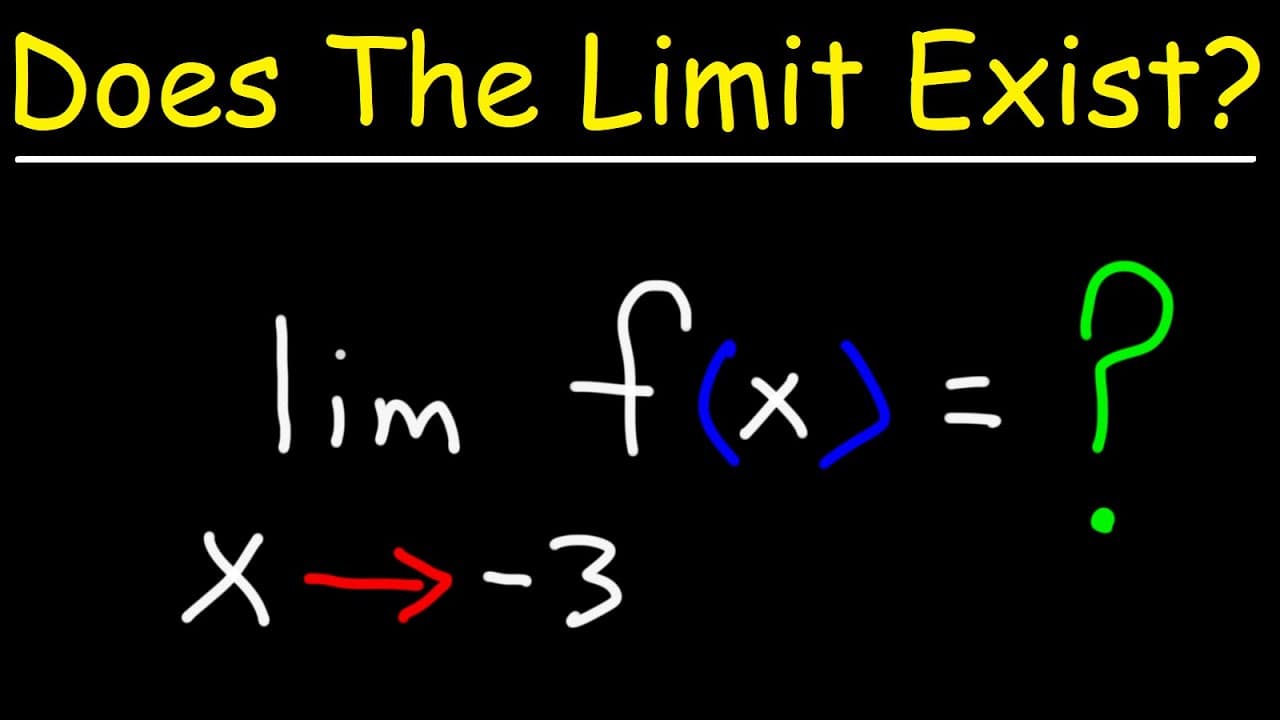
how do you tell if the limit exists how do you tell if it doesn't exist in this video we're going to answer that question so let's say if you want to find a limit as X approaches negative 3. and let's say this graph represents f of x how do you determine if this limit exists or not what you need to do is you need to check the left-sided limit as X ... Read More
Key Insights
- ⛔ To determine if a limit exists, compare the left-sided and right-sided limits.
- ⛔ The left-sided limit and the right-sided limit need to have the same value for the limit to exist.
- 🎁 Piecewise functions present an additional consideration when evaluating limits.
- ⛔ Limits can exist or not exist depending on the behavior of the function.
- ⛔ The existence of limits is crucial in calculus and helps understand the behavior of functions.
- ⛔ In some cases, the limit may approach positive or negative infinity, resulting in a limit that still exists.
- ↔️ One-sided limits are used to evaluate the behavior of a function from the left or right side of a specific value.
Install to Summarize YouTube Videos and Get Transcripts
Explore YouTube Video Summarizer or Get YouTube Transcript Extractor
Questions & Answers
Q: How do you determine whether a limit exists?
Evaluate the left-sided and right-sided limits at the specified x-value. The limit exists if both approach the same value; if their values differ, the limit does not exist.
Q: What are left-sided and right-sided limits?
A left-sided limit follows the function toward the target x-value from smaller x-values. A right-sided limit follows it from larger x-values.
Q: Why does the limit as x approaches −3 not exist in the graph example?
Approaching −3 from the left gives a y-value of −4, while approaching from the right gives −2. Because −4 and −2 do not match, the two-sided limit does not exist.
Q: Why does the limit as x approaches −1 exist?
The graph approaches a y-value of −1 from both the left and the right. Since the one-sided limits match, the limit exists and equals −1.
Q: Does a limit exist when one side approaches negative infinity and the other approaches positive infinity?
No, not under the matching-sides test presented here. At x = 3 in the graph example, the left side approaches negative infinity and the right side approaches positive infinity, so the limit does not exist.
Q: How do you test a limit for a piecewise function?
Choose the expression that applies to x-values on the left of the target and evaluate its one-sided limit. Then use the expression for x-values on the right and compare the two results.
Q: Why does the piecewise-function limit at x = −2 not exist?
From the left, the applicable expression is 5x + 1, which gives 5(−2) + 1 = −9. From the right, x² + 1 gives (−2)² + 1 = 5, so the unequal one-sided limits mean the limit does not exist.
Q: What is the limit of the piecewise function as x approaches 3?
From the left, x² + 1 gives 3² + 1 = 10. From the right, 2x + 4 gives 2(3) + 4 = 10, so the limit exists and equals 10.
Summary & Key Takeaways
-
When finding a limit as X approaches a specific value, check the left-sided limit and the right-sided limit.
-
If the one-sided limits are the same, the limit exists. If they have different values, the limit does not exist.
-
Examples of limits existing and not existing are provided, including limits with piecewise functions.
Read in Other Languages (beta)
Share This Summary 📚
Summarize YouTube Videos and Get Video Transcripts with 1-Click
Try YouTube Summary with ChatGPT & Claude or YouTube Transcript Generator
Explore More Summaries from The Organic Chemistry Tutor 📚

Summarize YouTube Videos and Get Video Transcripts with 1-Click
Try YouTube Summary with ChatGPT & Claude or YouTube Transcript Generator