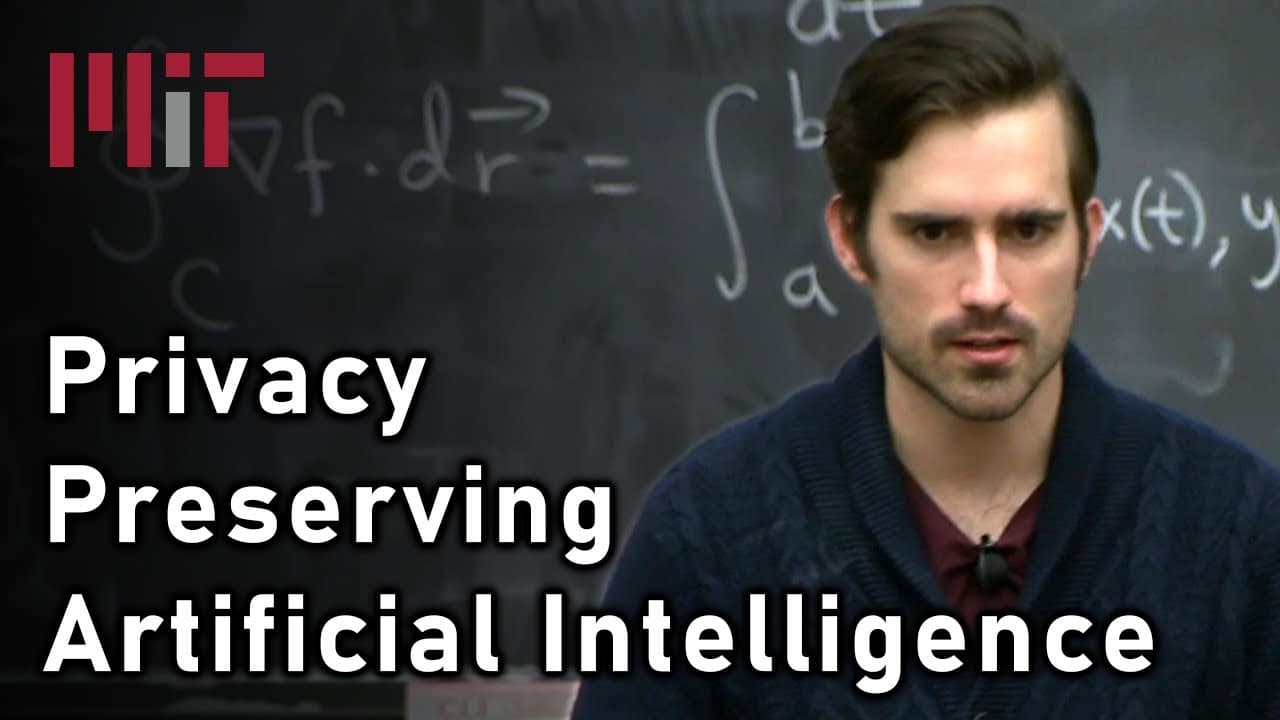
Privacy Preserving AI (Andrew Trask) | MIT Deep Learning Series
TL;DR
Privacy-preserving AI can answer questions using sensitive data without giving researchers direct access to it. Andrew Trask explains techniques including remote execution, differential privacy, secure multi-party computation, and federated learning, alongside PySyft, an OpenMined tool that extends major deep-learning frameworks for privacy-preserving machine learning. Read on to see how these methods could open important healthcare and scientific datasets while protecting individuals.
Transcript
today we were happy very happy to have Andrew Trask he's a brilliant writer researcher tweeter that's a word in the world of machine learning and artificial intelligence he is the author of grokking deep learning the book that I highly recommended in the lecturer on Monday he's the leader in creator of open mind which is an open source community th... Read More
Key Insights
- Privacy-preserving AI allows data analysis without direct data access, crucial for sensitive fields.
- Remote execution enables computations on data without transferring it to the analyst.
- Differential privacy adds noise to data queries to protect individual data points.
- Secure multi-party computation allows joint data analysis without revealing individual data.
- Federated learning trains models across decentralized devices without sharing raw data.
- Open data for science can accelerate AI development by providing extensive datasets.
- Single-use accountability systems can enhance privacy in monitoring and surveillance.
- End-to-end encrypted services could revolutionize data privacy in digital services.
Install to Summarize YouTube Videos and Get Transcripts
Explore YouTube Video Summarizer or Get YouTube Transcript Extractor
Questions & Answers
Q: How does privacy-preserving AI analyze data that researchers cannot see?
It uses methods such as remote execution, differential privacy, secure multi-party computation, and federated learning to perform analysis without exposing raw sensitive data. The goal is to let researchers answer important questions while protecting the people represented in the data.
Q: Why is privacy-preserving AI important for medical research?
Tumor images and other medical data are rare, highly regulated, difficult to move, and potentially expensive to obtain. Privacy-preserving tools could lower this access barrier, allowing more researchers to study dementia, diabetes, Alzheimer's, depression, anxiety, and other consequential problems.
Q: What is remote execution in privacy-preserving AI?
Remote execution allows computations to run where the data is held instead of transferring the data to the researcher. This changes the data scientist's workflow by enabling questions to be answered without direct possession of the underlying information.
Q: What is differential privacy?
Differential privacy adds noise to data queries to protect individual data points. It supports statistical analysis while limiting how much the presence or absence of one person's data affects the result.
Q: What is secure multi-party computation?
Secure multi-party computation lets multiple parties jointly analyze data without revealing each party's individual data. Computations operate on protected shares, enabling collaboration while preserving privacy.
Q: How does federated learning preserve privacy?
Federated learning trains models across decentralized devices without sharing their raw data. Devices compute updates locally and contribute model updates rather than transferring personal information.
Q: What are OpenMined and PySyft?
OpenMined is an open-source community led by Andrew Trask and described in the talk as having a little over 6,000 people focused on lowering barriers to privacy-preserving machine learning. PySyft is one of its tools, extending major deep-learning frameworks, including PyTorch, with privacy-preserving machine-learning capabilities.
Q: What broader effects could privacy-preserving AI have?
The talk considers both positive and negative consequences if these technologies mature. Potential applications include opening more data for science, creating single-use accountability systems, and supporting end-to-end encrypted services while maintaining stronger privacy.
Summary
In this video, Andrew Trask discusses privacy-preserving AI and the tools and techniques that can be used to answer questions using data that cannot be seen. He introduces several tools, including remote execution, private search, differential privacy, and secure multi-party computation. He explains how these tools can be used to perform data science tasks and build models while protecting the privacy of the data. Trask emphasizes the importance of making privacy-preserving AI more accessible to address important problems in society.
Questions & Answers
Q: Is it possible to answer questions using data that we cannot see?
Yes, it is possible to answer questions using data that we cannot see by using techniques such as remote execution, private search, differential privacy, and secure multi-party computation. These tools allow us to perform data science tasks and build models without directly accessing the data.
Q: Can we train a deep learning classifier without physically seeing the data?
Yes, we can use remote execution to train a deep learning classifier without physically seeing the data. By sending computations to a remote machine, we can learn patterns and information without direct access to the data. This allows us to work on important problems that require access to sensitive data.
Q: How does remote execution work in privacy-preserving AI?
Remote execution involves sending computations to a remote machine without directly accessing the data. This is done through the use of pointers that represent the data on the remote machine. When we execute something using a pointer, the computation is performed on the remote machine and the result is returned to us. This allows us to coordinate remote computations without needing direct access to the data.
Q: What is the significance of private search in privacy-preserving AI?
Private search allows us to perform queries on a remote dataset without revealing the specific data. It provides detailed descriptions of the data, allowing us to understand its structure and perform operations like remote normalization. We can also look at sample data that is representative of the dataset without compromising its privacy. Private search opens up possibilities for data analysis and feature engineering without direct access to the data.
Q: How does differential privacy protect the privacy of data in privacy-preserving AI?
Differential privacy is a field that allows us to perform statistical analysis without compromising the privacy of the data. It enables us to query a database while making guarantees about the privacy of the other records in the database. By adding noise to the data, we can provide plausible deniability and prevent the identification of individual records. This ensures that data analysis can be performed without revealing sensitive information.
Q: What is the role of epsilon in differential privacy?
Epsilon is a measure of the privacy budget in differential privacy. It determines the level of statistical uniqueness that is allowed in the data. By setting a specific value for epsilon, we can put an upper bound on the amount of information that can be inferred from the data. It allows us to balance privacy and accuracy, ensuring that the data remains private while still providing meaningful insights.
Q: How does secure multi-party computation contribute to privacy-preserving AI?
Secure multi-party computation allows multiple individuals to combine their private inputs to compute a function without revealing their inputs to each other. It enables shared governance and encryption of data and models, allowing computations to be performed on encrypted data while preserving privacy. It opens up possibilities for collaborative data analysis and model training across multiple data owners without compromising privacy.
Q: What are the advantages of using secure multi-party computation in privacy-preserving AI?
Secure multi-party computation provides encrypted data and shared governance, ensuring privacy while allowing computations to be performed. It allows data and model owners to collaborate without revealing sensitive information. It also enables training and prediction on encrypted data, preserving privacy while maintaining accuracy. Secure multi-party computation is a powerful tool for privacy-preserving AI.
Q: What are the limitations of privacy-preserving AI techniques?
One limitation is computational complexity. Privacy-preserving AI techniques can result in slower performance due to the additional computations and communication required. This can be a challenge when applying these techniques on a large scale or with limited computational resources. Additionally, there are still challenges in trust and verification, ensuring that computations are performed correctly and that privacy is maintained. These limitations are being actively researched and addressed to improve the effectiveness and efficiency of privacy-preserving AI.
Q: How can privacy-preserving AI make important problems more accessible?
Privacy-preserving AI lowers the barrier to accessing and working with important problems that require sensitive data. By providing tools and techniques that allow data science tasks to be performed without direct access to the data, privacy-preserving AI enables researchers and practitioners to tackle critical issues related to health, society, and other domains. It increases the accessibility of data and promotes collaboration while protecting privacy.
Q: What are the future possibilities and goals of privacy-preserving AI?
The goal of privacy-preserving AI is to create infrastructure and tools that make privacy protections robust and accessible. The aim is to make important datasets and models accessible while ensuring privacy for data owners. The long-term vision is to enable individuals to set their own privacy budgets and have control over their personal information. Continued advancements in privacy-preserving AI will create new possibilities for addressing important problems in society while upholding the values of privacy and security.
Takeaways
Privacy-preserving AI techniques such as remote execution, private search, differential privacy, and secure multi-party computation provide powerful tools for performing data science tasks and answering questions using data that cannot be seen. These techniques allow us to protect the privacy of sensitive data while still gaining meaningful insights. By making privacy-preserving AI more accessible, we can address important problems in society and promote collaboration while protecting privacy. Continued research and development in this field will enable new possibilities and increased control over personal information.
Summary & Key Takeaways
-
Privacy-preserving AI techniques allow for data analysis without direct access to sensitive information. These include remote execution, differential privacy, and secure multi-party computation. They aim to protect individual data while enabling robust analysis, potentially transforming data usage in science, accountability systems, and encrypted services.
-
Remote execution and differential privacy facilitate computations on data without transferring it, adding noise to protect individual data points. Secure multi-party computation enables joint data analysis without revealing individual data, while federated learning trains models across decentralized devices without sharing raw data.
-
The potential for open data in science could accelerate AI development by providing extensive datasets. Single-use accountability systems can enhance privacy in monitoring and surveillance, and end-to-end encrypted services could revolutionize data privacy in digital services, offering significant opportunities for innovation.
Read in Other Languages (beta)
Share This Summary 📚
Summarize YouTube Videos and Get Video Transcripts with 1-Click
Try YouTube Summary with ChatGPT & Claude or YouTube Transcript Generator
Explore More Summaries from Lex Fridman 📚





Summarize YouTube Videos and Get Video Transcripts with 1-Click
Try YouTube Summary with ChatGPT & Claude or YouTube Transcript Generator