How to Understand Position, Velocity, and Acceleration in Calculus

TL;DR
Position represents an object's location, while velocity and acceleration are the rates of change of position and velocity, respectively. To calculate distance, sum the absolute values of displacements, and understand that positive velocity indicates movement to the right while negative indicates movement to the left. Instantaneous values can be found using derivatives of the position and velocity functions.
Transcript
in this video we're going to talk about calculus as it relates to position velocity and acceleration perhaps you're wondering how do i know when the particle is moving to the right or moving to the left for when it's at rest and when it's speeding up slowing down and things like that so we're going to focus on almost all the questions that are rela... Read More
Key Insights
- ☠️ Position, velocity, and acceleration are fundamental concepts in calculus that describe the location, rate of change, and rate of change of velocity of an object.
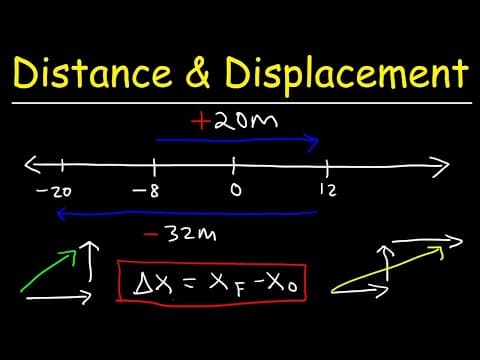
- 🧘 Displacement measures the change in position, while distance represents the total length covered by an object.
- ☠️ Velocity is the rate of change of position, while acceleration is the rate of change of velocity.
- 🤘 The sign of velocity and acceleration indicates the direction of motion and whether the object is speeding up or slowing down.
- 🧘 The derivative of the position function yields the velocity function, and the derivative of the velocity function yields the acceleration function.
- 💱 Average velocity can be calculated by dividing the displacement by the change in time, and average acceleration by dividing the change in velocity by the change in time.
- 😥 The instantaneous velocity can be obtained by taking the derivative of the position function or estimating using the average velocity between two points.
- 😥 Similarly, the instantaneous acceleration can be found by taking the derivative of the velocity function or estimating using the average acceleration between two points.
Install to Summarize YouTube Videos and Get Transcripts
Explore YouTube Video Summarizer or Get YouTube Transcript Extractor
Questions & Answers
Q: How do you calculate average velocity?
Average velocity is calculated by dividing the displacement (change in position) by the change in time. It represents the average rate at which an object changes its position over a specific time interval.
Q: How can we estimate the instantaneous velocity at a specific time using a data table?
If you are given a data table instead of a position function, you can estimate the instantaneous velocity by calculating the average velocity between two points where the time of interest is the midpoint. This provides a good approximation of the instantaneous velocity.
Q: When is a particle considered to be at rest?
A particle is considered to be at rest when its velocity is zero. However, it is important to note that zero velocity can also indicate a change in direction, so additional context may be needed to determine if the particle is truly at rest.
Q: How can we determine if a particle is speeding up or slowing down?
If the acceleration and velocity have the same sign (both positive or both negative), the particle is speeding up. If the acceleration and velocity have opposite signs, the particle is slowing down. The sign of velocity represents the direction of motion.
Q: How can we find the total distance traveled by an object?
To find the total distance traveled, add the magnitudes of all displacements without considering their direction. Displacement measures the change in position, while distance represents the total length covered regardless of direction.
Q: Can we approximate the instantaneous velocity using the average velocity?
Yes, you can estimate the instantaneous velocity by calculating the average velocity between two points where the time of interest is the midpoint. As the two points get closer together, the estimation becomes more accurate.
Q: How can we calculate the average acceleration using a data table?
To calculate the average acceleration, divide the change in velocity (v of b - v of a) by the change in time (b - a). This provides the average rate of change of velocity over the specified time interval.
Q: How can we find the instantaneous acceleration using the limit process?
Use the alternative form of the derivative, where the instantaneous acceleration is equal to the limit as time approaches a of (v of t - v of a) divided by (t - a). This is similar to finding the average acceleration, but with a smaller time interval to estimate the instantaneous value.
Summary & Key Takeaways
-
The position function, denoted as s(t), represents the location of an object on the x or y-axis.
-
To find distance, add the magnitudes of positive and negative displacements. Displacement is positive or negative depending on the direction of movement.
-
Velocity, denoted as v(t), is the derivative of the position function. It represents the rate of change of position over time.
-
Acceleration, denoted as a(t), is the derivative of the velocity function. It represents the rate of change of velocity over time.
Read in Other Languages (beta)
Share This Summary 📚
Summarize YouTube Videos and Get Video Transcripts with 1-Click
Try YouTube Summary with ChatGPT & Claude or YouTube Transcript Generator
Explore More Summaries from The Organic Chemistry Tutor 📚



Summarize YouTube Videos and Get Video Transcripts with 1-Click
Try YouTube Summary with ChatGPT & Claude or YouTube Transcript Generator