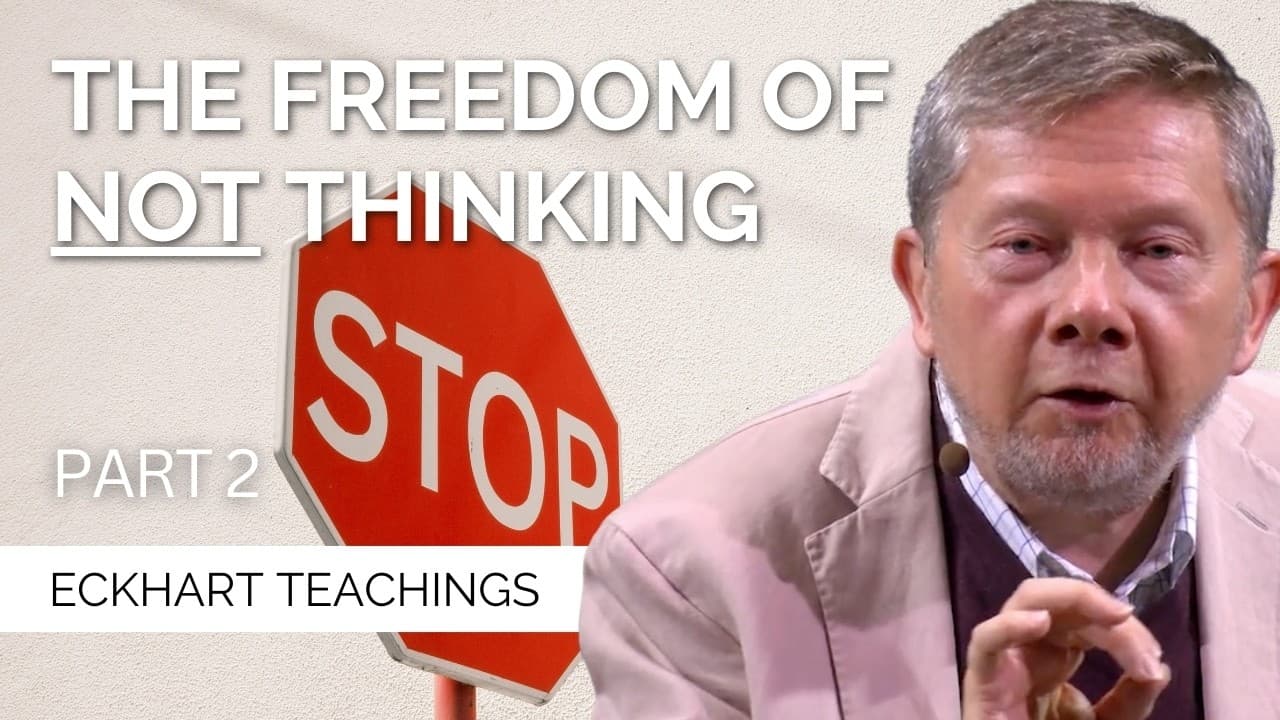
What Is the Freedom of Not Thinking? Eckhart Tolle on Freedom from Conditioning, Part 2
TL;DR
Freedom from conditioning begins when you receive present sense perceptions without labeling, interpreting, or adding mental commentary. Eckhart Tolle says that when interpretation stops, the conditioned person temporarily recedes while an alert, nonconceptual awareness remains. This shift reveals being as timeless consciousness beneath personal history, problems, desires, and goals. Read on to understand how perception, self-aware presence, therapeutic listening, and the human and being dimensions fit together.
Transcript
Are you able to take in the totality of your sense perceptions at this moment without any mental commentary? Just be like a maybe like a a one-year-old child hasn't learned language yet and just looks in wonder and amazement at the world. You don't have to look like that. I'm just pro. So you look around at the innocent perception without is it pos... Read More
Key Insights
- Perception can precede language: The suggested starting point is not a new interpretation but perception without interpretation. Tolle evokes a one-year-old child because the child has not yet learned the language used to label experience. Wonder and amazement illustrate attention before familiar concepts organize what is seen.
- Direct knowing answers the exercise: Whether you can remain without mental commentary is something only you can determine. The answer does not come through verbal analysis, because analysis would recreate the commentary being examined. Instead, you allow all sense perceptions to be present and know directly whether interpretation has become quiet.
- Interpretation carries the past: When a person interprets present perceptions, the conditioning of the mind is operating. The past shapes the perceiver and supplies the framework imposed on the world. Suspending interpretation therefore changes more than the content of thought, it interrupts the conditioned person's usual way of meeting experience.
- Knowing survives without concepts: The absence of commentary does not produce blankness or eliminate perception. A deeper, nonconceptual knowing remains when labels and interpretations fall silent. This shows, within the talk's account, that knowing need not always take the form of words, explanations, or conclusions generated by the conditioned mind.
- The person recedes temporarily: Tolle does not claim that the personal identity permanently disappears during the exercise. He says the person comes to an end temporarily when commentary ceases. Awareness or presence then arises to replace it, so to speak, revealing a mode of perception that is not organized by the conditioned personality.
- Stillness remains fully alert: Spiritual stillness is presented as a pointer rather than a sleepy or passive state. Its defining quality is wakefulness without the usual mental noise. A person can remain acutely aware of the room and its sensory contents while resting as the still space in which those perceptions occur.
- Presence includes two recognitions: Presence begins with awareness of sense perceptions without labeling, but it does not stop there. The next step is recognizing the awareness through which those perceptions are known. Attention therefore includes both what appears through the senses and the conscious presence that makes sensing possible.
- Grammar creates apparent duality: Saying, "I am aware of awareness," makes awareness sound like an object observed by a separate subject. Tolle attributes this split to language, which operates with subjects and objects. In the direct experience he describes, there are not two versions of you. Awareness recognizes itself.
- Personal problems can become identity: The burden people carry is intensified when identity becomes intimately bound to problems requiring solutions. Tolle condenses this condition into the sense that "I am a problem to be solved." Brief freedom from the person matters because it loosens identification with both the burden and the search for a solution.
- Listening can embody consciousness: A therapist may hear a client or patient while remaining present instead of interpreting every statement. The distinction is not between listening and ignoring what is said. It is between automatic conceptual interpretation and listening as consciousness, which Tolle says can make a huge difference and perhaps permit awakening.
- Being exceeds the limited self: Awareness of consciousness is described as sensing the beingness of yourself, but this is not merely the limited personal you. Tolle calls it the beingness of the universe in you and a transcendent dimension of identity. Awakening means becoming conscious of this dimension rather than remaining confined to personality.
- Both dimensions remain together: Awakening to being does not erase history, conditioning, desires, goals, personality, or ordinary circumstances. Those belong to the continuing human dimension. The change is that timeless consciousness is no longer overlooked, allowing the human form to embody being until the body dissolves.
Install to Summarize YouTube Videos and Get Transcripts
Explore YouTube Video Summarizer or Get YouTube Transcript Extractor
Questions & Answers
Q: How can I perceive the present moment without mental commentary?
Take in the totality of your current sense perceptions and let them be present without labeling, interpreting, or mentally explaining them. Approach the surroundings with the innocent perception of a one-year-old child who has not learned language. Do not try to answer verbally whether you have succeeded, because that would add another conceptual layer. Know directly whether perception remains while commentary becomes quiet.
Q: What happens when mental interpretation stops?
Perception continues, and a deeper knowing remains even though it is not conceptual. The conditioned person temporarily recedes because the mind is no longer imposing interpretations shaped by the past. Awareness or presence arises in its place, so to speak, and perceives the room directly. This shift matters because it reveals consciousness that does not depend on continuous commentary.
Q: Why does Eckhart Tolle call stillness alert?
The stillness he describes is fully awake, not sleepy or dull. Sense perceptions remain available, but the mind is not automatically labeling or interpreting them. This creates a shift from being a conditioned entity to being the space of awareness. Calling it alert prevents stillness from being mistaken for disengagement or an absence of consciousness.
Q: How does awareness become aware of itself?
First, you notice sense perceptions without labeling them. Then you recognize the conscious presence through which those perceptions are possible. Language may express this as "I am aware of awareness," which appears to create an observer and an observed awareness. Tolle says that duality exists only in the wording, because awareness is simply becoming self-aware.
Q: Why can freedom from personal identity feel relieving?
Personal identity can carry heaviness when it is bound to a continuing burden of problems. A person may come to experience the self as a problem that must find a solution. When commentary stops, the conditioned person and its burden temporarily recede. Even a brief recognition of awareness therefore reveals freedom from complete identification with that troubled personal identity.
Q: How can presence change therapeutic listening?
A therapist can remain present while a client or patient speaks instead of interpreting everything automatically. This does not mean ceasing to listen, but listening while embodying consciousness. Tolle says that a present therapist can make a huge difference. He suggests that some awakening may happen because the quality of awareness is present within the encounter.
Q: What are the human and being dimensions?
The human dimension includes your past, mental and emotional conditioning, ego, personality, life situation, desires, and goals. The being dimension is timeless consciousness, which Tolle calls your essence identity. Most humans overlook this transcendent dimension because they are lost in their human nature. Awakening allows both dimensions to remain together rather than requiring the human dimension to disappear.
Q: What is the purpose of awakening to being?
The purpose is to embody being while continuing to live as a human. Awakening does not remove your history, circumstances, desires, goals, or personality, and you remain human until the body dissolves. It reveals timeless consciousness as the essential reality of who or what you are. Your task or mission is therefore to bring the human and being dimensions together in your life.
Summary & Key Takeaways
-
Beginning with pure perception: Eckhart Tolle asks whether you can take in the totality of your present sense perceptions without mental commentary. He compares this quality of attention to a one-year-old child who has not learned language and looks at the world with wonder. The exercise is not answered through words. You allow perceptions to be present without labeling or interpretation, then recognize through direct knowing whether such innocent perception is possible for you.
-
Moving beyond conditioned interpretation: Interpreting sense perceptions expresses the conditioning of the mind because a person shaped by the past is imposing meaning on the world. When commentary stops, perception and knowing continue, but the knowing is deeper and nonconceptual. The person temporarily recedes and is replaced, so to speak, by awareness or presence. What perceives the room without past-conditioned commentary is awareness itself, marking a shift away from identification with a conditioned entity.
-
Recognizing alert, self-aware presence: The awareness that remains is very still, but its stillness is alert rather than sleepy. You become the space of awareness that receives sense perceptions without labeling them. Presence then deepens as awareness recognizes not only perceived things but also the consciousness making perception possible. Language describes this as an I becoming aware of awareness, creating apparent duality, yet Tolle says there are not two selves. Awareness simply becomes aware of itself.
-
Releasing the burdened person: Even brief moments of self-aware presence can free you from the heaviness of personal identity. Tolle describes many people as intimately identified with burdens and life problems, effectively experiencing themselves as a problem seeking a solution. He then connects presence with therapy. A therapist who listens consciously instead of automatically interpreting everything can make a huge difference, because embodying presence while a client or patient speaks may allow some awakening to happen.
-
Uniting human and being: Tolle uses the phrase human being to identify two dimensions of reality. The human dimension includes the past, mental and emotional conditioning, ego, personality, life situation, desires, and goals. The often-overlooked being dimension is timeless consciousness and essential identity. Awakening does not end human life. Until the body dissolves, the task, mission, or purpose is to remain human while also embodying being, bringing both dimensions into life.
Read in Other Languages (beta)
Share This Summary 📚
Summarize YouTube Videos and Get Video Transcripts with 1-Click
Try YouTube Summary with ChatGPT & Claude or YouTube Transcript Generator
Explore More Summaries from Eckhart Tolle 📚





Summarize YouTube Videos and Get Video Transcripts with 1-Click
Try YouTube Summary with ChatGPT & Claude or YouTube Transcript Generator