Terrestrial Biomes and Ecosystems | Biology
TL;DR
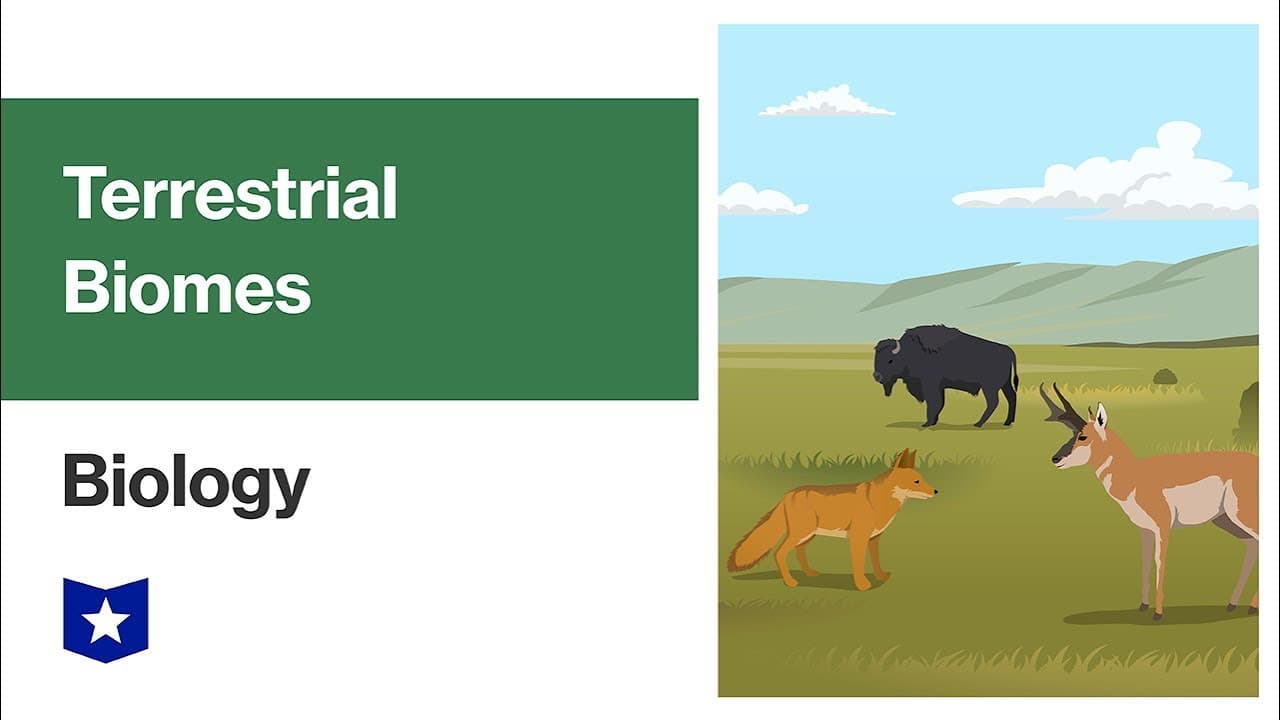
Terrestrial biomes are large regions on land characterized by temperature, rainfall, and dominant plant types, including tropical rainforests, savannas, deserts, grasslands, deciduous forests, taigas, and tundras.
Transcript
terrestrial biomes a large geographic regions on land defined by the average temperature average rainfall and dominant plant types if the climate in two separate areas is similar you can expect to find the same type of volume in both these regions let's survey the major terrestrial biomes beginning near the equator and finishing close to the poles ... Read More
Key Insights
- 🌱 Terrestrial biomes are defined by temperature, rainfall, and dominant plant types.
- 🤑 Tropical rainforests are rich in biodiversity but face threats from overharvesting and habitat destruction.
- 🌥️ Savannas have dry conditions, grasses, and are impacted by overhunting of large mammals.
- 😘 Deserts have low rainfall, diverse temperature ranges, and plants and animals adapted to arid conditions.
- 🌸 Grasslands provide fertile soils but are endangered by habitat loss due to agriculture.
- 🌳 Deciduous forests have moderate temperatures, deciduous trees, and animals that hibernate or migrate.
- ❄️ Taigas are northern coniferous forests with cold winters, warm summers, and are endangered by overharvesting.
Install to Summarize YouTube Videos and Get Transcripts
Explore YouTube Video Summarizer or Get YouTube Transcript Extractor
Questions & Answers
Q: What is the main threat to tropical rainforests?
The main threats to tropical rainforests are overharvesting and habitat destruction caused by human activities, leading to a decline in biodiversity and loss of habitats for various species.
Q: How do animals in deserts adapt to low water consumption?
Desert animals have adapted to low water consumption by being nocturnal to avoid intense heat and sun exposure, while others have evolved specific physiological traits to help them survive in the arid conditions, such as storing water or having efficient water-conserving mechanisms.
Q: How are grasslands endangered by agriculture?
Grasslands, like prairies, are endangered by agriculture because farmers often convert these regions into agricultural land, leading to habitat loss for wildlife. This pushes animals out of their natural habitats and disrupts the ecological balance of the biome.
Q: What makes taigas vulnerable to overharvesting?
Taigas are vulnerable to overharvesting because coniferous trees, which are the primary vegetation, take a long time to grow, with some species taking up to 70 years to reach maturity. When these trees are overharvested, it endangers the old-growth forests and reduces plant biodiversity.
Summary & Key Takeaways
-
Tropical rainforests, located near the equator, have high rainfall and temperatures, a layered structure, and are threatened by overharvesting and habitat destruction.
-
Savannas, found near the tropics, have dry conditions, warm temperatures, mostly grasses and shrubs, and suffer from overhunting of large mammals.
-
Deserts, characterized by low rainfall, can be hot or cold, plants are adapted to dry conditions, and animals have low water consumption.
-
Grasslands, like prairies, have seasonal rainfall, hot summers, cold winters, fertile soils, few trees, and are endangered by habitat loss through agriculture.
-
Deciduous forests, located in the northern hemisphere, have moderate temperatures, moderate to high rainfall, deciduous trees, and animals that hibernate or migrate.
-
Taigas, or northern coniferous forests, have coniferous trees, cold and long winters, warm summers, moderate rainfall, and are endangered by overharvesting.
-
Tundras, found in the northernmost and southernmost parts of the world, have cold temperatures, little precipitation, grasses, permafrost, and are common breeding grounds for migratory animals.
Read in Other Languages (beta)
Share This Summary 📚
Summarize YouTube Videos and Get Video Transcripts with 1-Click
Try YouTube Summary with ChatGPT & Claude or YouTube Transcript Generator
Explore More Summaries from Course Hero 📚




Summarize YouTube Videos and Get Video Transcripts with 1-Click
Try YouTube Summary with ChatGPT & Claude or YouTube Transcript Generator