How Does the Adaptive Staggered-Tilted Grid Improve Fluid and Smoke Simulations?
TL;DR
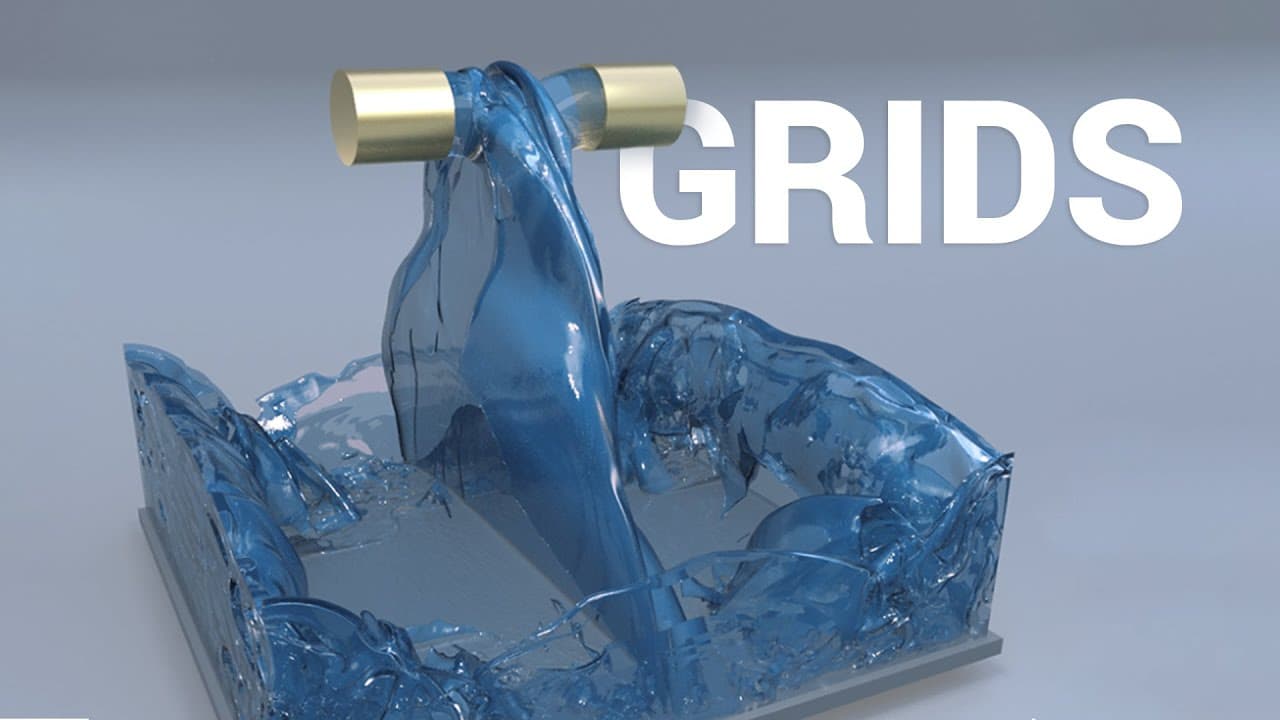
The Adaptive Staggered-Tilted grid improves fluid and smoke simulations by placing rotated, variably sized cells only where additional detail is needed. Across four experiments, the AST grid follows vortices, resolves turbulent regions, captures narrow smoke flows, and details boat wakes and thin water sheets, while typically adding just 1% to computation time. Read on to see how its adaptive cells work in each case.
Transcript
Dear Fellow Scholars, this is Two Minute Papers with Dr. Károly Zsolnai-Fehér. Today we are going to concoct some absolutely insane fluid and smoke simulations. A common property of these simulation programs is that they subdivide the simulation domain into a grid, and they compute important quantities like velocity and pressure in these gr... Read More
Key Insights
- "This is called the Adaptive Staggered-Tilted grid, an AST grid in short." (0:29)
- "The tilted part means that cells can be rotated by 45 degrees like this." (0:43)
- "The adaptive part means that the size of the grid cells is not fixed, and can be all over the place." (0:50)
- "And even better, this concept can be easily generalized to 3D grids as well." (1:00)
- "It costs almost nothing, and adds typically an additional 1% of computation time." (4:27)
Install to Summarize YouTube Videos and Get Transcripts
Explore YouTube Video Summarizer or Get YouTube Transcript Extractor
Questions & Answers
Q: What is the Adaptive Staggered-Tilted grid?
The Adaptive Staggered-Tilted grid, or AST grid, replaces the regular grid used to compute quantities such as velocity and pressure in fluid and smoke simulations. Its cells can be rotated by 45 degrees and can vary in size.
Q: What do the tilted and adaptive parts of the AST grid mean?
Tilted means that grid cells can be rotated by 45 degrees and typically appear only where needed. Adaptive means that cell sizes are not fixed and can vary throughout the simulation.
Q: Why does the AST grid improve fluid and smoke simulations?
The AST grid concentrates tilted cells in turbulent areas and other regions of interest. This increases detail and helps flows pass through places where they should, such as narrow gaps around obstacles.
Q: How does the AST grid handle Kármán vortex streets?
In the first experiment, tilted cells appear in regions with a great deal of vorticity. The algorithm identifies those regions, and the cells flow through the repeated vortex patterns.
Q: How does the AST grid help smoke pass through porous nets?
The grid adds tilted cells around the net because it is a region of interest, not only because of turbulence. These cells capture narrow flow around the obstacle, allowing smoke plumes that might otherwise fail to pass through the net.
Q: How does the AST grid improve the simulation of a boat wake?
In the boat experiment, tilted cells completely cover the pool surface so the wake can be highly detailed. The volume beneath the surface remains free of those cells, avoiding work where they are not needed.
Q: Can the Adaptive Staggered-Tilted grid be generalized to 3D simulations?
Yes, the concept can be easily generalized to 3D grids. The transcript presents this as an extension of the same tilted and adaptive grid approach.
Q: How much additional computation time does an AST grid require?
An AST grid typically adds an additional 1% of computation time compared with a regular grid. In return, it increases simulation detail and improves how fluid and smoke move through important regions.
Summary & Key Takeaways
-
The AST grid is a new technique that replaces regular grids in fluid and smoke simulations, utilizing rotated and adaptive cells.
-
Experiment 1 demonstrates how the tilted cells in the AST grid accurately capture vorticity patterns, improving simulation accuracy.
-
Experiment 2 shows that the AST grid can refine grids in turbulent areas and capture narrow flows, increasing simulation quality.
-
Experiment 3 highlights the AST grid's ability to ensure detailed wake formation without wasting computational resources.
-
Experiment 4 showcases how the AST grid selectively works in regions that require additional detail without significant computation cost.
Read in Other Languages (beta)
Share This Summary 📚
Summarize YouTube Videos and Get Video Transcripts with 1-Click
Try YouTube Summary with ChatGPT & Claude or YouTube Transcript Generator
Explore More Summaries from Two Minute Papers 📚






Summarize YouTube Videos and Get Video Transcripts with 1-Click
Try YouTube Summary with ChatGPT & Claude or YouTube Transcript Generator