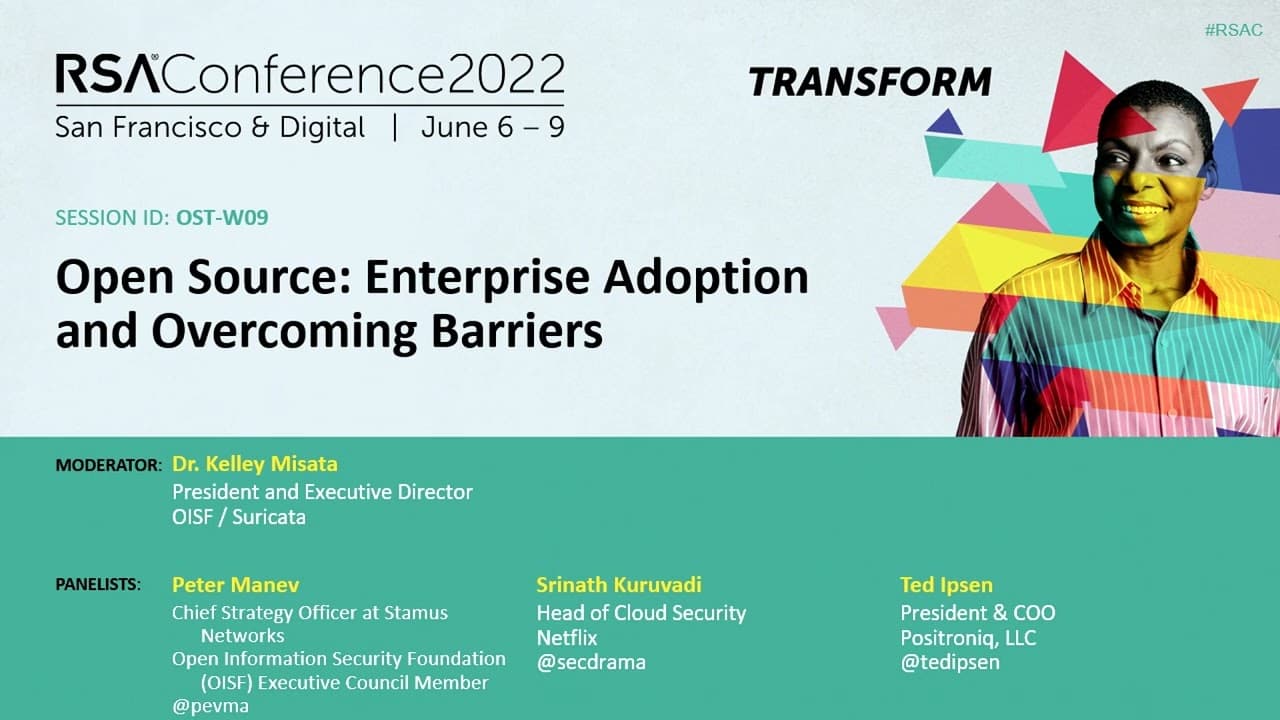
How to Adopt Open Source Security in Enterprises
TL;DR
Enterprise adoption of open source security starts with knowing every dependency, understanding its license and criticality, and preparing a risk-based remediation process before a major vulnerability appears. Open source can accelerate innovation and give smaller organizations access to valuable security telemetry, but teams must manage legal concerns, community relationships, software inventories, and response responsibilities directly.
Transcript
Welcome to our session. Really happy to have all of you here. Um, for those in the back, um, just know that I am a, a professor also in my life, so I have no problems with calling on people in the back of the room. Uh, but if you'd like to come closer, feel free. We're delighted to have you here for our panel. Um, I'm excited for this conversation.... Read More
Key Insights
- Open source software is already widespread across consumer devices, cars, operating systems, commercial products, security tools, and software libraries. An organization may therefore depend on open source even when it has not consciously chosen or directly deployed a standalone open source product.
- Open source adoption is a way to accelerate innovation because organizations can build from an existing software baseline instead of staffing teams to create every capability from scratch. Netflix describes this as a significant business advantage, while smaller organizations value access to security capabilities they could not otherwise afford.
- Dependency visibility is essential for responding to vulnerabilities because organizations need to know which libraries exist, where they are deployed, and how critical each affected system is. Software bills of materials are presented as one mechanism for understanding software that an organization uses but did not write.
- Risk-based remediation is a practical response to widespread vulnerabilities because a small security team cannot necessarily fix every affected system simultaneously. Netflix prioritizes its most critical tier with a one-day service-level target, followed by lower tiers with five-day and fifteen-day targets.
- Tabletop exercises are a preparation method for major open source incidents. Netflix simulates the compromise of a widely used library, then examines how teams would identify every affected location, determine system criticality, coordinate remediation, and reduce business risk quickly.
- Open source licensing is a source of enterprise complexity because arrangements and requirements are not uniform across communities. Legal and risk-management teams need to understand the applicable license before deployment rather than assuming that every open source project creates the same obligations or protections.
- Commercial vendor responsibility differs from direct open source use because a vendor typically assumes responsibility for tools incorporated into its software, appliances, or services. Organizations using open source software or libraries directly must take additional steps to understand and manage their own exposure.
- Community dialogue is part of responsible open source adoption because enterprises are dealing with more than a codebase. They must consider the people, project community, licensing model, and available communication channels, while contributors can also support projects through tools, code, and ongoing participation.
Install to Summarize YouTube Videos and Get Transcripts
Explore YouTube Video Summarizer or Get YouTube Transcript Extractor
Questions & Answers
Q: How should enterprises adopt open source security tools?
Enterprises should begin by identifying the open source software and libraries already present in their environments. They should document where each component is used, assess its criticality, understand its license, and establish who is responsible for responding to vulnerabilities. Direct dialogue with project communities, tabletop exercises, and a risk-based remediation process can make adoption more manageable.
Q: Why do organizations use open source security software?
Organizations use open source security software because it provides an existing baseline that can accelerate innovation without requiring every capability to be built and staffed from scratch. For small and medium-sized businesses, these tools can also provide valuable security telemetry when a commercial product costing fifty thousand dollars per year is beyond their purchasing ability.
Q: What risks can open source software create for enterprises?
Open source software can create dependency, vulnerability, licensing, legal, and operational risks when an organization does not understand what it uses. Risk managers and legal teams may also ask who is responsible or available for recourse if something goes wrong. These concerns become harder to resolve when software inventories, criticality assessments, and license information are incomplete.
Q: How can a software bill of materials support open source security?
A software bill of materials can help an organization understand the software it relies on but did not write. That visibility matters when a library becomes vulnerable because responders need to locate affected deployments and evaluate their criticality. The panel connects this inventory problem with dependency awareness, legal requirements, and the ability to perform rapid remediation across an enterprise.
Q: How does Netflix prepare for a major library compromise?
Netflix uses tabletop exercises that assume a widely used library has been compromised. The exercise tests whether teams can find every place the library exists, determine the criticality of each affected deployment, and remediate quickly. This preparation reflects a broader practice of planning for severe scenarios before an incident creates pressure for mass remediation.
Q: What is risk-based remediation for open source vulnerabilities?
Risk-based remediation prioritizes affected systems according to their importance and exposure instead of attempting to fix everything at once. Netflix describes a tiered model in which the highest-risk tier has a one-day service-level target, the next tier has five days, and another tier has fifteen days. This helps small security teams focus first on reducing the greatest business risk.
Q: Why is open source licensing difficult for enterprises?
Open source licensing is difficult because arrangements are not uniform across different communities, creating additional work for legal and risk-management teams. An enterprise must examine the relevant license and its requirements rather than treating all open source projects alike. Licensing is only one adoption dimension alongside the technology, codebase, contributors, and health of the surrounding community.
Q: How does direct open source use differ from buying commercial software?
A commercial vendor usually takes responsibility for the tools included within its software, appliances, or services. When an organization uses open source software or libraries directly, it must take extra steps to understand vulnerabilities, dependencies, licenses, and remediation responsibilities. The distinction does not mean commercial products lack vulnerabilities, since serious issues occur in both open source and commercial software.
Summary & Key Takeaways
-
Open source security technology can help enterprises innovate faster because teams can begin with an existing baseline instead of staffing and building everything from scratch. It is also valuable to smaller organizations that cannot afford costly commercial licenses but still need tools that improve their security telemetry and address real-world security problems.
-
Adoption introduces legal and risk-management questions about licenses, vulnerabilities, responsibility, and recourse when software fails. Organizations must understand which open source libraries exist in their environments, where they are deployed, how critical they are, and what obligations accompany them. Software bills of materials can support this visibility and dependency awareness.
-
Netflix prepares for major dependency compromises through tabletop exercises and risk-based remediation. Its approach identifies affected locations, evaluates their criticality, and assigns different response windows by risk tier. The panel also emphasizes direct dialogue with open source communities, careful license review, and recognition that commercial products frequently incorporate open source components too.
Read in Other Languages (beta)
Share This Summary 📚
Summarize YouTube Videos and Get Video Transcripts with 1-Click
Try YouTube Summary with ChatGPT & Claude or YouTube Transcript Generator
Explore More Summaries from RSAC Cybersecurity 📚



Summarize YouTube Videos and Get Video Transcripts with 1-Click
Try YouTube Summary with ChatGPT & Claude or YouTube Transcript Generator