How did Jensen Huang build Nvidia from Denny's to a $5T company
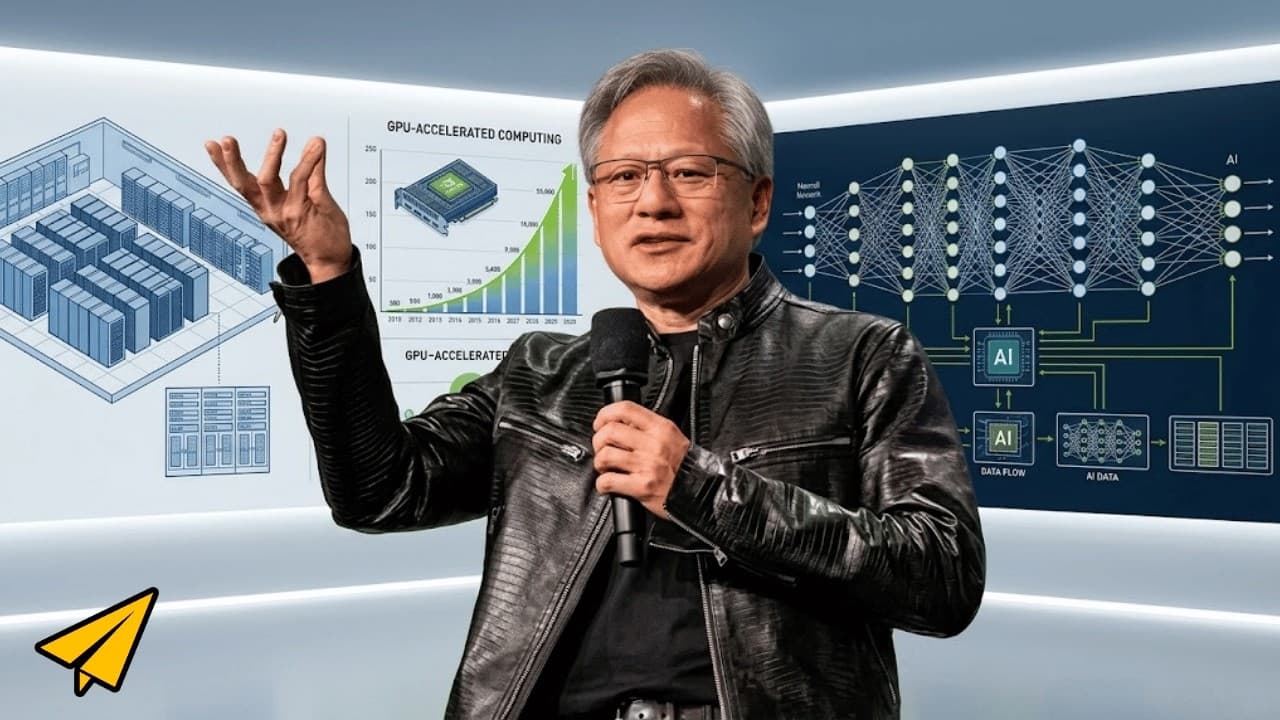
TL;DR
Jensen Huang rose from a Denny's dishwasher to cofound Nvidia, betting on a new kind of graphics chip for a growing market and surviving early failures. The company faced a failed NV1 design and a risky Sega contract, but secured $5 million and pivoted to a successful chip strategy that propelled Nvidia toward global dominance.
Transcript
In 2024, Jensen Huang stood in front of a room of Stanford students and said, I wish upon you ample doses of pain and suffering. Students, I wish upon you, you know, ample doses of pain and suffering. I thought that was interesting because it's the opposite of what everyone else usually tells you. Now, Jensen runs Nvidia, the company that makes the... Read More
Key Insights
- Jensen Huang began his career in humble roles, including dishwasher and toilet cleaner, before advancing to electrical engineering and chip design, showing how early grit can fuel later innovation.
- The idea of investing in zero to billion markets drove Nvidia’s riskier bets, highlighting how long term vision can enable breakthroughs despite initial market uncertainty.
- Early design failures, such as the NV1, demonstrate that a misaligned product can threaten a startup’s survival, forcing strategic course corrections.
- Sega’s partnership was pivotal; convincing them to release the company from a contract while paying $5 million marked a dramatic turn of funds that kept Nvidia afloat.
- Sequoia Capital investment, following a strong recommendation from a mentor, provided essential capital and credibility to accelerate Nvidia’s growth.
- Leadership decisions, including accepting a bold but painful pivot, illustrate how high stakes choices define a company’s ability to pivot toward success.
- The company’s branding and naming choice, NVIDIA, reflects a strategic aim to evoke envy in competitors, reinforcing a brand-driven approach alongside product development.
- The founder’s use of regret minimization and practical risk assessment shows how personal frameworks can influence decisive entrepreneurial action.]
- Summary точки 1: Jensen Huang’s early life and ascent to Nvidia highlight grit and long horizon thinking, shaping a mission driven by bold bets. The company’s survival depended on strategic pivots and pivotal partnerships that unlocked capital and credibility.
- Summary точки 2: Nvidia’s early missteps, notably the NV1, forced an essential pivot toward products aligned with market timing and ecosystem support, underlining the importance of flexible product strategy in startups.
- Summary точки 3: The combination of leadership vision, external funding, and memorable branding enabled Nvidia to weather setbacks and grow into a market leader, illustrating how culture and strategy converge to compound success.
Install to Summarize YouTube Videos and Get Transcripts
Explore YouTube Video Summarizer or Get YouTube Transcript Extractor
Questions & Answers
Q: How did Jensen Huang move from working at Denny's to starting Nvidia?
Jensen Huang started on the overnight shift at a Denny's in Portland, working his way up from dishwasher to busboy and waiter over several years, while pursuing electrical engineering studies at Oregon State University. This background underscores a trajectory from humble, blue collar roots to high tech entrepreneurship, driven by persistence, education, and a willingness to take risks when opportunities align. The narrative demonstrates that early jobs can coexist with long term career ambition, and that practical experience may complement formal training in shaping a founder’s approach to innovation and team-building.
Q: What was Nvidia’s initial business bet and why did it struggle?
Nvidia’s initial bet was to create a graphics chip for PC games, aiming to enter a market that did not yet exist in demand, with the vision of a future where advanced graphics would power everyday computing. The first chip, NV1, used four sided shapes for 3D rendering and failed because DirectX and Windows 95 favored triangles. This misalignment illustrates how a product can fail when it does not fit the software ecosystem and consumer needs, highlighting the importance of aligning hardware capabilities with prevailing software standards.
Q: What role did the Sega partnership play in Nvidia’s early story?
Sega became Nvidia’s ally and biggest customer during the early days, supporting the company when its first chip failed. Nvidia requested to be released from the contract but to be paid in full, a move Sega accepted, providing $5 million in funding. That investment sustained Nvidia and bought time to pivot toward a new chip design, demonstrating how major strategic partnerships can be decisive for survival during brink moments.
Q: How did Nvidia pivot after the NV1 setback?
After the NV1 setback, Nvidia redirected its efforts toward a new generation of graphics chips and relied on Sega’s continued support while seeking broader market reach. The team focused on a design that would better fit DirectX and the evolving Windows ecosystem, learning from the failure, and leveraging that knowledge to accelerate product development and align with the needs of game developers and PC manufacturers.
Q: What frameworks did Jensen Huang attribute to his entrepreneurial decision making?
Jensen credited Jeff Bezos’ regret minimization framework, which asks what decision one would regret most in the future if they do not pursue entrepreneurship. He also cited other strategic influences such as a mindset of risk weighing, and willingness to walk away from stable jobs to pursue high-potential ventures. These mental models helped him choose inevitability over comfort and guided Nvidia’s early risk-taking and persistence.
Q: Why was the company named NVIDIA and what does the logo symbolize?
The company was named NVIDIA as a nod to the Latin word for envy, chosen to evoke the idea that competitors would be green with envy over their superior graphics technology. The logo features a green eye, reinforcing the theme of vision and focus on graphical capabilities. This branding was part of a broader strategy to position Nvidia as a premium, forward-looking tech brand within a growing market.
Q: What does the phrase investing in $0 billion markets imply about Nvidia’s strategy?
The phrase investing in $0 billion markets reflects Nvidia’s willingness to pursue opportunities that do not yet exist or are not fully recognized by the market. This reflects a contrarian approach where the team bets on future demand for new types of processing power in computation and graphics, with the belief that the market will develop around the company’s technology. It signals a long horizon, high risk tolerance, and confidence in the team’s ability to create demand through innovation.
Q: What was the turning point that kept Nvidia alive during its toughest period?
A critical turning point was Sega’s decision to provide $5 million in funding after Nvidia requested to be released from its contract with Sey and still be paid in full. This cash infusion bought time, allowing Nvidia to continue operations, preserve jobs, and invest in its next chip, the one that would eventually define the company. This moment underscores how external financing and strategic concessions can be decisive in sustaining a startup through its most precarious phase.
Summary & Key Takeaways
-
Jensen Huang starts life with humble beginnings, working as a dishwasher and later cleaning toilets, before pursuing engineering and joining Nvidia’s founders to create a new kind of graphics chip.
-
Nvidia’s early challenges include a flawed first chip and a difficult negotiation with Sega, yet strategic decisions and external investment kept the company alive long enough to pivot successfully.
-
The trajectory from a tiny startup to a multi trillion dollar market cap rests on identifying a zero to low market belief, persisting through near fatal setbacks, and leveraging partnerships to scale innovation.
Read in Other Languages (beta)
Share This Summary 📚
Summarize YouTube Videos and Get Video Transcripts with 1-Click
Try YouTube Summary with ChatGPT & Claude or YouTube Transcript Generator
Explore More Summaries from Evan Carmichael 📚





Summarize YouTube Videos and Get Video Transcripts with 1-Click
Try YouTube Summary with ChatGPT & Claude or YouTube Transcript Generator