What Is the Central Limit Theorem and Its Importance?
TL;DR
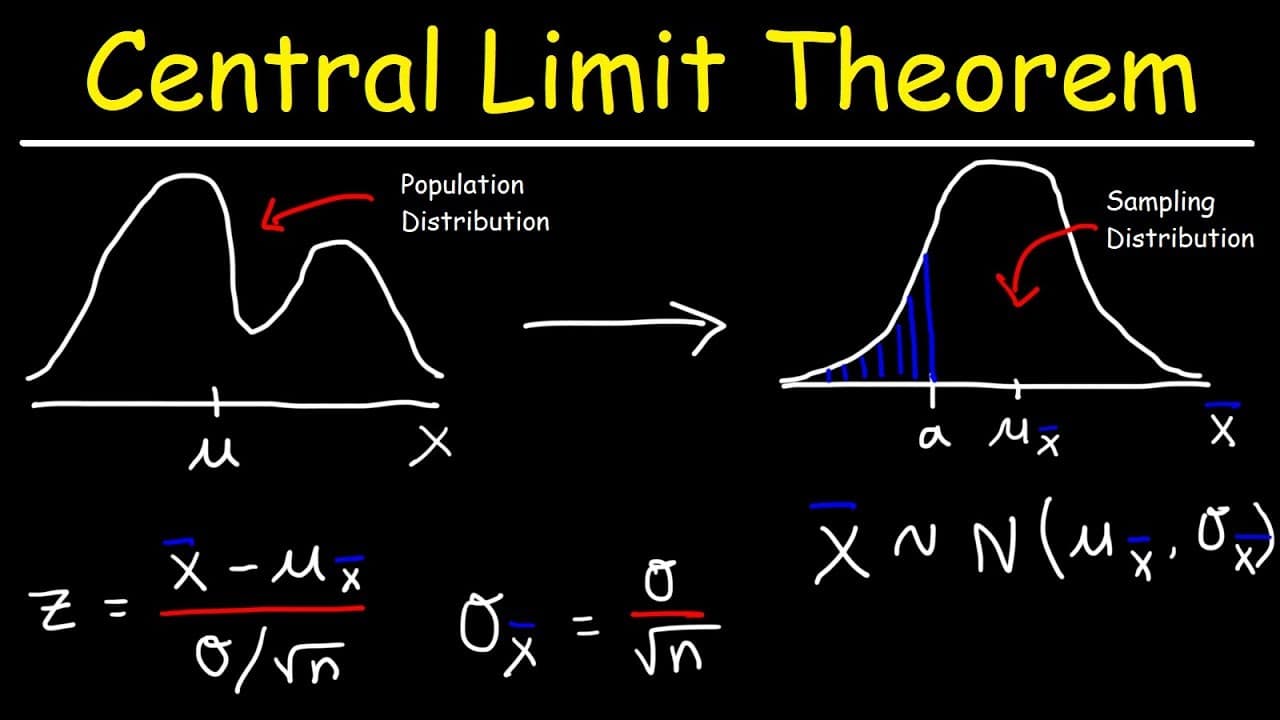
The central limit theorem states that the distribution of sample means will approximate a normal distribution, regardless of the population's shape, as long as the sample size is sufficiently large (typically n ≥ 30). This allows for easier statistical analysis and probability calculations using techniques like the Z-score and normal distribution tables.
Transcript
in this video we're gonna talk about the central limit theorem so what is the central limit theorem the basic idea behind the central limit theorem is this let's say we collect samples of size n from a population and then we calculate the mean of each of those samples and then plot those means on a histogram the histogram will approximate a normal ... Read More
Key Insights
- ⛔ The central limit theorem states that the distribution of sample means approximates a normal distribution, regardless of the shape of the population distribution.
- ❓ The standard deviation of the sample means is inversely related to the sample size - as the sample size increases, the standard deviation decreases.
- 🌂 The law of large numbers states that as the sample size increases, the sample mean gets closer to the population mean.
- 🤪 The formula for calculating Z-score differs for population and sampling distributions.
Install to Summarize YouTube Videos and Get Transcripts
Explore YouTube Video Summarizer or Get YouTube Transcript Extractor
Questions & Answers
Q: What is the central limit theorem?
The central limit theorem states that the distribution of sample means, calculated from samples taken from any population, will approximate a normal distribution.
Q: How does the shape of the population distribution affect the shape of the sampling distribution?
If the population distribution already has a normal shape, the sampling distribution will also have a normal shape. If the population distribution has a different shape, the sampling distribution will approximate a normal distribution if the sample size is large enough (usually n>30).
Q: What is the difference between the standard deviation of a sample and the standard deviation of a sampling distribution?
The standard deviation of a sample represents the variability within a single sample. The standard deviation of a sampling distribution represents the variability among the means of multiple samples.
Q: How does the sample size affect the shape and accuracy of the sampling distribution?
As the sample size increases, the shape of the sampling distribution becomes narrower and taller, with less spread in the data. This results in a better estimate of the population mean and increased accuracy.
Summary & Key Takeaways
-
The central limit theorem states that if you collect samples from a population and calculate the mean of each sample, the distribution of these means will approximate a normal distribution.
-
This approximation holds true for any population distribution, regardless of its shape, as long as the sample size is sufficiently large.
-
The standard deviation of the sample means decreases as the sample size increases, resulting in a narrower and taller distribution.
Read in Other Languages (beta)
Share This Summary 📚
Summarize YouTube Videos and Get Video Transcripts with 1-Click
Try YouTube Summary with ChatGPT & Claude or YouTube Transcript Generator
Explore More Summaries from The Organic Chemistry Tutor 📚



Summarize YouTube Videos and Get Video Transcripts with 1-Click
Try YouTube Summary with ChatGPT & Claude or YouTube Transcript Generator