How to Solve a System of Equations with 4 Variables using Gaussian Elimination
TL;DR
To solve a system of equations with four variables using Gaussian elimination, convert the equations into an augmented matrix and apply row operations to achieve row echelon form. Once in this form, you can derive the variable values by back-substitution from the simplified matrix.
Transcript
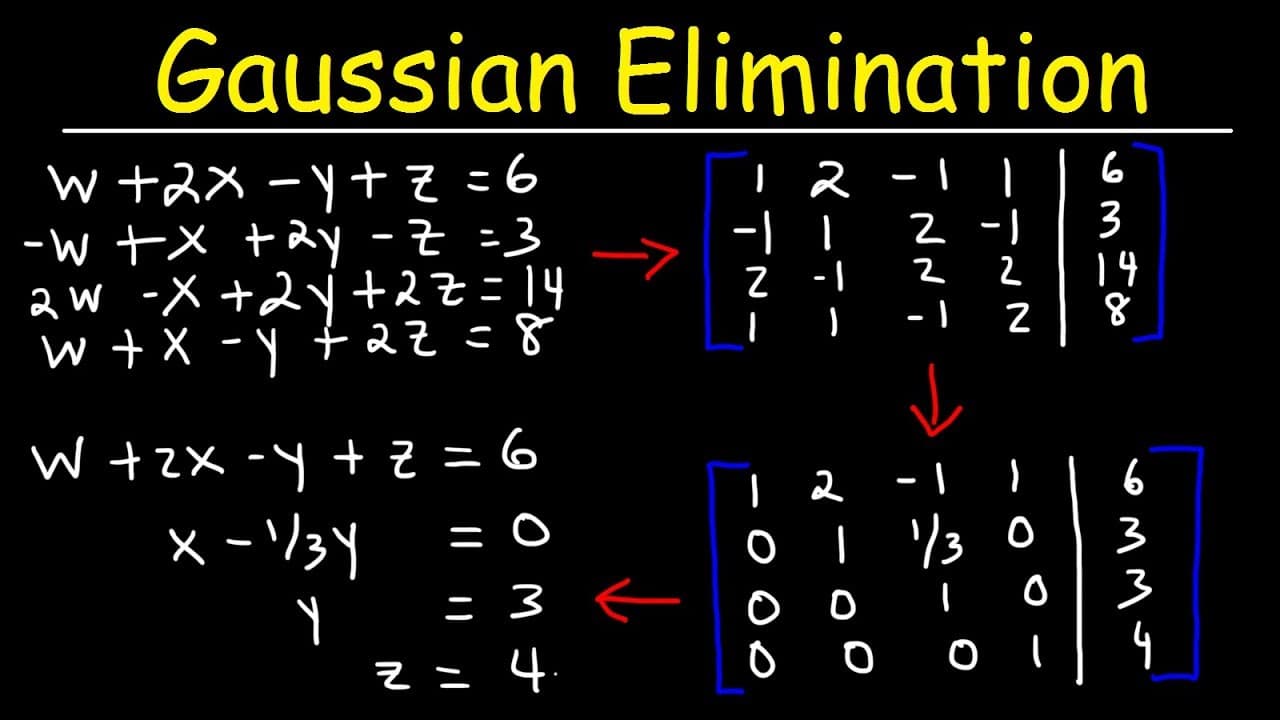
in this lesson we're going to use the gaussian elimination to solve a system of equations with four variables so we're going to have w plus 2x minus y plus z and that's going to equal six and then negative w plus x plus two y minus z and that's going to equal 3 and then we're going to have 2w minus x plus 2y plus 2z and let's say that's equal to 14... Read More
Key Insights
- 🆘 Gaussian elimination helps simplify a system of equations by transforming it into an augmented matrix.
- 🤨 Row operations are performed on the augmented matrix to create zeros below the main diagonal and simplify the matrix further.
- 🤨 Converting the matrix into row echelon form allows for the direct calculation of variable values.
- 🆘 The process of converting back to the system of equations helps in obtaining the final solution.
- ❓ Gaussian elimination is a powerful technique for solving systems of equations with multiple variables.
- 🤨 Attention to detail and accuracy in performing row operations is crucial to ensure accurate results.
- 🥺 Gaussian elimination reduces the complexity of solving systems with multiple variables, leading to quicker solutions.
Install to Summarize YouTube Videos and Get Transcripts
Explore YouTube Video Summarizer or Get YouTube Transcript Extractor
Questions & Answers
Q: How does Gaussian elimination help in solving a system of equations with four variables?
Gaussian elimination is a method that transforms the system's equations into an augmented matrix, allowing for systematic elimination of variables through row operations. It simplifies the equations, making them easier to solve.
Q: What is the purpose of converting the augmented matrix into row echelon form?
Converting the augmented matrix into row echelon form simplifies the system of equations further by ensuring a simplified structure where zeros are present below the main diagonal. This form makes it easier to obtain the values of the variables.
Q: What are the steps involved in Gaussian elimination?
The steps include converting the system of equations into an augmented matrix, performing row operations to eliminate variables and obtain zeros, converting back to a system of equations, and finally calculating the values of the variables.
Q: How can row echelon form be identified in the matrix?
Row echelon form is characterized by zeros below the main diagonal and leading entry in each row is to the right of the leading entry in the row above it. This structure allows for simpler calculations to find the variable values.
Q: Can Gaussian elimination be used for systems with a different number of variables?
Yes, Gaussian elimination is a general method that can be applied to systems with any number of variables. The process remains the same, but the dimensions of the augmented matrix will change accordingly.
Summary & Key Takeaways
-
The content explains how to solve a system of equations with four variables using Gaussian elimination.
-
It demonstrates the process of converting the equations into an augmented matrix and performing row operations to eliminate variables and obtain zeros.
-
The steps are illustrated with detailed explanations for each operation, showing how the matrix is reduced to row echelon form.
-
After achieving the row echelon form, the matrix is converted back into a system of equations, and the values of the variables can be calculated.
Read in Other Languages (beta)
Share This Summary 📚
Summarize YouTube Videos and Get Video Transcripts with 1-Click
Try YouTube Summary with ChatGPT & Claude or YouTube Transcript Generator
Explore More Summaries from The Organic Chemistry Tutor 📚


Summarize YouTube Videos and Get Video Transcripts with 1-Click
Try YouTube Summary with ChatGPT & Claude or YouTube Transcript Generator