How to Implement Stable Diffusion in Tiny Grad
TL;DR
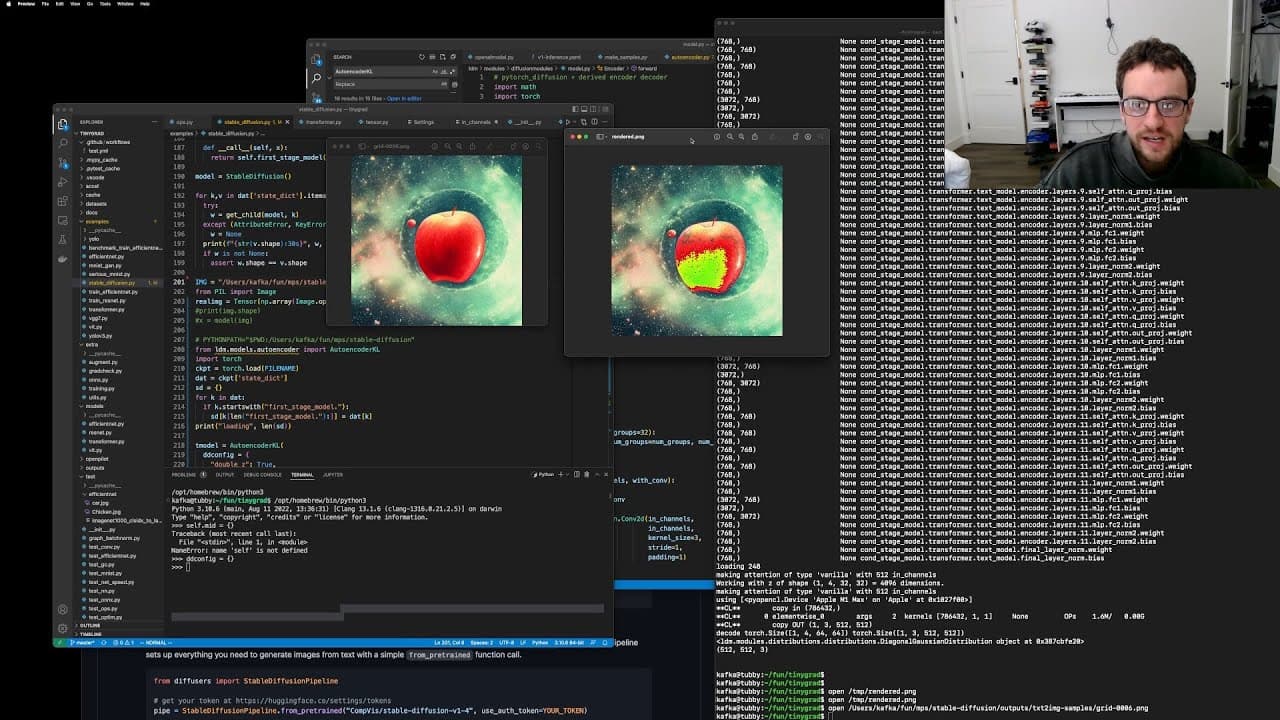
To implement stable diffusion using Tiny Grad, start by setting up your environment and downloading the required weights. Then, build the necessary components, including the encoder, decoder, and attention blocks, while systematically debugging any issues that arise during the process.
Transcript
twitch to good morning good morning all right I played with a little before the stream but I thought I would start fresh for you guys uh I just wanted to check the feasibility of this and honestly I have no idea if it's gonna happen so if it doesn't happen I'm a liar I'm a fucking liar who am I I'm only 25 can't remember half the time that I've bee... Read More
Key Insights
- ❓ Stable diffusion is a technique used in deep learning to denoise images and learn data distributions gradually.
- 🏛️ The implementation of stable diffusion in Tiny Grad requires building components such as the encoder, decoder, and attention blocks.
- 🥳 Debugging and troubleshooting are essential parts of the implementation process to overcome bugs and challenges.
- 🎙️ More videos with George Hotz:
Install to Summarize YouTube Videos and Get Transcripts
Explore YouTube Video Summarizer or Get YouTube Transcript Extractor
Questions & Answers
Q: What is the main objective of the streamer in this content?
The streamer's main objective is to implement stable diffusion in Tiny Grad and deep learning, using it as an opportunity to learn and share their progress with the audience.
Q: What are some of the challenges faced by the streamer during the implementation?
The streamer faces challenges such as incorrect shapes in tensors, missing code for some components, and slow computation speed.
Q: What is the purpose of the encoder and decoder in stable diffusion?
The encoder and decoder are components of stable diffusion that respectively reduce the dimensionality of the input image and restore it to its original shape after the diffusion process.
Q: How does the streamer handle bugs and challenges encountered during the implementation?
The streamer debugs the code by using print statements, checking the shapes of tensors, and making necessary adjustments to the code to resolve any issues.
Summary & Key Takeaways
-
The content begins with the streamer explaining their goal of implementing stable diffusion in Tiny Grad for deep learning.
-
They start by setting up the environment and downloading the necessary weights for stable diffusion.
-
The streamer goes through the code step by step, discussing different components such as the encoder, decoder, and attention blocks.
-
They face some challenges and bugs along the way but continue to debug and make progress.
Read in Other Languages (beta)
Share This Summary 📚
Summarize YouTube Videos and Get Video Transcripts with 1-Click
Try YouTube Summary with ChatGPT & Claude or YouTube Transcript Generator
Explore More Summaries from george hotz archive 📚
Summarize YouTube Videos and Get Video Transcripts with 1-Click
Try YouTube Summary with ChatGPT & Claude or YouTube Transcript Generator