Atomic Radius - Basic Introduction - Periodic Table Trends, Chemistry
TL;DR
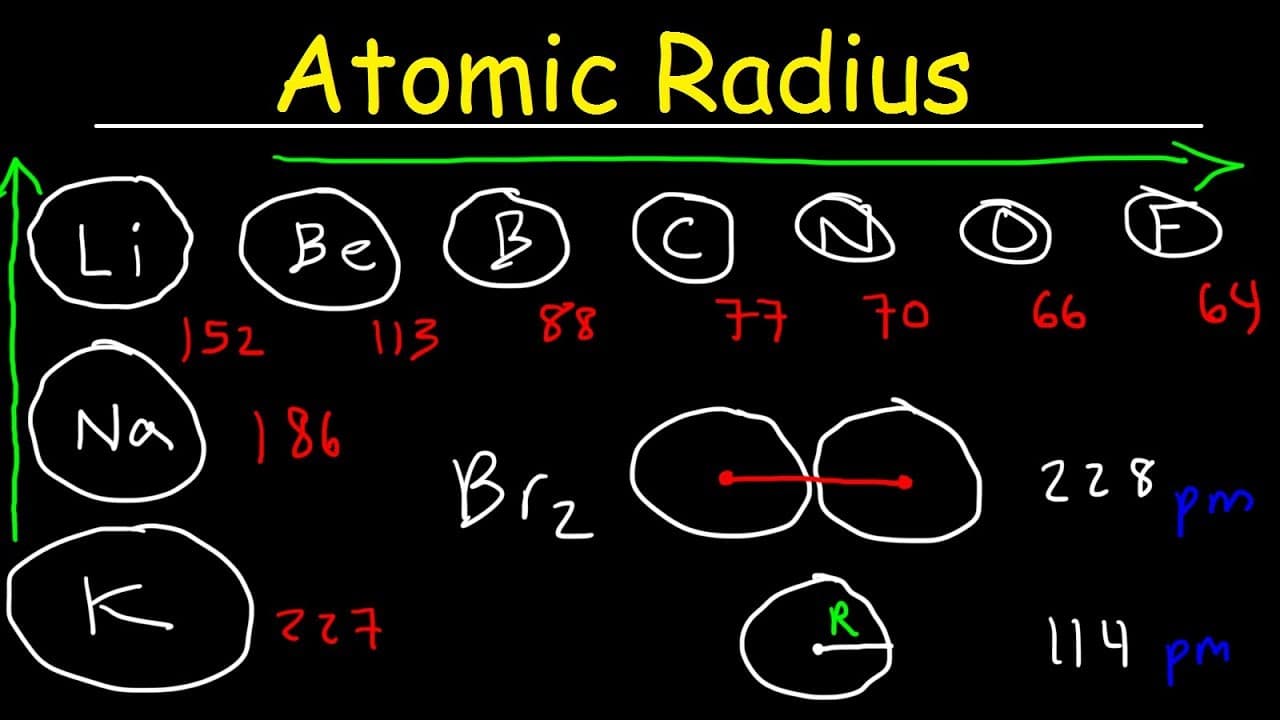
The atomic radius is the distance between the center and any edge of an atom, and it can be calculated based on the distance between nuclei in a molecule. As you move from left to right across the periodic table, the atomic radius generally decreases, while going down a group, the atomic radius increases.
Transcript
so let's talk about atomic radius what is the atomic radius of an atom well imagine drawing an atom as a circle and the radius of that circle is the distance between the center and any edge on a circle so therefore that's also the atomic radius of an atom now I'm gonna use bromine as an example now how do we go about calculating the atomic radius o... Read More
Key Insights
- 🫀 Atomic radius is the distance between the center and any edge of an atom and can be calculated based on the distance between nuclei in a molecule.
- 🗯️ The atomic radius generally decreases as you move from left to right across the periodic table.
- 🤪 Going down a group in the periodic table, the atomic radius increases.
- 🗯️ The increase or decrease in atomic radius is influenced by the effective nuclear charge, which increases from left to right in the periodic table but remains the same within a group.
- 🫀 The addition of energy levels (shells) in atoms leads to larger atomic radii as you go down a group.
- 😚 The effective nuclear charge has a stronger effect on the outer valence electrons, pulling them closer to the nucleus and decreasing the atomic radius.
- 🫀 Comparing the atomic radii of different elements can help determine the larger or smaller atom.
Install to Summarize YouTube Videos and Get Transcripts
Explore YouTube Video Summarizer or Get YouTube Transcript Extractor
Questions & Answers
Q: How is the atomic radius of an atom calculated?
The atomic radius of an atom can be calculated by taking half of the distance between the nuclei of two atoms in a molecule. For example, if the distance between the nuclei of bromine atoms in a molecule is 228 picometers, the atomic radius of one bromine atom would be 114 picometers.
Q: Why does the atomic radius decrease as you move from left to right in the periodic table?
As you move from left to right in the periodic table, the nuclear charge increases, resulting in a higher effective nuclear charge. This increased charge has a stronger effect on the outer valence electrons, pulling them closer to the nucleus and making the atomic radius smaller.
Q: Does the atomic radius increase or decrease as you go down a group in the periodic table?
The atomic radius increases as you go down a group in the periodic table. This is because the addition of energy levels (shells) in the atoms leads to larger orbital sizes, resulting in a larger atomic radius.
Q: How does the effective nuclear charge affect atomic size?
The effective nuclear charge plays a role in determining atomic size. As the effective nuclear charge increases (as you move from left to right in the periodic table), there is less shielding of the outer valence electrons, causing them to be pulled closer to the nucleus and decreasing the atomic radius.
Summary & Key Takeaways
-
Atomic radius is the distance between the center and any edge of an atom, and it can be calculated based on the distance between nuclei in a molecule.
-
As you move from left to right across the periodic table, the atomic radius generally decreases.
-
Going down a group in the periodic table, the atomic radius increases.
Read in Other Languages (beta)
Share This Summary 📚
Summarize YouTube Videos and Get Video Transcripts with 1-Click
Try YouTube Summary with ChatGPT & Claude or YouTube Transcript Generator
Explore More Summaries from The Organic Chemistry Tutor 📚


Summarize YouTube Videos and Get Video Transcripts with 1-Click
Try YouTube Summary with ChatGPT & Claude or YouTube Transcript Generator