Exploring Consciousness, Sensory Augmentation, The Lazy Susan Method of Productivity, and More
TL;DR
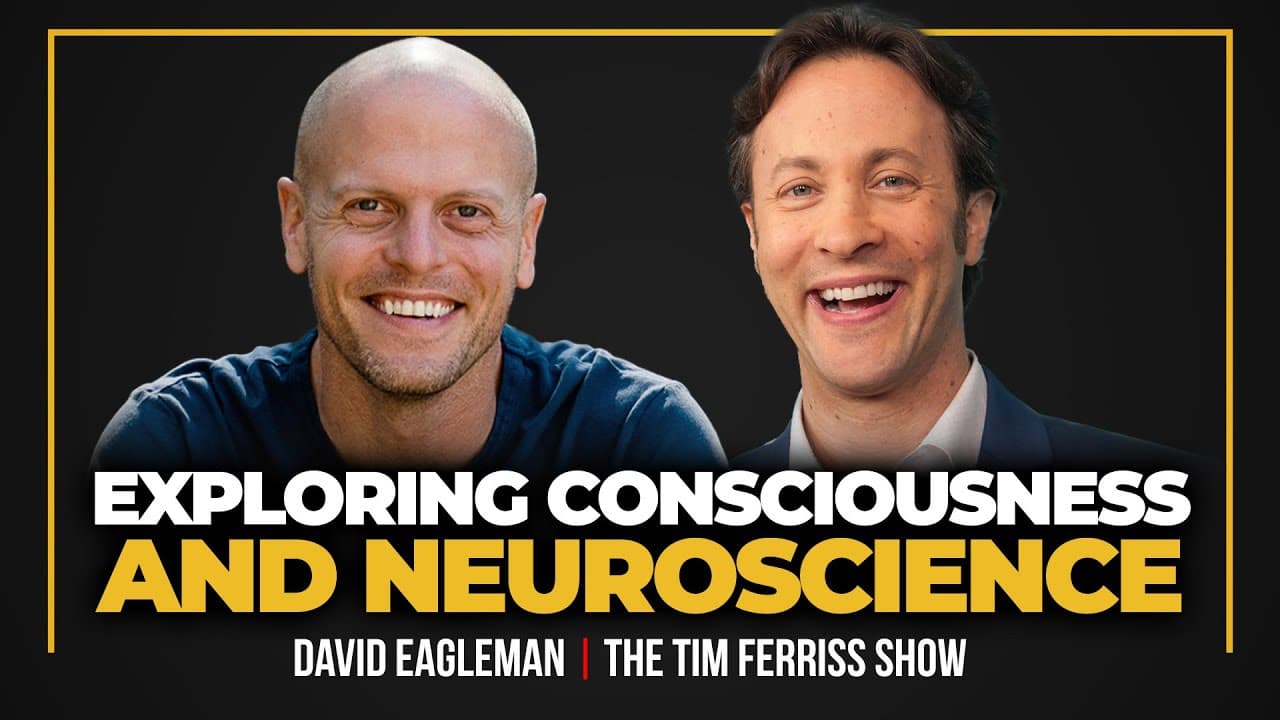
David Eagleman, a neuroscientist and author, discusses topics such as synesthesia, sensory addition, brain plasticity, and the nature of consciousness.
Transcript
Tim Ferriss: Hello, boys and girls, ladies and germs. This is Tim Ferriss. Welcome to another episode of The Tim Ferriss Show, where it is always my job to deconstruct world-class performers, to interview people who are very good at what they do, to find out what makes them tick, their influences, things you can use, that you can borrow f... Read More
Key Insights
- 😵 Synesthesia, where individuals experience cross-modal associations, provides a unique window into the extraordinary diversity of human perception.
- 💁 Sensory addition technology, such as vibratory devices, can enable individuals to perceive auditory information through touch, expanding the possibilities for enhancing human perception.
- 🛟 Dreams serve a function in defending the visual system against sensory takeover from other modalities during periods of darkness, preventing the encroachment of non-visual sensations.
- 👻 The plasticity of the brain allows for constant reconfiguration and adaptation, facilitating learning, memory, and the development of new skills.
Install to Summarize YouTube Videos and Get Transcripts
Explore YouTube Video Summarizer or Get YouTube Transcript Extractor
Questions & Answers
Q: What is synesthesia, and how does it affect the way individuals memorize information?
Synesthesia is a phenomenon where individuals experience associations between different stimuli, such as numbers and colors. For those with synesthesia, when they memorize information, such as numbers, they often create rich mental landscapes where various stimuli interact, aiding their memory recall.
Q: Can individuals acquire the ability of mnemonists through training?
Yes, individuals can develop mnemonist-like abilities through training, regardless of whether they have congenital synesthesia or not. Mnemonists often use spatial associations to remember sequences of information, such as numbers, by placing them within specific visual landscapes in their minds.
Q: How does sensory addition work, and what potential applications does it have?
Sensory addition involves using technology to feed information into the brain through non-traditional sensory channels. For example, wearable devices can convert sound into patterns of vibration on the skin, allowing deaf individuals to perceive sound through touch. Sensory addition has applications in areas such as hearing loss and tinnitus management, as well as enhancing human perception for various purposes like detecting infrared radiation or stock market data.
Q: Is consciousness an emergent property or a fundamental quality of the cosmos?
The nature of consciousness remains largely unknown, and there are different theories. One perspective suggests that consciousness is an emergent property that arises when complex systems, such as the human brain, reach a certain level of organization. Another perspective, known as panpsychism, proposes that consciousness is inherent in the fundamental fabric of the universe itself.
Summary & Key Takeaways
-
David Eagleman introduces himself and his diverse range of expertise, including neuroscience, writing, and filmmaking.
-
He explains the concept of synesthesia, where there is an association between one stimulus and another, such as numbers triggering color experiences.
-
Eagleman discusses his work on sensory addition, specifically developing new senses for humans through innovative technologies.
Read in Other Languages (beta)
Share This Summary 📚
Summarize YouTube Videos and Get Video Transcripts with 1-Click
Try YouTube Summary with ChatGPT & Claude or YouTube Transcript Generator
Explore More Summaries from The Tim Ferriss Show 📚






Summarize YouTube Videos and Get Video Transcripts with 1-Click
Try YouTube Summary with ChatGPT & Claude or YouTube Transcript Generator