What Are the Stages of Meiosis and Their Importance?
TL;DR
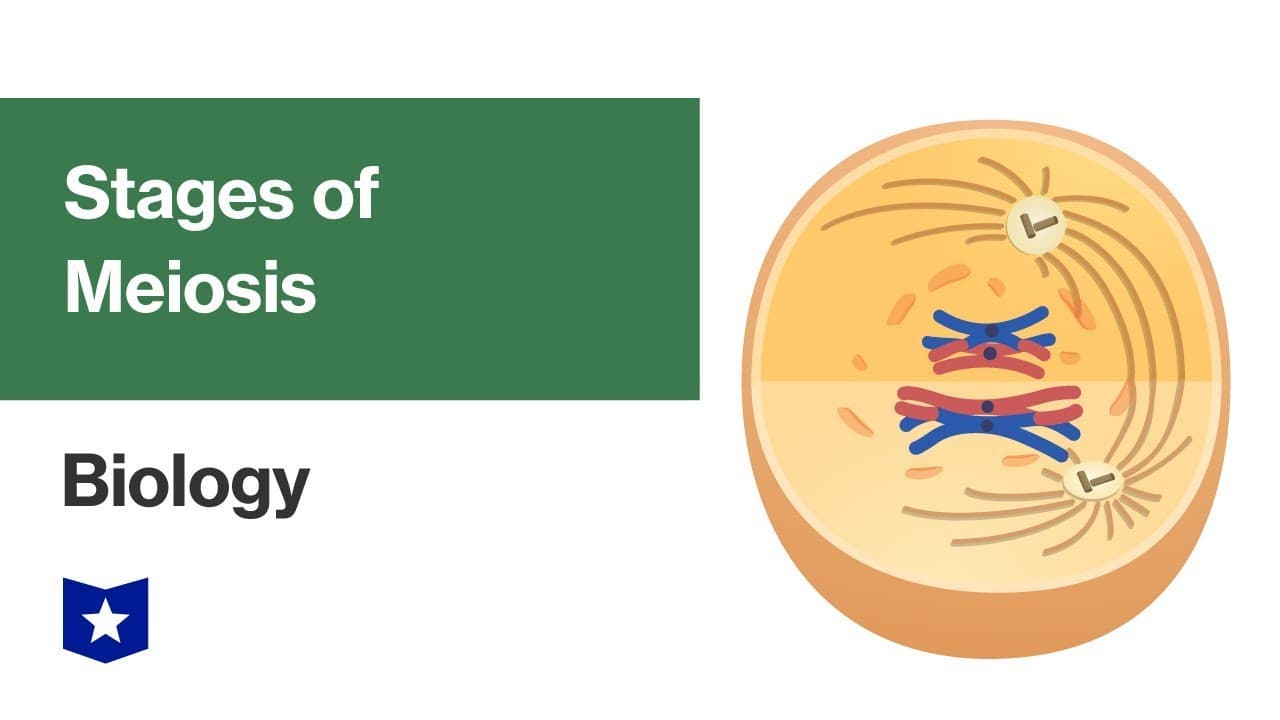
Meiosis consists of two rounds of cell division that produce four genetically unique haploid gametes from a diploid cell. This process is crucial for sexual reproduction, increasing genetic diversity through mechanisms like crossing-over during Prophase I. Each stage, including Prophase, Metaphase, Anaphase, and Telophase, plays a vital role in ensuring the correct distribution of chromosomes.
Transcript
I can pretty much guarantee that if you examine members of the same family it won't be too hard for you to notice for semblances between them unless a family has a set of identical twins though you wouldn't expect to see any two members looking identical even if a set of parents has 20 children the reason for this variation not only in the members ... Read More
Key Insights
- ❓ Meiosis is essential in sexual reproduction to ensure genetic diversity and the production of gametes.
- ➗ It involves two consecutive cell divisions, resulting in four haploid daughter cells.
- 🚸 Synapses and crossing-over contribute to genetic variation.
- #️⃣ Meiosis is distinct from mitosis, which produces identical daughter cells with the same number of chromosomes.
- ❓ Prophase I and metaphase I are crucial stages where homologous chromosomes pair up and align, respectively.
- ❓ Anaphase I and II involve the separation of chromosome pairs and sister chromatids.
- 🥺 Telophase II and cytokinesis lead to the formation of four haploid daughter cells.
Install to Summarize YouTube Videos and Get Transcripts
Explore YouTube Video Summarizer or Get YouTube Transcript Extractor
Questions & Answers
Q: What is the difference between mitosis and meiosis?
While both involve cell division, mitosis occurs in somatic cells and results in identical daughter cells with the same number of chromosomes. Meiosis, on the other hand, occurs in germ cells and produces genetically unique gametes with half the number of chromosomes.
Q: How does meiosis increase genetic diversity?
Meiosis increases genetic diversity through processes like synapses and crossing-over. Synapses pair up homologous chromosomes, while crossing-over results in the exchange of DNA between chromatids. These processes create new combinations of genetic material in the gametes.
Q: What happens during metaphase I of meiosis?
During metaphase I, homologous pairs of chromosomes line up along the equator of the cell, attached to spindle fibers. This alignment allows for independent assortment and further contributes to genetic diversity.
Q: How many daughter cells are produced in meiosis?
Meiosis produces four daughter cells. Each of these cells is haploid, containing half the number of chromosomes as the original diploid cell. These daughter cells are genetically unique due to crossing-over in prophase I.
Summary & Key Takeaways
-
Meiosis is the process of cell division that produces gametes, which are sex cells with half the number of chromosomes compared to the parent cell.
-
Unlike mitosis, meiosis involves two consecutive divisions, resulting in four haploid daughter cells.
-
Meiosis increases genetic diversity through processes like synapses and crossing-over.
Read in Other Languages (beta)
Share This Summary 📚
Summarize YouTube Videos and Get Video Transcripts with 1-Click
Try YouTube Summary with ChatGPT & Claude or YouTube Transcript Generator
Explore More Summaries from Course Hero 📚


Summarize YouTube Videos and Get Video Transcripts with 1-Click
Try YouTube Summary with ChatGPT & Claude or YouTube Transcript Generator