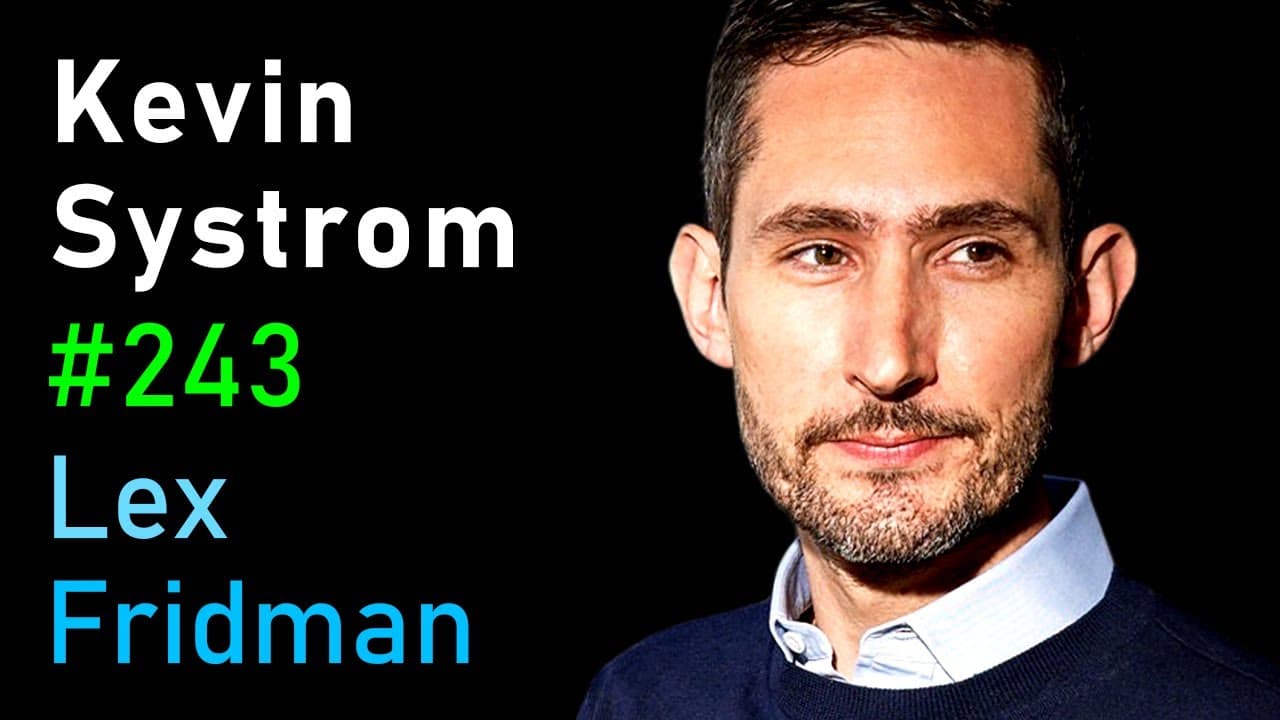
Kevin Systrom: Instagram | Lex Fridman Podcast #243
TL;DR
Kevin Systrom is Instagram’s co-founder and longtime CEO, including for six years after Facebook acquired the company. On the Lex Fridman Podcast #243, he explains how the unsuccessful check-in app Burbn became Instagram after usage data showed that people most valued sharing photos. Read on to learn how rapid iteration helped the team find product-market fit.
Transcript
the following is a conversation with kevin systrom co-founder and long-time ceo of instagram including for six years after facebook's acquisition of instagram this is the lex friedman podcast to support it please check out our sponsors in the description and now here's my conversation with kevin systrom at the risk of uh asking the rolling stones t... Read More
Key Insights
- Instagram originated from a pivot of a check-in app called Burbn, focusing on photo sharing.
- User feedback and data analysis were crucial in identifying the features that mattered most.
- Instagram's success was partly due to its simplicity and focus on real-time photo sharing.
- Filters were introduced to enhance low-quality photos, leaning into an artistic style.
- The decision to sell Instagram to Facebook was influenced by the potential for rapid growth.
- Scaling challenges were addressed by leveraging Facebook's resources post-acquisition.
- Kevin Systrom emphasizes the importance of understanding product-market fit over early scaling.
- The conversation highlights the emotional and strategic complexities of selling a startup.
Install to Summarize YouTube Videos and Get Transcripts
Explore YouTube Video Summarizer or Get YouTube Transcript Extractor
Questions & Answers
Q: Who is Kevin Systrom?
Kevin Systrom is the co-founder and longtime CEO of Instagram. He remained CEO for six years after Facebook acquired Instagram.
Q: How did Kevin Systrom come up with Instagram?
Systrom initially created a check-in app called Burbn, spelled B-U-R-B-N. When people showed little interest in it, the founders examined what users valued and found that photo sharing was the strongest feature.
Q: What was Burbn before it became Instagram?
Burbn was designed as a check-in service competing with apps such as Foursquare, Gowalla, and Hot Potato. It included the option to post a photo from a location, but users did not find the overall product different enough.
Q: Why did Burbn pivot to photo sharing?
The founders listed three parts of Burbn that users uniquely liked, and photos ranked first. Their usage data showed that people particularly enjoyed sharing a photo of what they were doing and where they were.
Q: How was Instagram different from Facebook and Twitter in 2010?
Systrom says Facebook was oriented toward posting albums from events such as a vacation taken weeks earlier. Twitter allowed photos, but its feed was primarily text and did not show photos inline at the time, as he recalls.
Q: Why does Kevin Systrom describe Instagram as a photo check-in app?
Instagram let people communicate what they were doing and where they were through a photo. Systrom says it replaced the model of stating a location first and adding a photo only as an optional extra.
Q: How did early user data shape Instagram?
The team released its service to about one hundred people and examined what they shared and what resonated. When users preferred one behavior over the feature the founders expected, the company shifted toward the behavior supported by the data.
Q: What product-market fit lesson does Kevin Systrom share?
Systrom says companies must test ideas, identify how they are wrong, and adjust in the right direction. Learning too slowly can leave a company committed to an idea contradicted by data, while learning too quickly can cause it to chase ideas without settling on one.
Summary
In this video conversation with Kevin Systrom, co-founder and former CEO of Instagram, he discusses the origin story of Instagram and how it evolved into a successful photo-sharing app. He talks about the importance of product-market fit, the challenges they faced in scaling the app, and the role of community in their success. Systrom also shares insights on the technical aspects of building and scaling Instagram, including the programming languages and tools they used.
Questions & Answers
Q: What was the origin story of Instagram?
Instagram started out as a company called Bourbon, with the idea of creating a better version of check-in apps like Foursquare. However, the initial concept didn't gain traction, so they pivoted to focus on photo sharing. They realized that people loved sharing photos of what they were doing and where they were, and that became the foundation of Instagram.
Q: How did Instagram differentiate itself from other photo-sharing apps?
Instagram differentiated itself by focusing on making photos look artistic and unique. They introduced filters that transformed ordinary photos into more visually appealing ones. This approach resonated with users who were willing to share their not-so-great photos if they looked intentionally artistic.
Q: How did Instagram handle technical challenges in scaling the app?
In the early days, Instagram faced scalability challenges as the number of users grew rapidly. They relied on AWS for infrastructure and made sure their code was designed to easily spread across multiple instances. They also hired experienced people who had previous experience with scaling startups. Additionally, they wrote tests from the beginning, which helped them move quickly when rewriting parts of the product.
Q: How did Instagram build a community?
Instagram focused on creating a community of users who shared beautiful photos in a certain style. They connected people from around the world through their images, enabling users to discover and engage with photographers and influencers. By seeding the platform with content from compelling users, Instagram created a social network where people could connect over shared interests and visual experiences.
Q: When did Instagram achieve product-market fit?
Product-market fit is not about reaching a specific number of users but about finding a market where the product resonates and retains users. Instagram achieved product-market fit when they started seeing consistent growth in user cohorts and positive retention metrics. It was a matter of finding the right user experience and engagement that kept people coming back to the app.
Q: How much did Instagram focus on monetization early on?
The focus on monetization depends on the nature of the business. For Instagram, which started as a social network, their initial focus was on finding product-market fit and building a strong user base. However, having a clear plan for monetization is important for long-term sustainability. While some startups may have a roadmap to profitability, others may struggle if they don't have a viable monetization strategy.
Q: What programming languages and tools did Instagram use?
Instagram used Objective-C for the client-side app development and Python with the Django framework for the backend. They also utilized Postgres as their database and Redis for solving certain technical challenges. These choices were made based on the available technologies at the time and the specific needs of the application.
Q: How did Instagram handle technical scalability issues with limited resources?
Instagram faced technical scalability challenges early on but managed to handle them with their limited resources. They focused on optimizing their code to make it performant and scalable. They also relied on AWS infrastructure for scaling the app and hired experienced professionals who had expertise in scaling startups.
Q: Did Instagram prioritize performance and latency in the early stages?
Yes, Instagram prioritized performance and latency from the beginning. They focused on delivering a fast and smooth user experience by optimizing image processing, reducing latency in photo uploads, and leveraging background loading of user data. They were able to hide certain latency issues by using clever strategies and optimizations.
Q: How did Instagram build a strong community of users?
Instagram built a strong community by allowing users to connect with each other through shared interests and visually appealing content. They made it easy for users to discover and engage with photographers and influencers, which created a sense of community around beautiful and artistic images. Additionally, Instagram's international appeal and language support played a role in fostering a diverse and global community.
Takeaways
The origin story of Instagram showcases the importance of finding product-market fit and adapting the product to meet user needs. Kevin Systrom emphasizes that startups should prioritize building a product that people love before worrying about technical scalability or monetization. By focusing on user experience, community building, and continuous iteration based on data, startups can increase their chances of achieving success. Additionally, leveraging available technologies, optimizing code, and making strategic hiring decisions are key factors in managing technical scalability challenges.
Summary & Key Takeaways
-
Instagram began as a pivot from a check-in app called Burbn, focusing on the unique appeal of real-time photo sharing. The founders identified that users loved sharing photos and leaned into this by adding filters to enhance the aesthetic appeal of low-quality mobile photos. This focus on simplicity and immediate sharing set Instagram apart, leading to rapid user growth.
-
Kevin Systrom discusses the challenges and decisions involved in scaling Instagram, including the pivotal choice to sell to Facebook. He emphasizes the importance of understanding user behavior and iterating quickly to find product-market fit. The acquisition by Facebook provided the resources needed to scale Instagram globally, but also posed challenges in maintaining its original vision.
-
The conversation also touches on broader themes of entrepreneurship, such as the emotional complexities of selling a startup and the importance of creating products that resonate with users. Systrom reflects on the lessons learned from Instagram's journey, highlighting the need for strategic decision-making and adaptability in the fast-paced tech industry.
Read in Other Languages (beta)
Share This Summary 📚
Summarize YouTube Videos and Get Video Transcripts with 1-Click
Try YouTube Summary with ChatGPT & Claude or YouTube Transcript Generator
Explore More Summaries from Lex Fridman Podcast 📚






Summarize YouTube Videos and Get Video Transcripts with 1-Click
Try YouTube Summary with ChatGPT & Claude or YouTube Transcript Generator