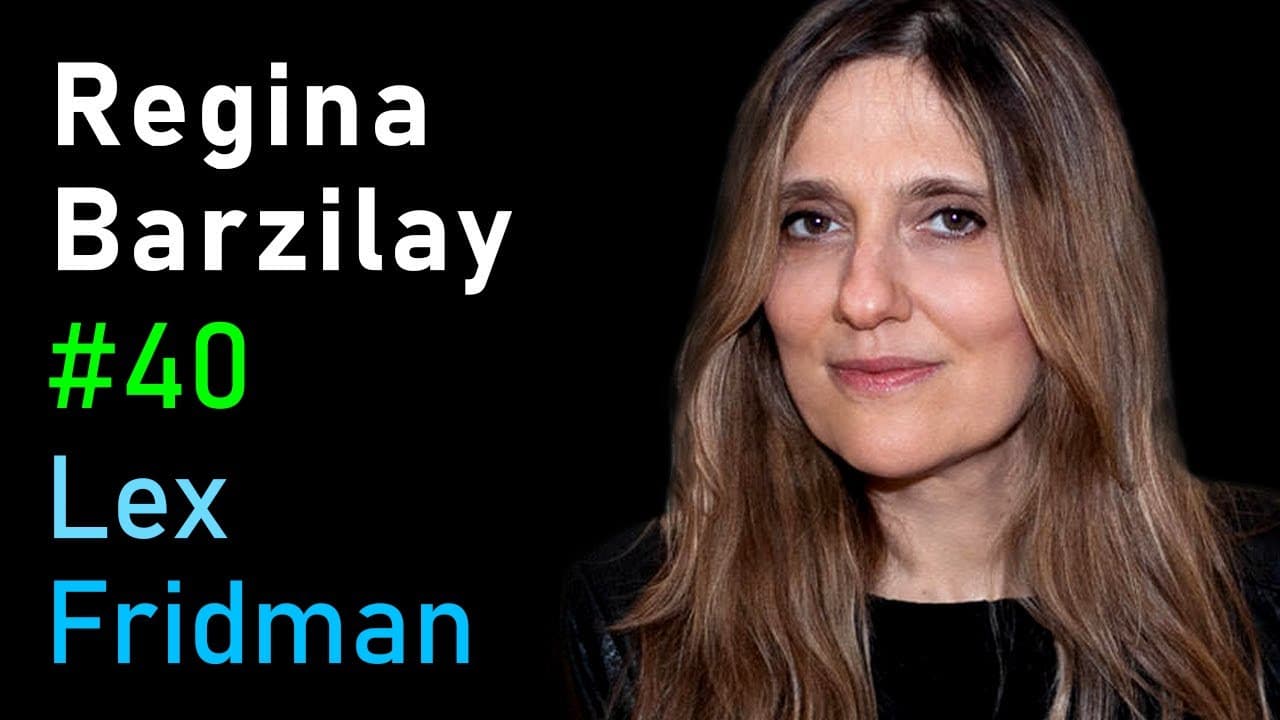
Regina Barzilay: Deep Learning for Cancer Diagnosis and Treatment | Lex Fridman Podcast #40
TL;DR
MIT professor Regina Bardsley discusses the profound impact of books on her understanding of the world and how deep learning can revolutionize the fields of science and healthcare, particularly in the early detection and treatment of cancer.
Transcript
the following is a conversation with Regina Bardsley she's a professor at MIT and a world-class researcher in natural language processing and applications of deep learning to chemistry and oncology or the use of deep learning for early diagnosis prevention and treatment of cancer she has also been recognized for teaching of several successful AI re... Read More
Key Insights
- 🖐️ Books, such as "The Emperor of All Maladies" and "Americana," have played a significant role in shaping Professor Bardsley's understanding of scientific processes and cultural adaptation.
- 🖐️ Personalities and dedication play a crucial role in the implementation and adoption of scientific ideas.
- 🎰 Machine learning can greatly improve early detection and prediction in healthcare, particularly in diseases like cancer, but regulatory and implementation challenges remain.
- 💨 The current state of machine learning in healthcare focuses on improving diagnostic accuracy and drug design, but there is still a long way to go in fully understanding complex biological systems.
Install to Summarize YouTube Videos and Get Transcripts
Explore YouTube Video Summarizer or Get YouTube Transcript Extractor
Questions & Answers
Q: How did the book "The Emperor of All Maladies" change Professor Bardsley's perspective on the scientific process?
Professor Bardsley explains that the book highlighted the imprecise nature of the discovery process in cancer treatment and the importance of dedication and implementation in scientific progress.
Q: How did the book "Americana" impact Professor Bardsley's understanding of cultural adaptation and personal experiences?
Professor Bardsley shares how the book made her reflect on her own experiences moving from different countries and gave her a new lens to view different events and interactions.
Q: According to Professor Bardsley, what is the role of personalities in scientific progress?
Professor Bardsley believes that personalities and devotion to ideas play a crucial role in driving scientific progress, particularly at a local level, where implementation and adoption of ideas are key.
Q: How does Professor Bardsley view the current state of understanding the human body and the potential for manipulating it to cure diseases?
Professor Bardsley highlights the difference between mechanistic understanding and probabilistic matching in computer science and suggests that, while mechanistic understanding is the traditional approach in biology and medicine, probabilistic matching through machine learning can be a powerful tool for early diagnosis and treatment.
Summary
In this conversation with Regina Bardsley, a professor at MIT and expert in natural language processing and deep learning, they discuss the impact of books and ideas outside of computer science on her life, the role of personalities in scientific progress, the challenges in understanding the human body and biology, the use of machine learning in cancer diagnosis and treatment, and the obstacles in gathering and sharing large data sets for medical research. They also touch on the role of AI in drug discovery and the complexities within the healthcare system that hinder adoption of new technologies.
Questions & Answers
Q: Are there books or ideas that have had a profound impact on your life journey?
As a researcher spending most of my time at MIT, books have played a significant role in shaping my understanding of the world. One book that stands out is "The Emperor of All Maladies" by Siddhartha Mukherjee. It provided insights into the history of cancer treatments and the imperfections of scientific discovery. It made me realize the importance of not only having strong ideas but also the devotion to seeing them implemented.
Q: Can you share another book that has impacted your thinking?
Sure! Another book that I found influential is "Americanah" by Chimamanda Ngozi Adichie. It tells the story of a young African woman studying in the United States and explores themes of cultural adaptation and personal transformation. Reading this book made me reflect on my own experiences moving between countries and opened my eyes to different perspectives on events, even some that I may not have paid attention to before.
Q: In the interview, you mentioned that personalities of human beings are more important than ideas. Can you elaborate on that?
It's not that personalities are more important than ideas, but rather that, at a local level, the personalities and devotion of individuals can have a significant impact on the progress of ideas. This is particularly true in the field of AI, where certain individuals have been able to push forward their ideas and shape the academic landscape. For example, in the area of natural language processing, the adoption of statistical methods took a long time due to the skepticism of some personalities in the field. So while ideas are important, it is often the personalities and their dedication that drive change on a smaller scale.
Q: What did you learn from reading "The Emperor of All Maladies" about the process of cancer treatment and drug development?
Reading this book shed light on the imprecise and imperfect nature of the discovery process in science, particularly in the development of cancer treatments. It highlighted the challenges and mistakes that have been made along the way, such as experiments leading to the death of patients. This made me realize that our current solutions are not perfect and that the success of implementing scientific ideas often depends not just on the strength of the idea itself, but also on the determination of individuals to see it through.
Q: From a computer scientist's perspective, how far along are we from understanding the human body and being able to manipulate it to cure diseases like cancer?
Understanding the human body and biology is a complex task, and as computer scientists, we have been successful in AI domains because we don't necessarily need to fully understand the systems we're working with. In the field of healthcare, there is a lot of emphasis on mechanistic understanding, which can be challenging given the complexity of the human body. While deterministic understanding may be beyond our capacity, we can still make progress by leveraging probabilistic matching processes and utilizing machine learning to aid in early diagnosis, treatment, and drug discovery. So, we may not achieve a complete understanding, but we can still make significant advancements.
Q: Is early detection crucial in improving cancer outcomes, and how can machine learning contribute to this?
Early detection plays a crucial role in improving cancer outcomes. Machine learning can help in this area by utilizing various data sources, such as imaging and other tests, to predict the likelihood of developing cancer. For example, machine learning models can be trained to analyze mammograms and other medical images to identify early signs of cancer. By integrating different data points and patterns, these models can provide more accurate predictions and help in early intervention and treatment. Early detection is crucial because it allows for more effective utilization of existing treatments and increases the chances of successful intervention.
Q: What are the challenges in gathering large data sets for medical research, especially in the field of oncology?
Access to large data sets in the medical field, especially in oncology, can be challenging due to several factors. Firstly, there are regulatory challenges related to patient privacy and data protection. Hospitals are legally responsible for patient data and need to ensure that it is not misused or compromised. Secondly, there are concerns about data ownership and the potential misuse of personal information. These concerns make hospitals cautious about sharing data with researchers. Finally, the process of obtaining data can be time-consuming and arduous, involving interactions with individual hospitals and navigating their administrative processes. These factors combined make it difficult to gather large data sets, hindering research progress in the field.
Q: Are there any open problems in the application of machine learning to oncology, particularly in the areas of cancer detection and drug design?
There are several open problems in the application of machine learning to oncology. One of them is improving cancer detection. While significant progress has been made in utilizing machine learning for early diagnosis, there is still room for improvement, especially in terms of accuracy and reliability. Another open problem lies in drug design. Currently, there are no drugs developed solely with the help of machine learning, and there is a need to explore how ML models can aid in the design of new molecules and improve the drug discovery process. This area requires innovative approaches and the ability to work with complex data structures, such as graphs. Advancements in these areas have the potential to make a significant impact on cancer diagnosis and treatment.
Q: What is the role of individuals, such as doctors, hospitals, governments, and patients, in driving the adoption of machine learning and AI in healthcare?
The adoption of machine learning and AI in healthcare requires collaboration and effort from various stakeholders. Doctors and hospitals play a crucial role in implementing these technologies and integrating them into existing healthcare systems. Governments and policymakers can create policies that support the use of AI in healthcare and ensure regulatory frameworks that protect patient privacy while encouraging data sharing. Lastly, patients, as consumers of healthcare services, have the power to advocate for the adoption of innovative technologies and demand access to their own data. Their involvement and awareness of the potential benefits of AI in healthcare can help drive change and push for the adoption of new technologies.
Q: How can privacy concerns and the potential misuse of data be addressed in the context of gathering and sharing large healthcare data sets?
Addressing privacy concerns and ensuring data security is a complex challenge. Technical solutions can help mitigate these concerns, such as de-identification techniques that remove personal identification from the data while retaining its utility. For example, medical images can be analyzed and processed in an encoded form that preserves patient privacy. However, technical solutions alone are not sufficient. Societal solutions are also necessary. This includes creating a system where patients have more control over their own data and can choose to share it for research purposes. Educating the public about the potential benefits of data sharing and fostering trust in the system are also crucial in alleviating privacy concerns and encouraging data sharing.
Q: When do you think we, as a civilization, will cure cancer? And what are the challenges in achieving this goal?
It is difficult to predict when exactly we will cure cancer as it is a complex and multifaceted problem. However, with advancements in machine learning and AI, we can make significant strides in early detection and more effectively utilizing existing treatments. The challenge lies not only in the technical aspects but also in the implementation and adoption of these advancements. Regulatory bodies and the medical establishment need to catch up and embrace these new technologies, which may take time. Overcoming the barriers to adoption and ensuring efficient implementation are crucial aspects to consider in our journey towards finding a cure for cancer.
Takeaways
Machine learning and AI have the potential to greatly impact the field of oncology, particularly in early detection and drug design. However, challenges exist in gathering large data sets for research and ensuring patient privacy. Adoption of these technologies requires collaboration between doctors, hospitals, governments, and patients. Addressing privacy concerns and building trust in the system are essential for successful implementation. While curing cancer is a complex goal, advancements in AI and machine learning can contribute to improved outcomes and more personalized treatments. Efforts to accelerate progress should focus on both technical advancements and navigating the complexities of the healthcare system.
Summary & Key Takeaways
-
Professor Bardsley shares how books have shaped her worldview, specifically mentioning "The Emperor of All Maladies," which highlights the imperfect nature of the discovery process in cancer treatment and the importance of implementation.
-
She also discusses how the book "Americana" gave her a new perspective on cultural adaptation and personal experiences.
-
Bardsley emphasizes the significance of personalities and devotion in scientific progress and the need for a better understanding of scientific implementation.
Read in Other Languages (beta)
Share This Summary 📚
Summarize YouTube Videos and Get Video Transcripts with 1-Click
Try YouTube Summary with ChatGPT & Claude or YouTube Transcript Generator
Explore More Summaries from Lex Fridman Podcast 📚

Summarize YouTube Videos and Get Video Transcripts with 1-Click
Try YouTube Summary with ChatGPT & Claude or YouTube Transcript Generator