How Does the Fundamental Counting Principle Work?
TL;DR
The Fundamental Counting Principle finds the total number of possible outcomes by multiplying the number of choices available at each event. For example, Mike can form 12 outfits from 2 pants, 3 shirts and 2 pairs of boots because 2 × 3 × 2 = 12. The outfit, telephone-number and quiz examples below show how to identify events, account for restrictions and calculate the result.
Transcript
in this lesson we're going to talk about the fundamental counting principle this principle can help us to determine the total number of possible outcomes that can occur in a situation and the way we get this number is by multiplying the number of outcomes that occur for each event within that situation so let's look at this problem or situation tha... Read More
Key Insights
- Events determine multiplication factors: Each separate decision contributes one factor to the counting calculation. Mike's pants, shirt and boots are three events, while the quiz's four questions are four events. Correctly separating a situation into events is therefore the first step toward constructing the product that gives the total number of complete outcomes.
- Complete outcomes combine every event: An outfit is not counted after selecting only pants or only pants and a shirt. It becomes one complete outcome after pants, shirt and boots have all been chosen. The same structure applies to telephone numbers and quiz responses, where every required position or question must receive a choice.
- Choice order does not change totals: The outfit calculation appears first as 2 × 2 × 3 and later as 2 × 3 × 2. Both products equal 12 because they contain the same three choice counts. What matters is including one factor for each event, not the order in which those factors are written.
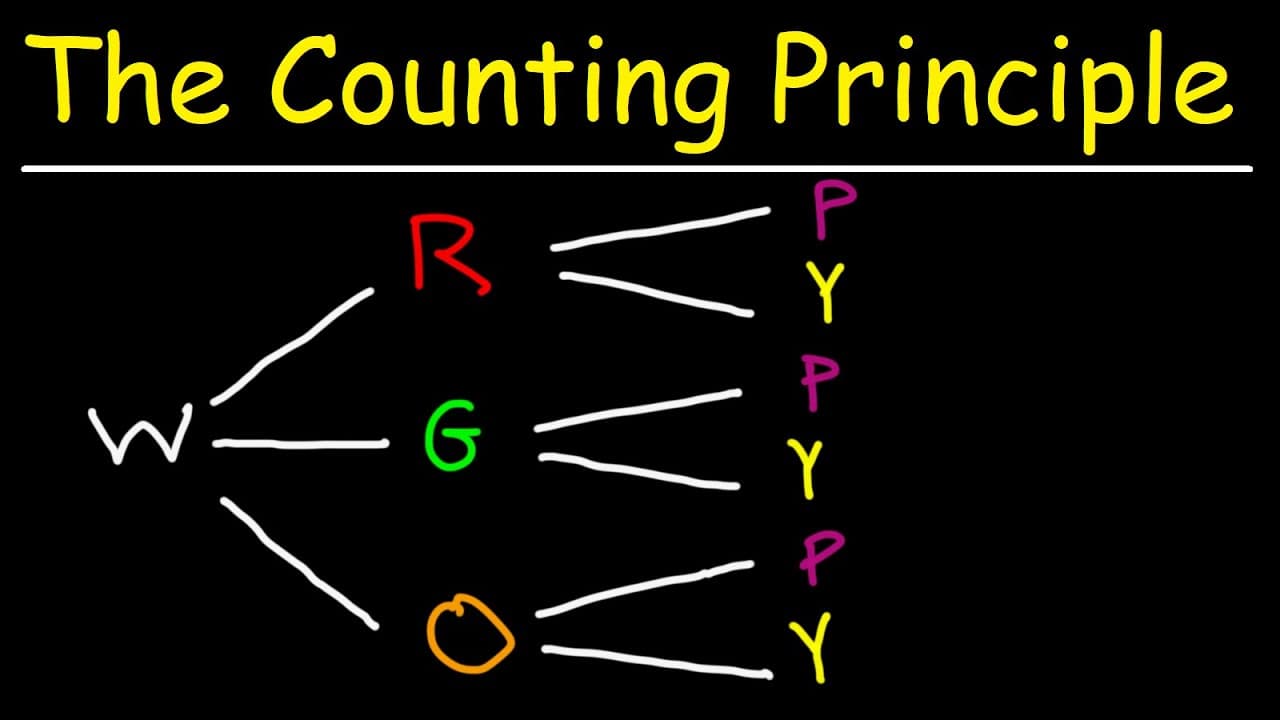
- Tree paths represent individual combinations: In the outfit tree, every route begins with white or black pants, continues to a red, green or orange shirt, and ends with purple or yellow boots. Each completed path corresponds to exactly one outfit. Counting those paths gives the same 12 outcomes obtained through multiplication.
- Branching explains the product: Each of the 2 pants choices branches into 3 shirt choices, creating 6 pants-and-shirt combinations. Each of those then branches into 2 boot choices, doubling the count to 12. The diagram therefore provides a visual explanation for multiplying 2 by 3 by 2.
- Restrictions reduce specific factors: A digit position normally has 10 choices because it can contain any number from 0 through 9. When 0 and 1 are prohibited at the beginning of an area code or local number, that position has only 8 choices. The restriction changes those factors without changing unrestricted positions.
- Telephone numbers contain two restricted starts: The example separates a telephone number into a three-digit area code and a seven-digit local number. The first digit of both parts cannot be 0 or 1. Those two positions contribute factors of 8, while all remaining digit positions contribute factors of 10.
- Exponents compress repeated factors: Repeated multiplication can be written more compactly with powers. In the telephone problem, the two restricted positions produce 8^2, while the unrestricted positions produce repeated factors of 10. In the quiz problem, four questions with 5 choices each are represented directly as 5^4.
- Scientific notation expresses large totals: The telephone-number product is simplified to 64 times a power of 10 and then rewritten as 6.4 × 10^9. Since 10^9 is a billion, the result is stated as 6.4 billion. This preserves the same count while presenting a large number compactly.
- Every quiz response is ordered: Answering A on the first question and B on the second represents a different response pattern from answering B first and A second. Each question is treated as its own event, even though every question offers the same 5 choices. That structure produces four separate factors of 5.
- Repeated choices create exponential growth: The quiz begins with 5 choices for one question, but adding the same number of choices across 4 questions gives 5^4 possibilities. The calculation is 5 × 5 × 5 × 5. Evaluating it as 25 × 25 gives 625 complete answer patterns.
- Verification can use two methods: The outfit example is solved algebraically by multiplying the counts and visually by listing branches in a tree diagram. Both methods produce 12. Agreement between the product and the complete list shows that the counting principle captures every allowed combination without requiring each outcome to be written individually.
Install to Summarize YouTube Videos and Get Transcripts
Explore YouTube Video Summarizer or Get YouTube Transcript Extractor
Questions & Answers
Q: How does the Fundamental Counting Principle work?
The Fundamental Counting Principle works by multiplying the number of possible outcomes for each event in a situation. First, identify the separate choices or events and count the options available for each one. Then multiply those counts to obtain the number of complete outcomes. This works because every option from one event can be paired with the available options from the other events.
Q: How many different outfits can Mike make?
Mike can make 12 different outfits. He has 2 choices of pants, 3 choices of shirts and 2 choices of boots. Multiplying 2 × 3 × 2 gives 12. The multiplication counts every combination containing one pair of pants, one shirt and one pair of boots.
Q: How does the outfit tree diagram confirm 12 outcomes?
The tree begins with 2 branches for white or black pants. Each pants branch splits into 3 shirt branches for red, green or orange, and each shirt branch splits into 2 boot branches for purple or yellow. Every path from the beginning to an ending branch represents one complete outfit. Counting all completed paths gives 12, matching 2 × 3 × 2.
Q: How many U.S. telephone numbers are possible under the stated restrictions?
The lesson calculates 6.4 billion possible telephone numbers. The first digit of the three-digit area code has 8 choices because it cannot be 0 or 1, and the first digit of the seven-digit local number also has 8 choices. Every other position has 10 choices because it may contain any digit from 0 through 9. Multiplying the choices gives 6.4 × 10^9, which is 6.4 billion.
Q: Why do the restricted telephone digits have 8 choices?
Each digit position initially has 10 possible values, from 0 through 9. The restriction excludes 0 and 1 from the first digit of the area code and the first digit of the local number. Removing those two values leaves 8 choices at each restricted position. The unrestricted positions retain all 10 choices.
Q: Why are telephone-number choices multiplied instead of added?
A complete telephone number requires a digit in every position, not a choice of only one position. Each allowed first digit can be combined with every permitted value in the next position and every later position. Multiplication counts all of these complete combinations across the three-digit area code and seven-digit local number. Adding would not represent the branching combinations created from position to position.
Q: How many ways can a four-question multiple-choice quiz be answered?
The quiz can be answered in 625 different ways. Each of the 4 questions has 5 answer choices, likely A, B, C, D and E. The Fundamental Counting Principle gives 5 × 5 × 5 × 5, or 5^4. Since 25 × 25 equals 625, there are 625 complete answer patterns.
Q: When can repeated choices be written with an exponent?
Repeated choices can be written with an exponent when several events have the same number of possible outcomes. The four quiz questions each have 5 choices, so four factors of 5 become 5^4. The exponent records how many times the same factor appears. Evaluating 5^4 gives the same 625 outcomes as multiplying 5 × 5 × 5 × 5.
Summary & Key Takeaways
-
Defining the counting principle: The lesson introduces the Fundamental Counting Principle as a way to determine the total number of possible outcomes in a situation. The method is to identify every event or choice involved, count the possible outcomes for each one and multiply those counts. This turns a multistage situation into a multiplication problem, provided that the available choices for each event are counted correctly.
-
Counting Mike's possible outfits: Mike chooses from 2 pants, 3 shirts and 2 pairs of boots, so the situation contains three events. Multiplying the choices gives 2 × 3 × 2 = 12 possible outfits. The pants may be white or black, the shirts may be red, green or orange, and the boots may be purple or yellow. Each complete outfit includes one selection from every category.
-
Confirming with a tree diagram: A tree diagram displays the same 12 outfits by branching from each pants choice to all three shirts and then from each shirt to both boot colors. Paths such as white pants, red shirt and purple boots represent individual outcomes. Listing every complete path confirms the multiplication result. The diagram makes clear why every pants and shirt pairing must be combined with each available boot choice.
-
Applying restrictions to telephone numbers: A U.S. telephone number is treated as a three-digit area code followed by a seven-digit local number. Neither part may begin with 0 or 1, so the first digit of each part has 8 choices. Every other digit can be any number from 0 through 9, giving 10 choices per position. Multiplication produces 6.4 × 10^9, or 6.4 billion, possible telephone numbers.
-
Counting multiple-choice responses: The final problem considers a quiz with 4 questions and 5 answer choices for each question, likely A through E. Each question is an event with 5 possible outcomes. The Fundamental Counting Principle gives 5 × 5 × 5 × 5, which is 5^4. Grouping the multiplication as 25 × 25 produces 625, so the four questions can be answered in 625 different ways.
Read in Other Languages (beta)
Share This Summary 📚
Summarize YouTube Videos and Get Video Transcripts with 1-Click
Try YouTube Summary with ChatGPT & Claude or YouTube Transcript Generator
Explore More Summaries from The Organic Chemistry Tutor 📚




Summarize YouTube Videos and Get Video Transcripts with 1-Click
Try YouTube Summary with ChatGPT & Claude or YouTube Transcript Generator