What Is DNA Replication and How Does It Work?
TL;DR
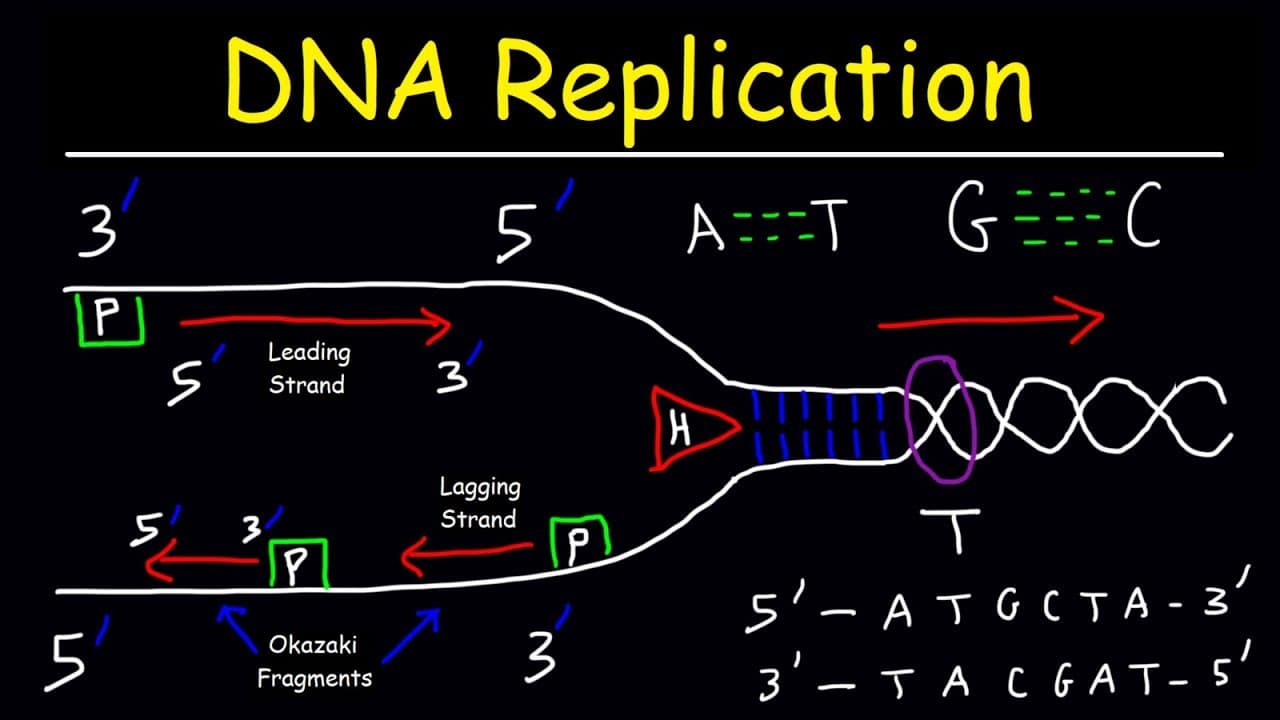
DNA replication is a semi-conservative process where each new DNA molecule consists of one original strand and one newly synthesized strand. The leading strand is created continuously, while the lagging strand is synthesized in short segments called Okazaki fragments due to its anti-parallel nature. Key enzymes involved include helicase, which unwinds the DNA, and DNA polymerases, which synthesize new strands.
Transcript
in this video we're going to focus on dna replication the first thing that you need to know is that dna replication is semi-conservative what does that mean so looking at the strand on the left that is the original strand you can call it the old strand and on the right it was replicated we have two new strands in each new copy we could see there's ... Read More
Key Insights
- 👶 DNA replication is semi-conservative, with each new copy containing one original and one new strand.
- 🏃 DNA strands are anti-parallel and run in opposite directions.
- ⚾ Complementary base pairing ensures accurate replication of the DNA sequence.
- 🥹 Hydrogen bonds hold the DNA strands together.
- 😃 DNA replication can occur bi-directionally or unidirectionally.
- 🍳 Helicase separates the DNA strands by breaking hydrogen bonds.
- 🧬 Topoisomerase enzymes reduce torsional strain in DNA replication.
Install to Summarize YouTube Videos and Get Transcripts
Explore YouTube Video Summarizer or Get YouTube Transcript Extractor
Questions & Answers
Q: What does it mean for DNA replication to be semi-conservative?
Semi-conservative replication means that each new copy of DNA contains one original strand and one newly synthesized strand.
Q: How do DNA strands run in relation to each other?
DNA strands are anti-parallel, running in opposite directions. One strand runs from 5' to 3', while the other runs from 3' to 5'.
Q: What is complementary base pairing and how does it work?
Complementary base pairing refers to the pairing of nucleotides in DNA. A always pairs with T, and G always pairs with C. This allows for the accurate replication of the DNA sequence.
Q: What holds the DNA strands together?
Hydrogen bonds hold the nucleotides together in DNA. Adenine forms two hydrogen bonds with thymine, while guanine forms three hydrogen bonds with cytosine.
Summary & Key Takeaways
-
DNA replication is semi-conservative, meaning each new copy of DNA has one original strand and one newly synthesized strand.
-
DNA strands are anti-parallel, running in opposite directions.
-
Complementary base pairing occurs, with A-T and G-C pairing.
Read in Other Languages (beta)
Share This Summary 📚
Summarize YouTube Videos and Get Video Transcripts with 1-Click
Try YouTube Summary with ChatGPT & Claude or YouTube Transcript Generator
Explore More Summaries from The Organic Chemistry Tutor 📚



Summarize YouTube Videos and Get Video Transcripts with 1-Click
Try YouTube Summary with ChatGPT & Claude or YouTube Transcript Generator