What Actually was Greek Fire?
TL;DR
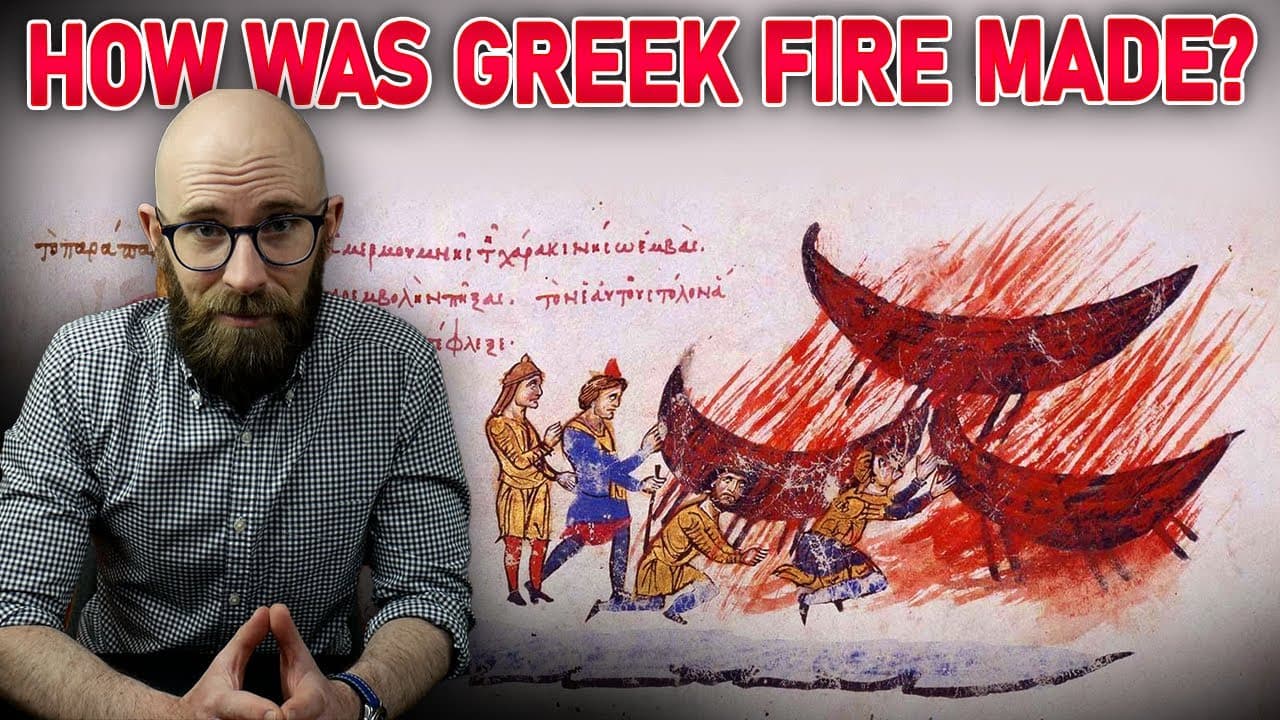
Greek Fire was a powerful Byzantine incendiary weapon: a sticky liquid projected in jets that burned even underwater and helped break the siege of Constantinople in 678. Typically credited to Kallinikos of Heliopolis, it was deployed from ship-mounted siphons as well as handheld projectors, grenades, and catapult projectiles, yet its exact composition remains a mystery. Read on to see how it worked and why its formula may have vanished.
Transcript
in the year 673 seed Byzantine Empire the last Eastern remnant of the once Mighty Roman Empire faced Annihilation the armies of the Islamic Ahmad caliphate led by caliph murawia had cut swaths through the territories of the Christian Empire conquering North Africa Sicily tasks and roads in quick succession they now set their sights on the capital o... Read More
Key Insights
- 🔫 Greek Fire was a highly effective incendiary weapon used by the Byzantine Empire for nearly 800 years.
- 🎁 It was invented by Kallinikos of Heliopolis and presented to Emperor Constantine IV.
- 📽️ Greek Fire was projected using a siphon system mounted on warships and used in handheld projectors, grenades, and catapult projectiles.
- 🌱 The exact composition of Greek Fire remains a mystery, but it is believed to include petroleum products, sulfur, plant resins, potassium nitrate, and quick lime.
Install to Summarize YouTube Videos and Get Transcripts
Explore YouTube Video Summarizer or Get YouTube Transcript Extractor
Questions & Answers
Q: What actually was Greek Fire?
Greek Fire was a powerful incendiary weapon used by the Byzantine Empire to repel foreign invaders for nearly 800 years. Its burning liquid stuck to surfaces, produced thick black smoke, and could continue burning underwater, while its exact composition remains unknown.
Q: Who invented Greek Fire?
The invention is typically attributed to Kallinikos of Heliopolis, a Greek Jewish architect who fled to Constantinople in 672 after the Arab invasion of Pho in modern-day Syria. According to legend, he worked for years on the weapon before presenting it to Byzantine emperor Constantine IV.
Q: How did Greek Fire save the Byzantine Empire?
In 678, a small Byzantine fleet used jets of Greek Fire against the Arab fleet besieging Constantinople. The flames engulfed the opposing ships, routed the fleet, broke the siege, and saved the Byzantine Empire from the immediate threat.
Q: How did the Byzantines project Greek Fire?
The Byzantines projected Greek Fire through siphons mounted on warships, with a stated range of 15 meters. They also deployed it through handheld projectors, grenades, and catapult projectiles.
Q: Why was Greek Fire so difficult to extinguish?
The substance clung to every surface it struck and ignited ships quickly. It could even keep burning underwater, so sailors who escaped the flames by jumping into the sea still faced danger.
Q: What ingredients may have been used in Greek Fire?
The exact recipe remains a mystery. The existing account identifies petroleum products, sulfur, plant resins, potassium nitrate, and quicklime as ingredients believed to have been involved.
Q: Did incendiary weapons exist before Greek Fire?
Yes. The Assyrians used flaming arrows and grenade-like clay jars as early as the 9th century BC, while the Babylonians produced petroleum derivatives by the 7th century BC and used them in warfare.
Q: Why did Greek Fire disappear from history?
The precise reason is unknown, but the formula may have been lost when Crusaders sacked Constantinople in 1204. Its status as a closely guarded state secret and its compartmentalized manufacturing process may have made that loss more likely.
Summary & Key Takeaways
-
In the year 673, the Byzantine Empire faced annihilation from the Islamic Ahmad Caliphate, but Greek Fire, a potent incendiary weapon, saved them.
-
The invention of Greek Fire is attributed to Kallinikos of Heliopolis, who presented it to the Byzantine emperor Constantine IV.
-
Greek Fire was projected using a siphon system mounted on warships and was also used in handheld projectors, grenades, and catapult projectiles.
Read in Other Languages (beta)
Share This Summary 📚
Summarize YouTube Videos and Get Video Transcripts with 1-Click
Try YouTube Summary with ChatGPT & Claude or YouTube Transcript Generator
Explore More Summaries from Today I Found Out 📚




Summarize YouTube Videos and Get Video Transcripts with 1-Click
Try YouTube Summary with ChatGPT & Claude or YouTube Transcript Generator