How Can Attackers Exploit DC/OS Orchestration?
TL;DR
Poorly managed orchestration tools can expose an entire data center because Mesos masters distribute tasks while agents execute them across pooled compute resources. Security teams should identify container deployments, including proofs of concept, understand every orchestration layer, and closely manage tools such as Mesos, Marathon, Chronos, and DC/OS before their complexity creates exploitable weaknesses.
Transcript
Well, good morning, everyone. This is not a bad turnout for day three of, uh, RSA at 9:00, so congrats to you for waking up and not being in a, a hungover stupor. Um, so my name is Mike Mellor. I'm the Director of Information Security at Adobe. Uh, previous to Adobe, um, uh, my background is within, uh, the US federal government, and then also heal... Read More
Key Insights
- Container orchestration adoption is already material: 16% of surveyed organizations use containers and compute orchestration tools, while 35% have a proof of concept running. These experimental environments deserve security scrutiny because they may hold sensitive or production data despite being described as development systems.
- Developer access makes unapproved container use likely: the presenters argue that organizations with developers probably already have container technologies somewhere in their environments. Security teams therefore need active discovery and oversight instead of assuming that container adoption begins only after a formal enterprise rollout.
- Business efficiency drives orchestration adoption: organizations will embrace containers when they can improve developer efficiency, with the presentation citing a potential 40% gain. These economic incentives mean security programs must prepare for expanding use rather than treating container platforms as a temporary technical trend.
- Cloud portability is a major orchestration benefit: abstracting the cloud layer allows organizations to move workloads among providers according to functionality, data sovereignty, and price. Using a provider-specific container service can undermine that flexibility by tying applications directly to one cloud platform.
- Complexity directly increases security difficulty: greater exposure to containers reveals more operational complexity, while organizations report difficulty hiring people capable of managing orchestration environments. If teams do not understand how these platforms operate, their ability to secure them is likely to be even weaker.
- Container management is the primary challenge reported by organizations: packaging applications into containers and running them can be relatively simple, but administering the resulting environment is harder. This management burden expands the opportunity for security gaps across interconnected orchestration components.
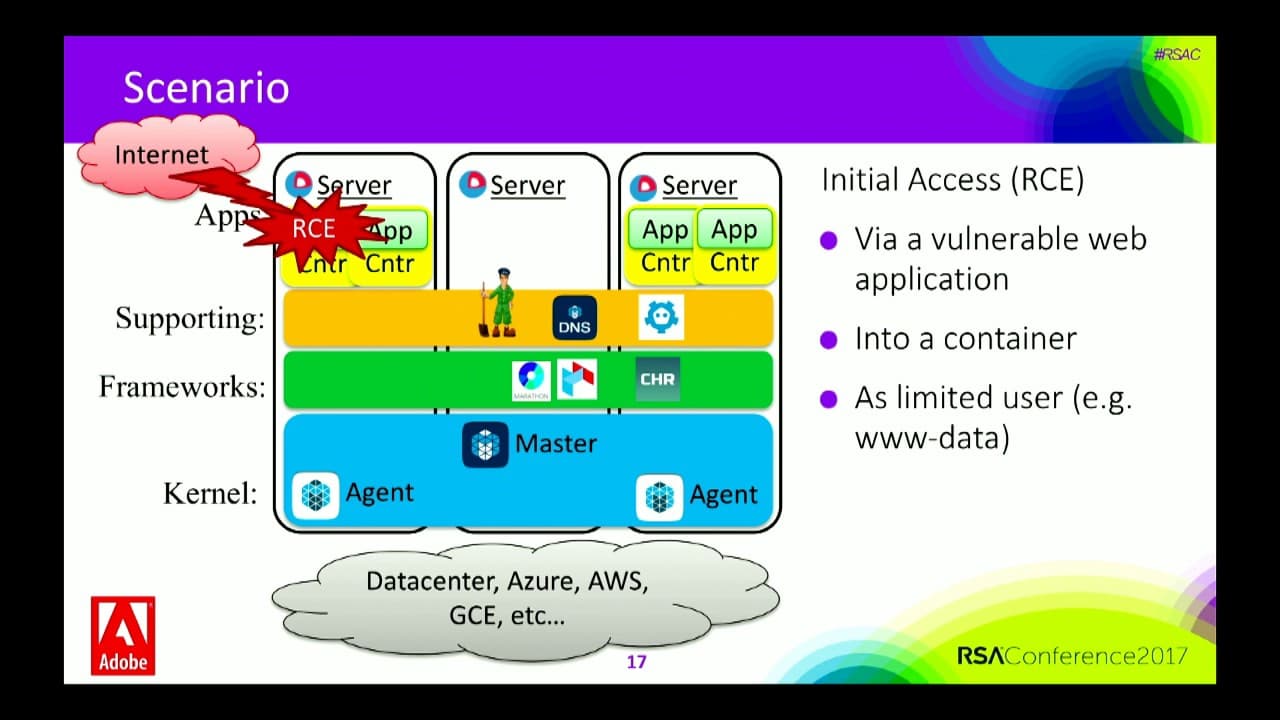
- Mesos divides cluster responsibilities between masters and agents: the Mesos master distributes tasks, and Mesos agents execute those tasks. This arrangement lets diverse compute resources be viewed and managed from a single plane as though they formed one large computer.
- DC/OS uses multiple interconnected layers: Mesos provides the kernel-level foundation, frameworks such as Marathon, Chronos, and Metronome supply orchestration logic, and supporting technologies keep components aligned. The rapid turnover of technologies at each layer makes continuous attention essential for operators and security teams.
Install to Summarize YouTube Videos and Get Transcripts
Explore YouTube Video Summarizer or Get YouTube Transcript Extractor
Questions & Answers
Q: Why are container proofs of concept a security risk?
Container proofs of concept can become security risks because their informal label may encourage weaker controls and less oversight. Teams may claim that a proof of concept is only a development site with no sensitive or production information, yet the presenters warn that important data often appears there anyway. Security teams should therefore treat these environments as real assets that require discovery, management, and protection.
Q: How does Mesos manage a data center cluster?
Mesos organizes compute resources from internal data centers, co-location facilities, Azure, and AWS so they can be managed through a single plane and viewed as one computer. The Mesos master is responsible for distributing tasks, while Mesos agents execute those tasks. This structure forms the kernel-level foundation beneath the frameworks and supporting technologies used in a data center operating system.
Q: What roles do Marathon, Chronos, and Metronome play?
Marathon, Chronos, and Metronome are identified as frameworks or capabilities within the framework layer above the Mesos kernel. That layer supplies the logic used by orchestration tools. Because the architecture includes several connected layers and the technologies within them rapidly move into and out of favor, operators must continually understand which components are deployed and how they interact.
Q: Why does orchestration complexity create security problems?
Orchestration complexity creates security problems because teams must understand and manage many rapidly changing components across a distributed environment. Survey respondents also reported a significant skills gap and difficulty hiring capable specialists. When an organization struggles to operate its container and orchestration platforms correctly, it is even less likely to configure, monitor, and secure every part of those platforms consistently.
Q: How can orchestration reduce cloud provider lock-in?
Orchestration can reduce provider lock-in by abstracting workloads from a single cloud platform. Organizations can then move work among providers based on functionality, data sovereignty, and price, rather than remaining tied to one vendor's services. By contrast, using container management capabilities that attach applications directly to Azure, Amazon, or another provider can make moving those workloads nearly impossible.
Q: Why are businesses adopting container orchestration?
Businesses are adopting container orchestration because it can improve developer efficiency, reduce operational costs, and make infrastructure more flexible. The presentation cites the prospect of 40% additional developer efficiency and describes Twitter managing tens of thousands of Mesos nodes with three operations engineers. It also emphasizes the ability to direct workloads toward different cloud providers based on business and technical requirements.
Q: What is the biggest container management challenge?
Container management is described as the leading challenge across the surveys discussed in the presentation. Organizations may find it fairly simple to create containers, place applications or business services inside them, and run them. The harder task is managing the resulting environment reliably. That operational difficulty also becomes a security concern because weak understanding and inconsistent administration can leave orchestration components exposed.
Q: How should security teams approach DC/OS environments?
Security teams should first identify where containers, orchestration platforms, and proofs of concept are already operating, including deployments created directly by developers. They should understand the Mesos master and agent roles, inventory frameworks such as Marathon and Chronos, and examine the supporting layer that maintains consistent configurations. Continuous attention is necessary because tools at every layer change rapidly.
Summary & Key Takeaways
-
Container and compute orchestration adoption is growing because organizations seek greater developer efficiency and the flexibility to move workloads among internal data centers, co-location facilities, Azure, and AWS. However, proofs of concept may contain sensitive or production data despite assurances that they are merely development environments, creating overlooked security exposure.
-
Mesos presents distributed compute resources through a single management plane. A Mesos master distributes tasks, while Mesos agents execute them. Above the kernel, frameworks such as Marathon, Chronos, and Metronome provide orchestration logic, and a supporting layer helps keep devices aligned through consistent configurations across the cluster environment.
-
Container management is the leading challenge described in the cited surveys. Organizations may find it easy to package and run applications but difficult to operate the resulting environment securely. Rapid technological change, limited expertise, and architectural complexity combine to create conditions in which orchestration weaknesses could enable broad data center compromise.
Read in Other Languages (beta)
Share This Summary 📚
Summarize YouTube Videos and Get Video Transcripts with 1-Click
Try YouTube Summary with ChatGPT & Claude or YouTube Transcript Generator
Explore More Summaries from RSAC Cybersecurity 📚

Summarize YouTube Videos and Get Video Transcripts with 1-Click
Try YouTube Summary with ChatGPT & Claude or YouTube Transcript Generator