What Are Multiprocessor Systems and Their Types?
TL;DR
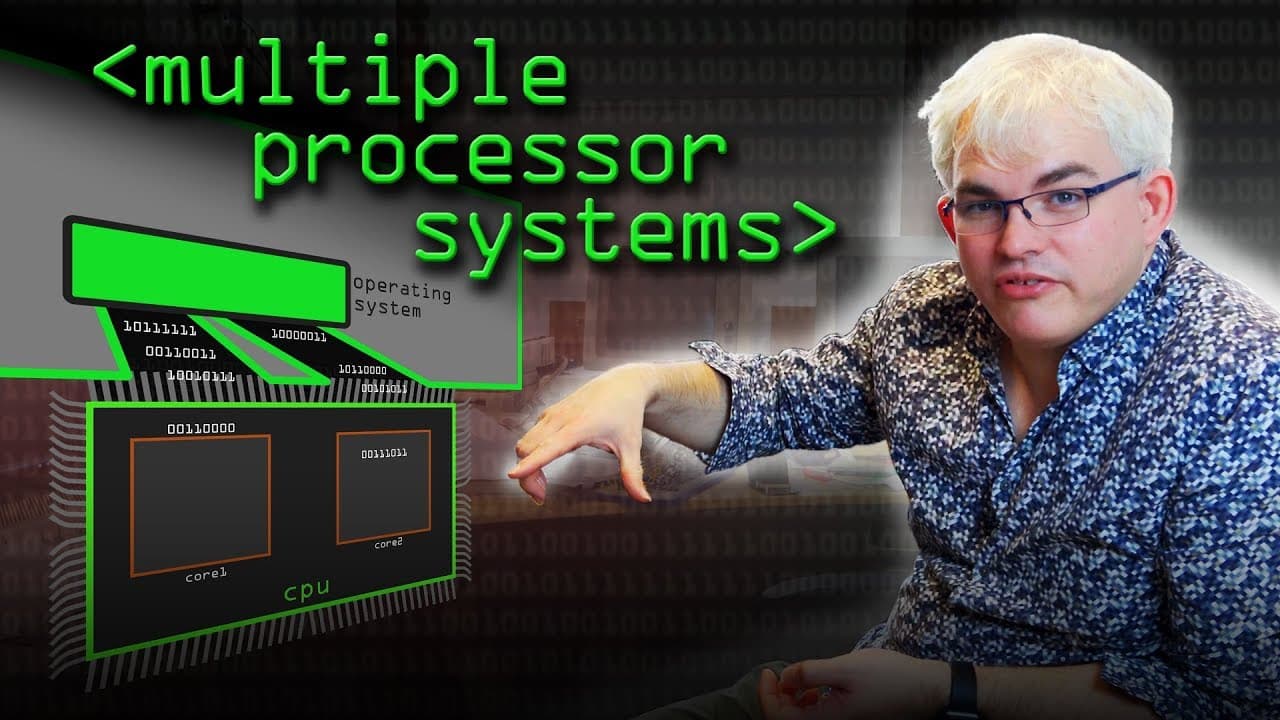
Multiprocessor systems consist of either multiple processors or multiple cores, each serving distinct functions. These systems can be classified as symmetric, where identical processors handle the same tasks, or asymmetric, where specialized CPUs tackle different jobs. Understanding these types helps optimise computing performance and harness parallel processing effectively.
Transcript
How many computers in here do you think we've got multiple processors in? Ok, um, yeah, I don't think any of them have got multiple processors in the way that I would think of multiple processors My edit machine has two Intel processors in it, physical chips Ok, so you define a multiprocessor system as having two physical chips? That's what I'm thi... Read More
Key Insights
- 💯 Multiprocessor systems can have multiple processors or multiple cores, with each type serving different purposes.
- 👻 Symmetric multiprocessor systems allow for running multiple programs concurrently, while asymmetric systems offload specialized tasks to different CPUs.
- 🎏 Flynn's taxonomy provides a framework to categorize processors based on their instruction and data stream capabilities.
- 🎨 The design of multiprocessor systems depends on the intended purpose and the need for parallel processing.
- 🅰️ Parallel processing has been a topic of study and implementation for several decades, with various types of multiprocessor systems developed.
- 🎏 Modern multi-core CPUs can behave like single instruction stream, single data stream systems or SIMD systems, depending on the task being performed.
- 🤩 Breaking down problems into multiple chunks and distributing them across multiple processors or cores is key to achieving speed-up in multiprocessor systems.
Install to Summarize YouTube Videos and Get Transcripts
Explore YouTube Video Summarizer or Get YouTube Transcript Extractor
Questions & Answers
Q: What is the difference between a multiprocessor system with multiple processors and one with multiple cores?
In a multiprocessor system with multiple processors, there are physically separate chips, each functioning as an individual processor. On the other hand, a multiprocessor system with multiple cores has multiple processing units within a single chip, sharing resources and performing tasks simultaneously.
Q: What is the difference between symmetric and asymmetric multiprocessor systems?
In a symmetric multiprocessor system, all CPUs are of the same design and can perform any task assigned by the operating system. In contrast, an asymmetric multiprocessor system has CPUs that specialize in different tasks, such as IO processing or graphics rendering.
Q: Does the trend towards multiple cores and parallel processing mean that symmetric multiprocessor systems are becoming obsolete?
No, symmetric and asymmetric multiprocessor systems have different applications. Symmetric systems are suitable for running multiple programs simultaneously, while asymmetric systems excel in offloading specific tasks to specialized CPUs, such as DSP or GPU.
Q: What is Flynn's taxonomy, and why is it relevant to understanding multiprocessor systems?
Flynn's taxonomy categorizes processors based on the number of instruction and data streams they can handle. It helps understand the different types of parallel processing systems, such as single instruction multiple data (SIMD) and multiple instruction multiple data (MIMD), and how they are utilized in modern CPUs.
Summary & Key Takeaways
-
The video discusses the concept of multiprocessor systems, specifically focusing on whether a computer has multiple processors or multiple cores.
-
The distinction between symmetric and asymmetric multiprocessor systems is explained, with examples given for each type.
-
The speaker also touches on Flynn's taxonomy, which categorizes processors based on the number of instruction and data streams.
Read in Other Languages (beta)
Share This Summary 📚
Summarize YouTube Videos and Get Video Transcripts with 1-Click
Try YouTube Summary with ChatGPT & Claude or YouTube Transcript Generator
Explore More Summaries from Computerphile 📚






Summarize YouTube Videos and Get Video Transcripts with 1-Click
Try YouTube Summary with ChatGPT & Claude or YouTube Transcript Generator