MonoPulse tracking radar | One coordinate | Radar Systems | Lec-48
TL;DR
Monopulse tracking radar efficiently tracks targets using a single pulse and dual signal feeds.
Transcript
hi everyone in this video I am going to explain about monopol striking radar which is nothing but amplitude comparison one coordinate system I will tell you what is this amplitude comparison on coordinate see monopol stacking radar what do you mean by monopulse by seeing the name mono pulse Nono means single so it is nothing but single pulse operat... Read More
Key Insights
- 💗 Monopulse radar operates on a principle that only a single pulse is necessary for effective target tracking, unlike conventional radar systems.
- 🤱 The structure of monopulse radar includes specific configurations, such as dual feeds in a parabolic antenna, which enhance tracking accuracy.
- 🎯 Amplitude and phase comparisons are crucial methodologies that determine how monopulse systems calculate and analyze target data.
- 📲 The duplexer within monopulse systems is essential for maintaining signal integrity by preventing outgoing signals from interfering with incoming ones.
- 🍹 Signal processing in monopulse radar involves creating sum and difference outputs, which collectively enhance tracking reliability and precision.
- 📡 The block diagram representation of monopulse radar provides a clear overview of how different components interact to process radar signals.
- 💗 Monopulse radar's efficiency is attributed to its capability to minimize the time lag between pulse emission and data retrieval, critical for tracking fast-moving targets.
Install to Summarize YouTube Videos and Get Transcripts
Explore YouTube Video Summarizer or Get YouTube Transcript Extractor
Questions & Answers
Q: What is monopulse radar and how does it differ from traditional radar systems?
Monopulse radar is a sophisticated tracking system that utilizes a single pulse for gathering information about targets, contrasting with traditional radar, which often requires multiple pulses or beams to determine target location. Monopulse radar can provide real-time tracking capabilities and has a faster response system due to its streamlined operation, minimizing the time between pulse emission and measurement.
Q: What are the types of monopulse tracking radar discussed in the video?
The video discusses two main types of monopulse tracking radar: amplitude comparison and phase comparison. Amplitude comparison is further categorized into single coordinate and dual coordinate systems. Each type offers unique methodologies for signal processing and target tracking, impacting the system's overall accuracy and efficiency.
Q: How does amplitude comparison work in monopulse radar?
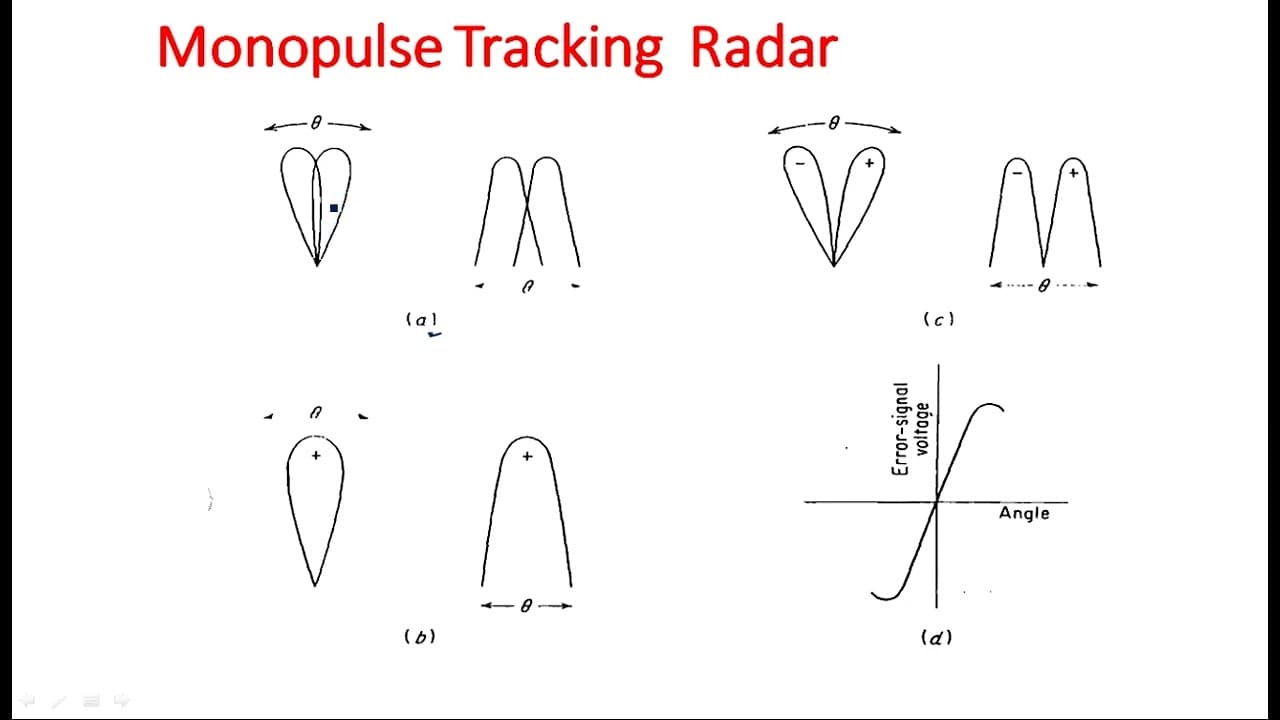
Amplitude comparison in monopulse radar involves using two antenna feeds to produce two signals: a sum and a difference signal. The sum signal represents the total power received, while the difference signal helps calculate the angular position of the target by analyzing the phase shifts between the two signals. This process allows for precise tracking without the need for multiple beams or complex angle measurements.
Q: What is the role of the duplexer in monopulse radar systems?
The duplexer plays a critical role in monopulse radar systems by ensuring that the outgoing transmission does not interfere with incoming signals. It directs the transmitted signals to the antenna for broadcasting while simultaneously preventing these signals from entering the receiving circuitry. This separation is essential for accurate target detection and tracking.
Q: How do the two feeds in the parabolic antenna achieve effective target tracking?
The two feeds positioned in the parabolic antenna are strategically designed to emit signals in different directions: one for vertical tracking and the other for horizontal. This dual feed configuration allows the monopulse radar to synthesize information from both directions simultaneously, enhancing the system's ability to determine the target's precise location and movement effectively and efficiently.
Q: What is the significance of using only one pulse in monopulse radar?
Utilizing only one pulse in monopulse radar dramatically simplifies the tracking process compared to traditional methods that rely on multiple pulses. This one-pulse operation enables seamless real-time tracking and reduces the time taken to gather target data. It allows the radar system to operate more efficiently, facilitating quicker responses in dynamic tracking scenarios.
Q: What information can be extracted from the sum and difference channels?
The sum channel in monopulse radar collects total signal data, helping to assess the overall signal strength from a target, while the difference channel focuses on phase discrepancies between the two signals, indicating the target's angular position. Together, these channels provide comprehensive insights into both range and angle error, crucial for precise tracking.
Summary & Key Takeaways
-
Monopulse tracking radar enables target tracking and information retrieval using just one pulse, streamlining the tracking process significantly compared to traditional methods requiring multiple signals.
-
There are two main types of monopulse radar systems: amplitude comparison and phase comparison. Within amplitude comparison, systems can either use one or two coordinate systems for tracking.
-
The design of monopulse radar involves a parabolic antenna with two feeds, which allows for simultaneous signal processing, enhancing accuracy and efficiency in detecting target location and movement.
Read in Other Languages (beta)
Share This Summary 📚
Summarize YouTube Videos and Get Video Transcripts with 1-Click
Try YouTube Summary with ChatGPT & Claude or YouTube Transcript Generator