MOS circuits | Area capacitance | Standard unit of capacitance | VLSI | Lec-39
TL;DR
Learn about the standard unit and calculation of capacitance in mass transistors.
Transcript
hi everyone in this video you are going to learn about the area capacitance and standard unit of capacitance of the mass transistors or any type of layer which is used for the creation of mass transistor so standard unit of capacitance before going into the particular standard unit of capacitance where the standard unit of capacitance is calculated... Read More
Key Insights
- 💆 Capacitance in mass transistors is primarily influenced by the dielectric material used and its thickness.
- 🇩🇬 The generalized formula for capacitance (C = Epsilon(A) / D) is essential for calculations involving different materials and configurations.
- 🎨 Area capacitance values can vary significantly between technologies, reflecting the importance of adaptation in design for specific applications.
- 🎨 Understanding the relationship between capacitance and geometry (length and width of transistors) is critical for effective circuit design.
- 🖐️ The dielectric layer, such as silicon dioxide, plays a crucial role in capacitance performance, necessitating careful selection based on application requirements.
- 🎨 Standardized capacitance values help streamline design practices, providing quick references for engineers and researchers in electronics.
- 👻 The concept of relative capacitance highlights variations in materials, allowing precise calculations when designing circuits with different types of semiconductor layers.
Install to Summarize YouTube Videos and Get Transcripts
Explore YouTube Video Summarizer or Get YouTube Transcript Extractor
Questions & Answers
Q: What is the basic formula for capacitance as introduced in the video?
The basic formula for capacitance, as presented in the video, is C = Epsilon(A) / D, where C represents capacitance, Epsilon is the permittivity of the dielectric material, A is the area of the plates, and D is the distance between these plates. This generalized formula illustrates how capacitance can be influenced by both the area of the conductive plates and the properties of the insulating material between them.
Q: How does the thickness of the dielectric material affect capacitance?
The thickness of the dielectric material, represented as D in the capacitance formula, has an inverse relationship with capacitance. A thinner dielectric layer leads to greater capacitance because the closer proximity of the conductive plates increases the electric field strength, thereby enhancing the overall capacitance value. For mass transistors, using materials like silicon dioxide with specific thicknesses affects the capacitance significantly.
Q: What are standard capacitance values for different technologies mentioned in the video?
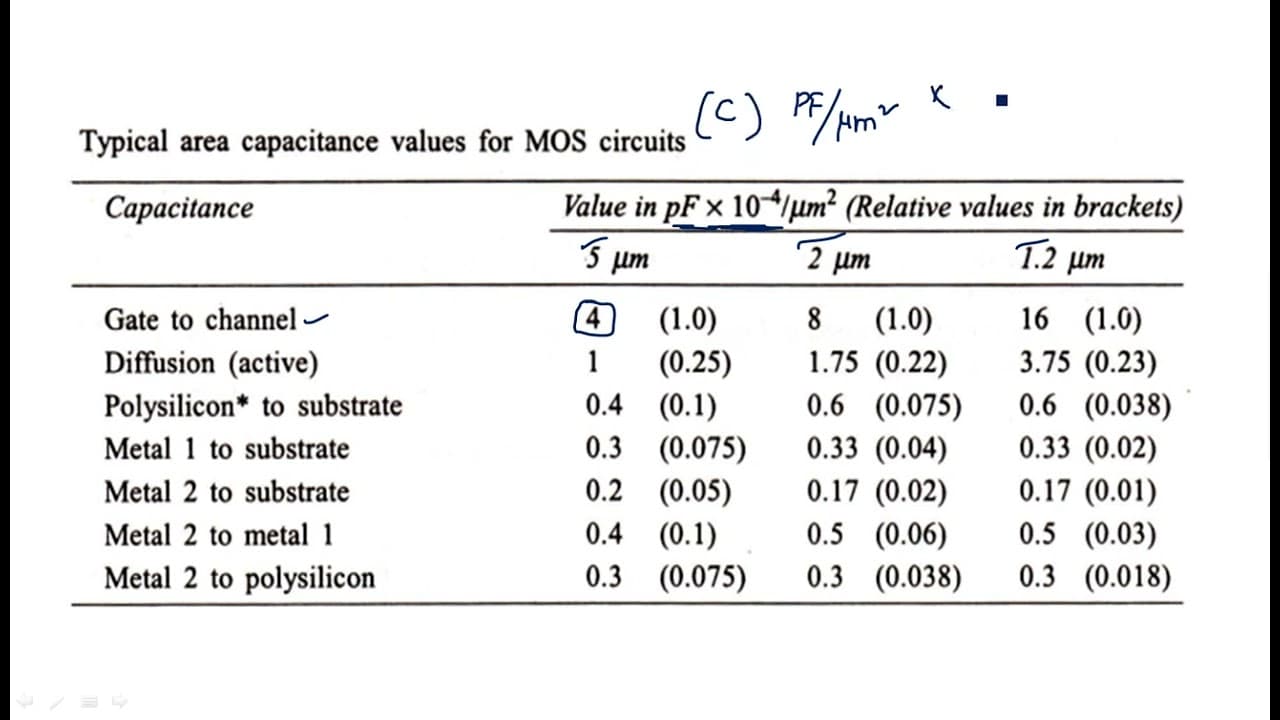
The video mentions standard capacitance values for various technologies, including 5 micrometer and 2 micrometer technologies. For example, for 5 micrometer technology, the gate to channel capacitance is 4 picofarads per micrometer square, while for 2 micrometer technology, it is 8 picofarads per micrometer square. These values are essential for calculating overall capacitance based on the specific area of each technology.
Q: Why is it important to represent capacitance in standard units?
Representing capacitance in standard units, such as picofarads per micrometer square, simplifies comparisons and calculations across different semiconductor technologies. This uniform metric allows engineers to easily assess and design circuits by using established values, ensuring consistent performance and efficiency across various applications in mass transistor circuitry.
Summary & Key Takeaways
-
The video provides an explanation of capacitance, focusing on the area capacitance and its standard unit, especially in the context of mass transistors. The capacitance formula discussed is C = Epsilon(A) / D, indicating the relationship between permittivity, area, and distance.
-
It details how to calculate standard capacitance values across different technologies (5 micrometer, 2 micrometer, etc.) using specific values for gate to channel capacitance. The process incorporates both the dimensions of the transistors and the dielectric material used.
-
The content emphasizes the importance of understanding capacitance for further applications in circuit design, illustrating how capacitance values differ based on the technology used and the area of the plates involved.
Read in Other Languages (beta)
Share This Summary 📚
Summarize YouTube Videos and Get Video Transcripts with 1-Click
Try YouTube Summary with ChatGPT & Claude or YouTube Transcript Generator