What Is a Carry Look-Ahead Adder and How Does It Work?
TL;DR
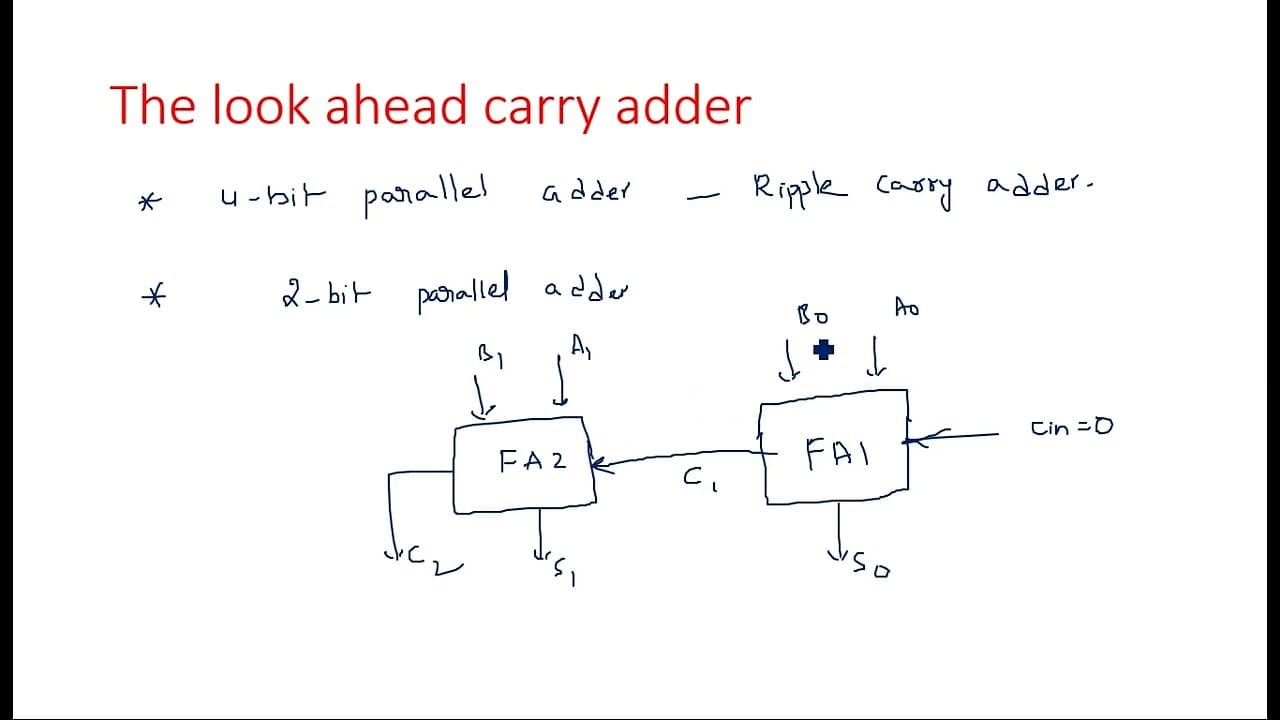
A carry look-ahead adder (CLA) enhances addition speed by predicting carry outputs in advance, allowing all full adders to operate simultaneously. Unlike ripple carry adders that depend on sequential carry generation, CLAs utilize logic gates to calculate carries for all input bits at once, significantly reducing computational delays and increasing efficiency in digital circuits.
Transcript
hi everyone in this video I'm going to explain about the carry look Ahad or it's also as the look ahead carrier in the prev I told you how to construct a rep car order and thereby we have already we have also seen um parallel binary adder and subtractor so the main purpose of carried look ahead Adder is to improve the speed of addition operation wh... Read More
Key Insights
- 👻 The carry look-ahead adder (CLA) improves binary addition speed by allowing parallel processing of carries.
- 🐢 Ripple carry adders are slower due to their reliance on sequential carry outputs from previous stages.
- ❓ CLA relies on the logical functions of carry generate and carry propagate to streamline calculations.
- 👻 Efficient carry calculations allow the CLA to dramatically reduce overall computational delays in digital circuits.
- 🫦 An adder designed with CLA technology can process larger bit-widths effectively, making it suitable for modern computing tasks.
- 🥺 The adoption of CLA in processors leads to improved performance in arithmetic logic units (ALUs).
- 🎨 The design of a CLA involves a combination of half adders and logic gates tailored for carry predictions.
Install to Summarize YouTube Videos and Get Transcripts
Explore YouTube Video Summarizer or Get YouTube Transcript Extractor
Questions & Answers
Q: What is the primary purpose of the carry look-ahead adder?
The primary purpose of the carry look-ahead adder (CLA) is to enhance the speed of binary addition processes. Unlike traditional ripple carry adders, where each stage relies on the previous carry, the CLA generates carries in advance based on all input combinations. This pre-calculation enables parallel processing of all full adders, significantly reducing execution time.
Q: How does the carry look-ahead adder differ from the ripple carry adder?
The carry look-ahead adder differs from the ripple carry adder in how it handles carry outputs. In a ripple carry adder, each full adder must wait for the carry output from the preceding adder, resulting in cumulative delays. In contrast, the CLA calculates the carry outputs for all adders simultaneously, allowing them to function in parallel and dramatically speeding up the addition operation.
Q: What are the key components involved in calculating carry outputs in the CLA?
The key components in calculating carry outputs in the carry look-ahead adder are the carry generate (G) and carry propagate (P) functions. The carry generate function computes whether a carry is produced from the addition of two bits, while the carry propagate function determines whether a carry from a previous stage will propagate through to the next stage. Together, they enable efficient computation of carry outputs without waiting on sequential stages.
Q: Can you explain how the carry generate and carry propagate functions work?
The carry generate (G) function is defined as the logical AND operation between two bits (A and B), indicating that a carry is generated whenever both bits are 1. The carry propagate (P) function, on the other hand, is defined as the logical XOR operation between these two bits, signifying that a carry from a previous stage may propagate to the next stage if at least one bit is 1. These functions work in tandem to allow simultaneous carry calculations in a CLA.
Q: What is the significance of the initial carry in the CLA?
The initial carry is crucial in the carry look-ahead adder because it allows for the calculation of subsequent carry outputs across all stages without the need for sequential processing. By inputting the initial carry alongside the bit pairs, the adder can determine if a carry is generated or propagated, thereby enabling parallel processing of all full adders and optimizing overall addition speed.
Q: How does the CLA enhance computational efficiency for binary addition?
The carry look-ahead adder enhances computational efficiency by generating carry outputs ahead of time, allowing multiple full adders to process inputs simultaneously. Instead of waiting for each stage to finish before starting the next one, the CLA combines the results of the carry generate and propagate functions to quickly resolve all carries, significantly reducing the time required for binary addition operations.
Summary & Key Takeaways
-
The carry look-ahead adder (CLA) improves addition speeds by pre-calculating carry outputs, eliminating delays inherent in traditional ripple carry adders.
-
In a ripple carry adder, each stage waits for the previous stage's carry, causing time delays that can accumulate and slow down calculations.
-
By using logic gates to generate carry outputs from all inputs simultaneously, the carry look-ahead adder allows all full adders to operate in parallel, significantly reducing overall computation time.
Read in Other Languages (beta)
Share This Summary 📚
Summarize YouTube Videos and Get Video Transcripts with 1-Click
Try YouTube Summary with ChatGPT & Claude or YouTube Transcript Generator