What Is Kelvin's Bridge and How Does It Measure Low Resistance?
TL;DR
Kelvin's Bridge is a specialized circuit for measuring very low resistance values, typically less than 1 ohm, providing accurate readings in balanced conditions. It outperforms Wheatstone's Bridge by effectively mitigating lead resistance effects, allowing for precise calculations of unknown resistances when the galvanometer is correctly placed at the center of the circuit.
Transcript
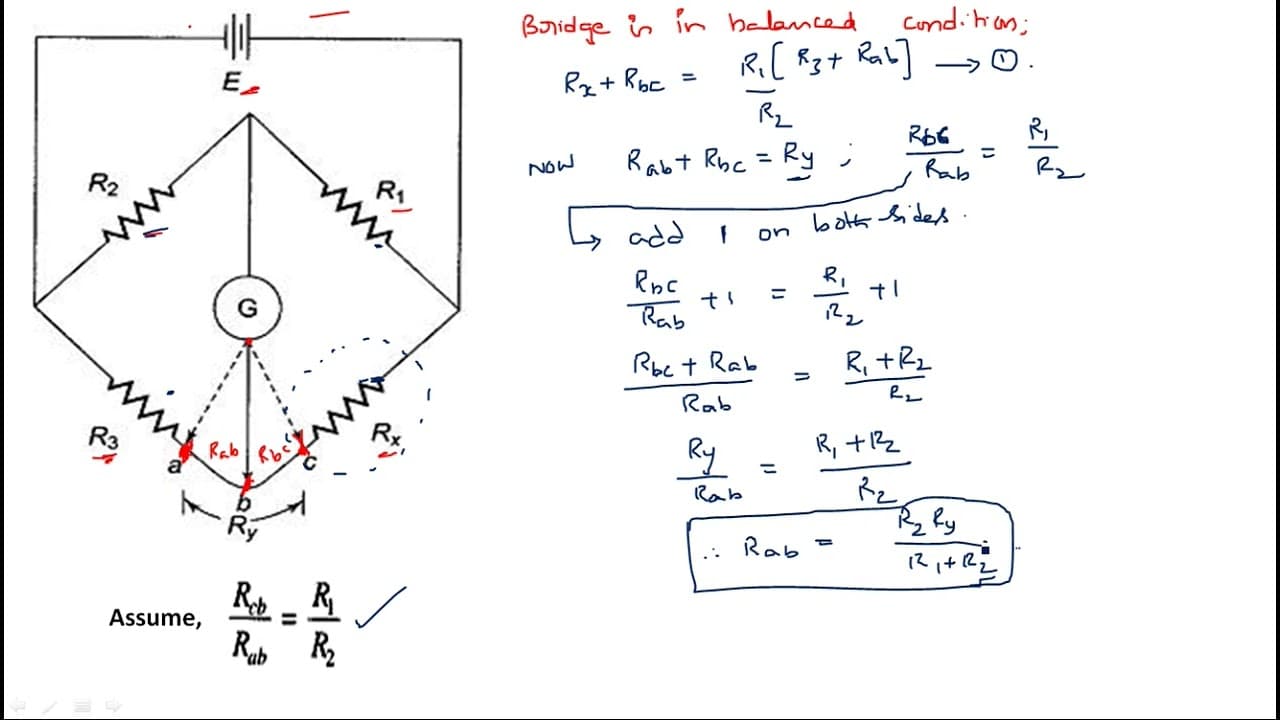
hi everyone in this video i am going to explain about kelvin's bridge in the previous video we have seen the wheatstone's bridge which is in balance recondition and unbalanced recondition in balance recondition we have taken a formula r4 is equal to r2 r3 by r1 and in unbalanced recognition we cannot measure the unknown values we can measure only t... Read More
Key Insights
- 😘 Kelvin's Bridge is a specialized circuit for measuring very low resistance values, invaluable in specific industrial applications.
- 👻 It functions effectively in balanced conditions, allowing for precise calculations of unknown resistances, such as Rx.
- 🥺 The bridge's design incorporates modifications to Wheatstone's approach, enhancing its ability to mitigate lead resistance effects.
- 🥺 The positioning of the galvanometer is critical; misplacement leads to erroneous results due to the interference of lead resistance.
- ❓ Understanding the mathematical relationships among the resistors is essential for conducting accurate measurements in the Kelvin's Bridge setup.
- 😒 The video underscores the importance of achieving a balance in the circuit for the successful use of Kelvin's Bridge.
- 😘 Accurate resistance measurement is essential in many fields, including electrical engineering and materials science, where low resistance values are prevalent.
Install to Summarize YouTube Videos and Get Transcripts
Explore YouTube Video Summarizer or Get YouTube Transcript Extractor
Questions & Answers
Q: How does Kelvin's Bridge differ from Wheatstone's Bridge in terms of resistance measurement?
Kelvin's Bridge is specifically designed for measuring very low resistance values, typically less than 1 ohm, while Wheatstone's Bridge is suited for moderate resistance values such as kilo-ohms. The primary advantage of Kelvin's Bridge lies in its ability to mitigate lead and contact resistance effects, enhancing accuracy in low resistance measurements.
Q: What are the implications of using Kelvin's Bridge in an unbalanced condition?
When Kelvin's Bridge operates in an unbalanced condition, it does not yield the unknown resistance values. Instead, it only measures the current flowing through the galvanometer, which is ineffective for resistance determination. This limitation emphasizes the importance of achieving a balanced state for accurate measurements.
Q: Can you explain the calculation process for unknown resistance in Kelvin's Bridge?
To determine the unknown resistance in Kelvin's Bridge, the video outlines a formula based on the balanced condition: Rx = (R1 * R3) / R2. Through carefully setting the galvanometer connection at point B, both lead resistance and contact resistance effects are effectively minimized, leading to a precise calculations of Rx.
Q: What role does the placement of the galvanometer play in measurements?
The position of the galvanometer is critical for accurate resistance measurement. When connected at the center, it minimizes the lead and contact resistance interference. If the connection deviates from this optimal point, unidentified lead resistance can skew the results, leading to inaccuracies in the measurement of unknown resistance.
Q: Why is it important to measure lead or contact resistance using Kelvin's Bridge?
Measuring lead or contact resistance is important because these resistances can introduce significant errors when evaluating low resistance values. By employing Kelvin's Bridge specifically for these measurements, the impact of lead and contact resistance is minimized, leading to more accurate and reliable data in precision applications.
Q: What theoretical assumptions must be satisfied when using Kelvin's Bridge?
Several assumptions must be satisfied for Kelvin's Bridge measurements: the bridge must be in a balanced state, the configuration of resistors must adhere to specific ratios, and the galvanometer must be optimally positioned to avoid lead resistance complications. Meeting these conditions ensures accurate determination of unknown resistances.
Summary & Key Takeaways
-
Kelvin's Bridge offers a method to accurately measure low resistance values, specifically those less than 1 ohm, making it superior to Wheatstone's Bridge for such applications.
-
In balanced conditions, Kelvin's Bridge can accurately determine unknown resistances, while in unbalanced conditions, it only provides current readings, which are not useful for measuring unknown values.
-
The video discusses the theoretical framework for calculating unknown resistances using the bridge, emphasizing connections and resistance considerations to avoid errors.
Read in Other Languages (beta)
Share This Summary 📚
Summarize YouTube Videos and Get Video Transcripts with 1-Click
Try YouTube Summary with ChatGPT & Claude or YouTube Transcript Generator