Number Analogy | Square logic | Part-04 | Reasoning | Bharath Kumar
TL;DR
This content explains solving number analogies using mathematical logic.
Transcript
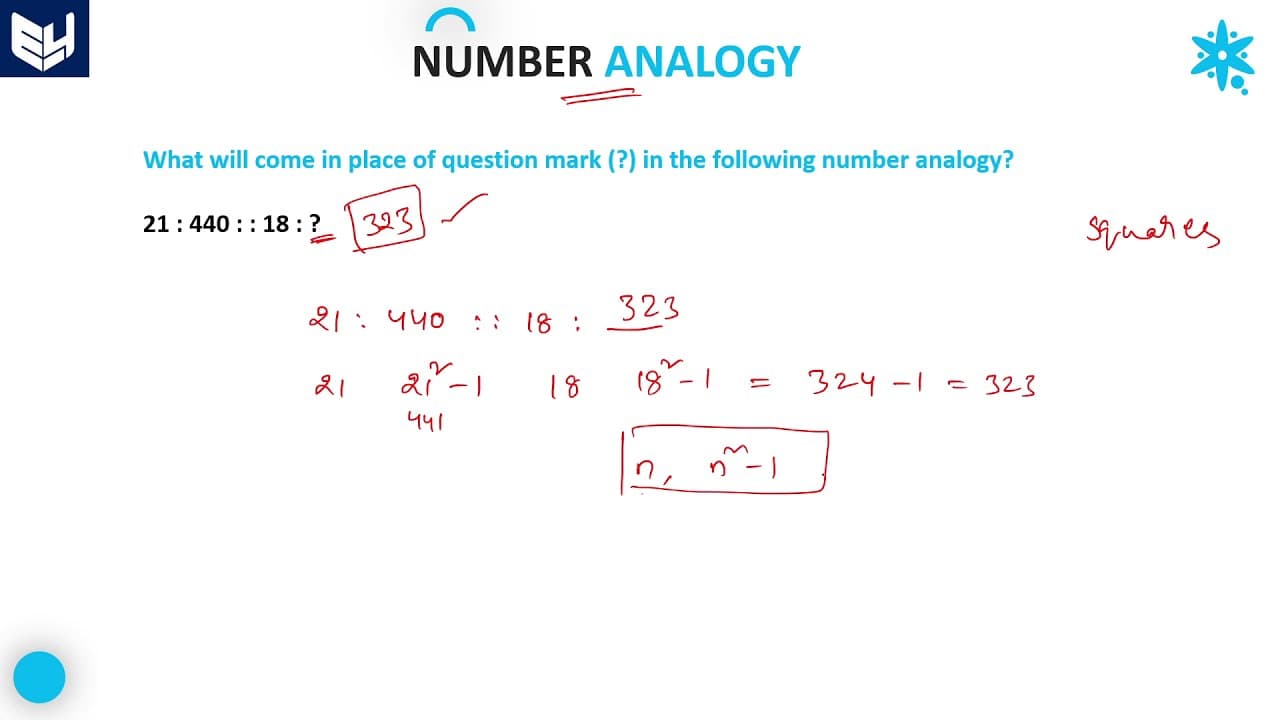
hi everyone welcome back in this session i am going to explaining about the analogy and the two number and all three uh now we will continue the last session of number analogy here in this session especially i am focusing on now space logica i'm focusing on squares logic so let's see the question what he has given see the first question here the qu... Read More
Key Insights
- ❎ Number analogies often rely on mathematical patterns involving squares and simple arithmetic operations.
- 💨 The identification of patterns like n and n squared minus one offers an effective way to solve analogy problems systematically.
- 👻 Observing relationships between successive numbers allows for consistent extrapolation of future values based on defined logic.
- #️⃣ The examples illustrate that solving number analogies can involve various mathematical approaches, providing flexibility in problem-solving methods.
- ❎ Recognizing square numbers can simplify complex relationships within sequences, yielding quick insights.
- 🏛️ Deducing patterns in sequences builds foundational skills for advancing mathematical understanding and reasoning.
- ❎ Variability in logical approaches, such as n squared plus n or n squared minus n, highlights the diversity in tackling mathematical problems.
Install to Summarize YouTube Videos and Get Transcripts
Explore YouTube Video Summarizer or Get YouTube Transcript Extractor
Questions & Answers
Q: What is the primary logic used for the first set of numbers in the analogy?
The primary logic for the first set with the numbers 21 and 440 involves recognizing that 440 is derived from squaring 21 and subtracting 1. Specifically, by calculating 21 squared (which equals 441) and subtracting 1, you arrive at 440, following the pattern of n and n squared minus one.
Q: How is the logic applied in solving the sequence involving 625 and 900?
In this sequence, 625 relates to 25 squared, and 650 is 625 plus 25. Extending this pattern, 900 is 30 squared. Therefore, to find the next number, you add 30 to 900, yielding 930, demonstrating the pattern of n squared and n squared plus n.
Q: What are the two logical patterns mentioned for the sequences?
The two logical patterns utilized for the sequences are n squared plus n and n squared minus n. These patterns provide different approaches to arrive at consecutive numbers in the analogies, allowing for flexibility in solving the problems based on convenience.
Q: Can you explain how 110 is connected to its logical structure?
The number 110 can be expressed as 10 squared plus 10, which shows that it follows the logic of n squared plus n. As you analyze the subsequent numbers, such as 132 (which is 11 squared plus 11), the consistent application of this logic leads to formulating the next numbers effectively.
Summary & Key Takeaways
-
The session focuses on solving number analogies using defined logical patterns, specifically through operations involving squares.
-
Various examples are solved, illustrating principles such as n and n squared minus one, and n squared plus n.
-
The logical approaches presented help to deduce the next number in sequences through systematic calculation.
Read in Other Languages (beta)
Share This Summary 📚
Summarize YouTube Videos and Get Video Transcripts with 1-Click
Try YouTube Summary with ChatGPT & Claude or YouTube Transcript Generator