Newton's 2nd Law (20 of 21) Will it Accelerate? Inclined Plane w/o Friction and a Pulley
TL;DR
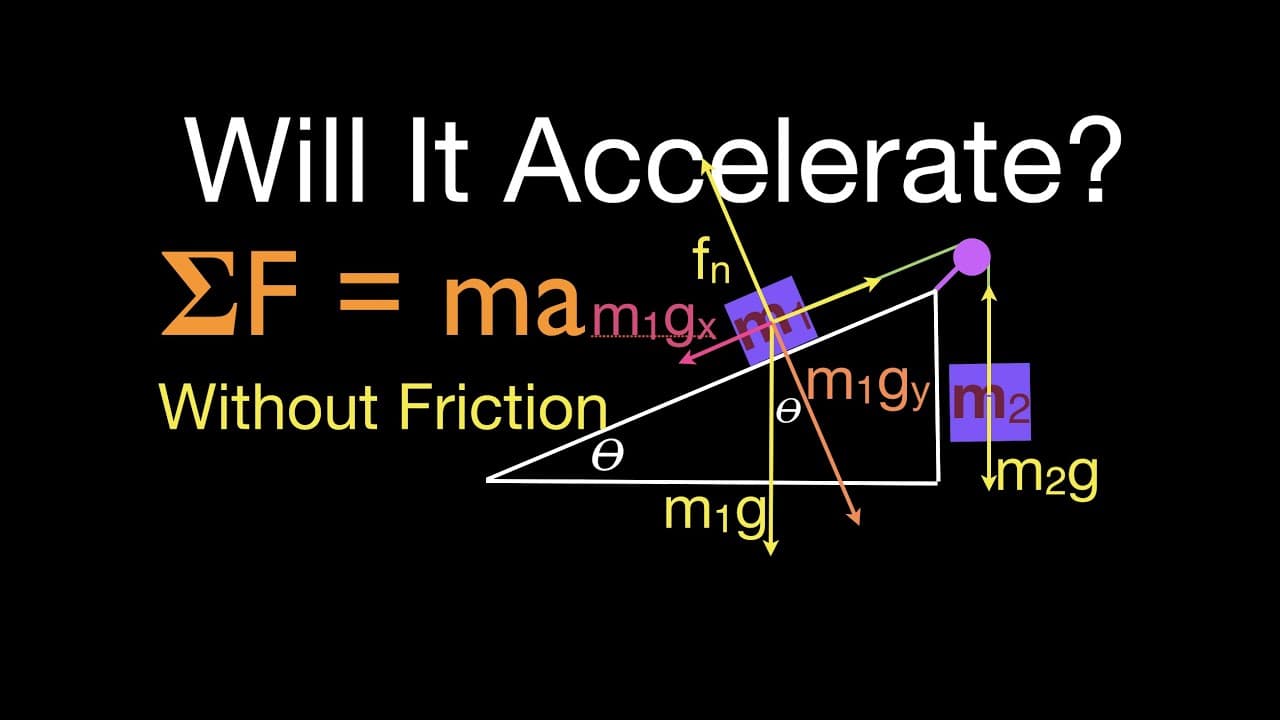
The objects accelerate when the forces along the string are unbalanced, with the direction determined by comparing m1g sin θ down the incline against m2g. For m1 = 6 kg, m2 = 2 kg, θ = 30°, and g rounded to 10, the forces are 30 N and 20 N, so acceleration is negative. Read on to see how changing m1 reverses the direction.
Transcript
okay in today's video once again we're going to play one of my favorite physics games and that is will it accelerate in this case it's really will they accelerate because in this situation we have the incline plane the pulley we have object m1 which is on the inclined plane there is no friction between object m1 and the incline plane then we have a... Read More
Key Insights
- ✈️ The presence of unbalanced forces is necessary for acceleration to occur in a pulley system on an incline plane.
- ❓ The direction of acceleration can be determined by comparing the forces of m1gx and m2g.
- 💆 Changing the mass of the objects or the angle of inclination can affect the direction of acceleration.
- 🧑🏭 Friction is not a factor in this system as there is no friction between m1 and the incline plane.
- 👮 The tension forces in the string are equal in magnitude but opposite in direction due to Newton's third law.
- ❓ Understanding the concept of acceleration in this system requires both calculations and conceptual understanding.
- 💆 Decreasing the mass of m1 can result in a change in acceleration direction from negative to positive.
Install to Summarize YouTube Videos and Get Transcripts
Explore YouTube Video Summarizer or Get YouTube Transcript Extractor
Questions & Answers
Q: Will the objects accelerate on a frictionless inclined plane with a pulley?
They accelerate if the forces affecting motion along the string are unbalanced. Compare m1g sin θ down the incline with m2g on the hanging object; the larger force determines the direction.
Q: What determines the direction of acceleration in this pulley system?
The direction depends on whether m1g sin θ or m2g is greater. If m1g sin θ is greater, acceleration is negative; if m2g is greater, acceleration is positive.
Q: What do positive and negative acceleration mean in this setup?
Positive acceleration means m1 moves up the inclined plane while m2 moves down. Negative acceleration means m1 moves down the plane while m2 moves up.
Q: What forces act on objects m1 and m2?
Object m1 has gravity, the normal force from the inclined plane, and string tension acting on it. Object m2 has gravity and string tension acting on it.
Q: How is the gravitational force on m1 resolved into components?
The force m1g is split into x- and y-components. The y-component is equal in magnitude and opposite in direction to the normal force, while the x-component, m1g sin θ, acts down the incline.
Q: Why are only m1g sin θ and m2g compared?
The normal force and the y-component of m1's weight do not affect motion along the incline. The transcript also treats the two tension forces in the inelastic string as equal in magnitude and opposite in direction, leaving m1g sin θ and m2g to determine the system's acceleration.
Q: What happens when m1 is 6 kg, m2 is 2 kg, and the incline angle is 30°?
Using g = 10 and sin 30° = 1/2, m1g sin θ is 30 N while m2g is 20 N. Because the force from m1 is greater, the objects accelerate in the negative direction: m1 moves down the incline and m2 moves up.
Q: How does reducing m1 from 6 kg to 3 kg change the acceleration?
With m1 reduced to 3 kg, m1g sin θ falls from 30 N to 15 N, while m2g remains 20 N. The hanging object's force is then greater, so the system accelerates in the positive direction, with m1 moving up the incline and m2 moving down.
Summary & Key Takeaways
-
The video explores whether two objects on an incline plane connected by a string will accelerate.
-
The presence of unbalanced forces determines whether the objects will accelerate in the positive or negative direction.
-
The video provides examples and calculations to demonstrate how changes in mass and angle of inclination affect the direction of acceleration.
Read in Other Languages (beta)
Share This Summary 📚
Summarize YouTube Videos and Get Video Transcripts with 1-Click
Try YouTube Summary with ChatGPT & Claude or YouTube Transcript Generator
Explore More Summaries from Step by Step Science 📚

Summarize YouTube Videos and Get Video Transcripts with 1-Click
Try YouTube Summary with ChatGPT & Claude or YouTube Transcript Generator