Hartley Oscillator Circuit
TL;DR
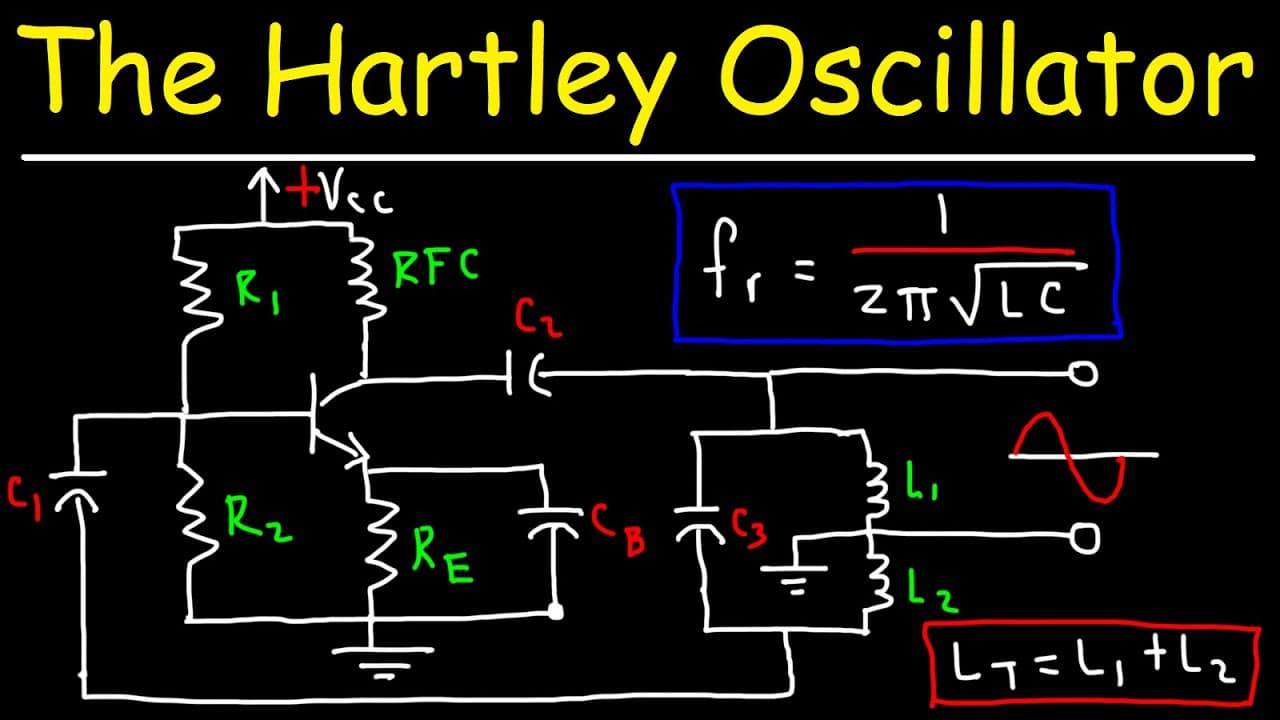
This video explains the design and calculations involved in creating a Hartley oscillator circuit, including the selection of resistors, capacitors, and inductors, for achieving desired frequencies.
Transcript
in this video we're going to talk about the hartley oscillator now this particular circuit only uses one npn transistor it also uses an emitter resistor which we'll call re and across the emitter resistor is the bypass capacitor this capacitor will increase the voltage gain of the circuit now we're going to have two other resistors r2 and r1 these ... Read More
Key Insights
- ⚡ A Hartley oscillator circuit can be designed with a single NPN transistor, an emitter resistor, and a bypass capacitor for increased voltage gain.
- ⚡ Resistors R1 and R2 form a voltage divider network, while a collector resistor or a radio frequency choke is used for impedance matching and increased voltage gain.
- 👻 Coupling capacitors block DC and allow AC signals to pass through. Adjusting their capacitance values can compensate for the effects of capacitive reactance at different frequencies.
- 🎮 The LC network, composed of capacitors and inductors, controls the frequency of oscillation in a Hartley oscillator circuit.
- 🗽 Calculating the desired capacitance value for a specific resonant frequency can be done using the formula c3 = 1 / (4 * pi^2 * f^2 * L), where c3 is the desired capacitance, f is the frequency, and L is the inductance of the LC network.
- 🍹 When combining multiple capacitors in parallel, the equivalent capacitance is the sum of the individual capacitance values. This can be used to achieve the desired capacitance value.
- ❓ Practical considerations may require combining multiple capacitors to reach the exact desired value due to component availability.
Install to Summarize YouTube Videos and Get Transcripts
Explore YouTube Video Summarizer or Get YouTube Transcript Extractor
Questions & Answers
Q: How can the voltage gain of a Hartley oscillator circuit be increased?
The voltage gain can be increased by using a collector resistor or a radio frequency choke that provides high reactance to high-frequency signals, while allowing DC current to flow.
Q: How can the effects of capacitive reactance be compensated for in low-frequency Hartley oscillator circuits?
To compensate for the increase in capacitive reactance at low frequencies, the values of coupling capacitors (C1 and C2) can be increased. Higher capacitance values decrease capacitive reactance.
Q: What is the formula for calculating the capacitive reactance?
The formula for capacitive reactance is 1 / (2 * pi * frequency * capacitance). As frequency increases or capacitance increases, capacitive reactance decreases.
Q: How can the desired capacitance value be achieved when designing a Hartley oscillator circuit?
Multiple capacitors can be combined in parallel to achieve the desired capacitance value. The equivalent capacitance is the sum of the individual capacitance values.
Summary & Key Takeaways
-
The Hartley oscillator circuit uses a single NPN transistor, an emitter resistor, and a bypass capacitor to increase voltage gain.
-
Two resistors, R1 and R2, create a voltage divider network at the base of the transistor, while a collector resistor or a radio frequency choke allows DC current but provides high reactance to high-frequency signals for increased voltage gain.
-
Two coupling capacitors, C1 and C2, block DC and allow AC signals to pass through. The capacitance values should be adjusted for low-frequency signals.
Read in Other Languages (beta)
Share This Summary 📚
Summarize YouTube Videos and Get Video Transcripts with 1-Click
Try YouTube Summary with ChatGPT & Claude or YouTube Transcript Generator
Explore More Summaries from The Organic Chemistry Tutor 📚



Summarize YouTube Videos and Get Video Transcripts with 1-Click
Try YouTube Summary with ChatGPT & Claude or YouTube Transcript Generator