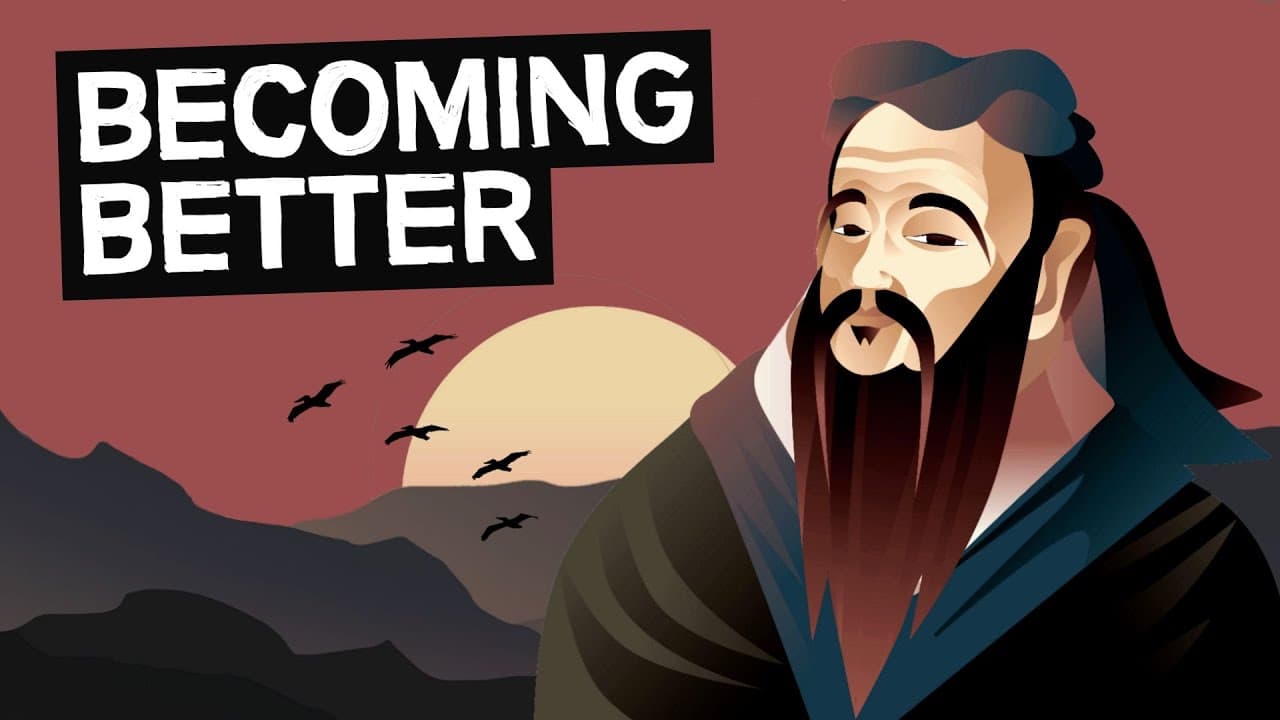
Confucius | The Art of Becoming Better (Self-Cultivation)
TL;DR
Confucian self-cultivation means improving who we are through disciplined behaviors, rituals, practice, and training rather than treating personality as fixed. Confucius viewed people as agents of great potential who can become more skilled, integrated, and virtuous, while Michael Puett describes the self as an evolving collection of emotions, thoughts, and sensations. Read on to see how this view challenges limiting beliefs and destructive patterns.
Transcript
Isn’t it the case we should always stay true to ourselves? Which means that we ought to know who we are, and organize our lives in ways that are compatible with our personalities? When we look for a partner, for example, we look for someone that we’re compatible with, and in regards to education and work, we need to do something that fits our chara... Read More
Key Insights
- 🤳 The Chinese view of the self as fluid and ever-changing contrasts with the Western idea of the self as fixed.
- ✊ Rituals and ceremonies have transformative power, shaping societies and individuals in Confucianism.
- 🤳 Self-cultivation involves breaking existing patterns and adopting new behaviors through transformative rituals.
- 🥺 Engaging in self-cultivation can lead to positive changes, such as overcoming fears, improving relationships, and developing new character traits.
- 🤳 Self-cultivation is a lifelong process that requires continuous effort and practice.
- 🥰 The art of self-cultivation is about being the change we want to see in ourselves.
- ✋ By embracing rituals and change, individuals can experience personal growth and a higher quality of life.
Install to Summarize YouTube Videos and Get Transcripts
Explore YouTube Video Summarizer or Get YouTube Transcript Extractor
Questions & Answers
Q: What is Confucian self-cultivation?
Confucian self-cultivation is the process of enhancing and perfecting how we act and relate to one another. It treats people as capable of becoming more skilled, integrated, and virtuous through disciplined practice and training.
Q: How does the Chinese view of the self differ from the Western view?
The transcript contrasts a Western view of personality as a fixed set of characteristics with a Chinese view of the self as fragmented, evolving, and changeable. Michael Puett describes the self as a collection of decentralized manifestations such as emotions, thoughts, and other sensations.
Q: Why does Confucianism emphasize rituals?
Confucius believed rituals could improve life because they function as a form of social cement. Their transformative effects shape both societies and individuals, supporting morality, order, respect, and social harmony.
Q: How can everyday rituals help someone change?
Disciplined behaviors such as morning rituals, habits, and exercises can interrupt existing patterns and cultivate different ways of acting. Because the self is shaped by what people do, repeated practice can produce change beyond their limiting beliefs.
Q: Why can a fixed view of personality be dangerous?
Believing that traits and behavioral patterns cannot change can keep people trapped in destructive situations. The transcript gives abusive relationships, substance abuse, and criminal activities leading to prison as examples of patterns that may continue when someone believes change is impossible.
Q: What does Michael Puett say about finding your true self?
Puett argues that the self is not a fixed essence hidden within and waiting to be discovered. Instead, the self is evolving and malleable, so it cannot simply be found but can be cultivated through action.
Q: How does Confucianism differ from Taoism in its approach to personal development?
The transcript says Taoist sage Zhuangzi opposed artificial ways of living and favored following nature with minimal interference. Confucianism acknowledges the inborn natural state but views people as diamonds in the rough who can improve through practice and training.
Q: Who was Confucius, and what did his teachings emphasize?
Confucius was a philosopher and politician born in the 6th century BC in the vassal state of Lu. Dissatisfied with the ruling aristocrats, he developed a way of life and governance later called Confucianism, emphasizing morality, order, respect, traditions, ceremonies, and rituals.
Summary & Key Takeaways
-
The Western idea of the self as a fixed set of characteristics is limited in comparison to the Chinese view of the self as evolving and changeable.
-
Confucianism emphasizes the power of rituals and ceremonies in shaping individuals and societies.
-
Self-cultivation involves breaking existing patterns and adopting new behaviors through transformative rituals, leading to personal growth and improved quality of life.
Read in Other Languages (beta)
Share This Summary 📚
Summarize YouTube Videos and Get Video Transcripts with 1-Click
Try YouTube Summary with ChatGPT & Claude or YouTube Transcript Generator
Explore More Summaries from Einzelgänger 📚
Summarize YouTube Videos and Get Video Transcripts with 1-Click
Try YouTube Summary with ChatGPT & Claude or YouTube Transcript Generator