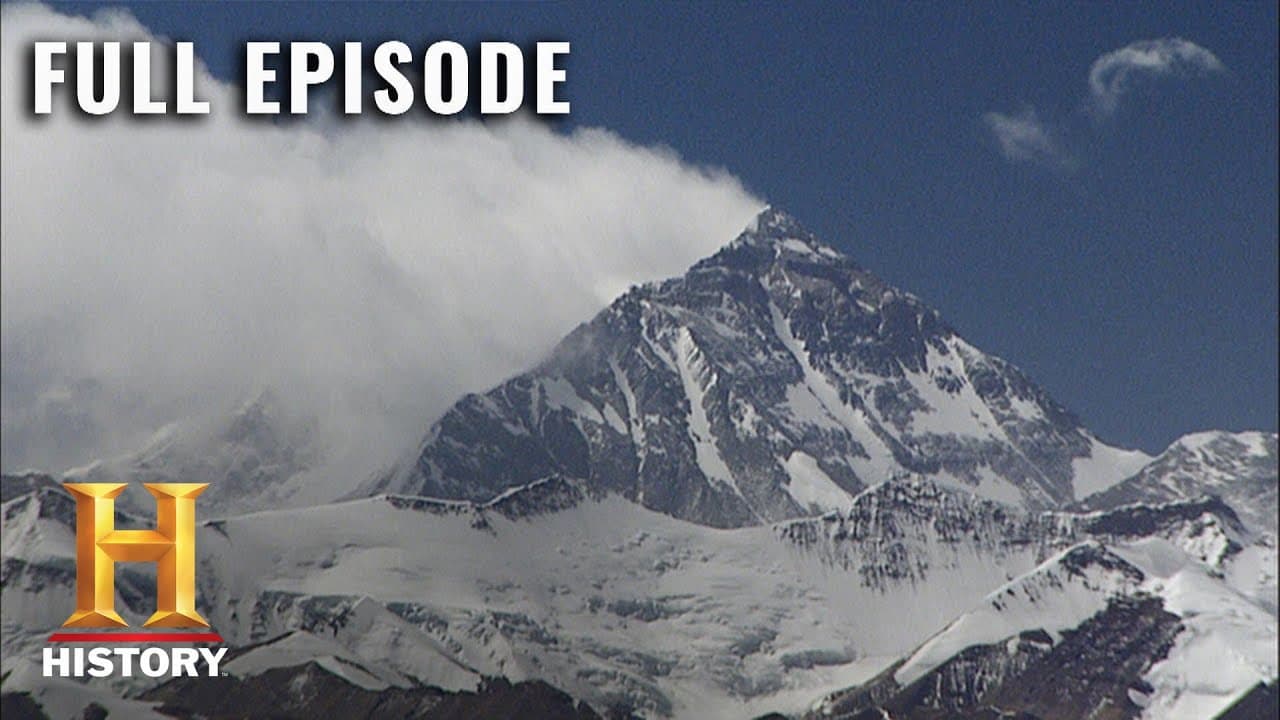
How Did Mount Everest Rise From the Ocean Floor? | How the Earth Was Made | Full Documentary | History
TL;DR
Mount Everest rose from an ancient ocean floor after India moved north and collided with Asia. Its summit contains limestone with a fossilized sea lily more than 400 million years old, while marble and crystal-rich granite appear lower on the mountain. The youngest marine fossils date the India-Asia collision to about 50.5 million years ago. Read on to see how three rock samples reveal Everest’s extraordinary formation.
Transcript
NARRATOR: Earth, a unique planet, restless and dynamic. Continents shift and clash. Volcanoes erupt. Glaciers grow and recede. Titanic forces that are constantly at work leaving a trail of geological mysteries behind. This episode explores Everest, the highest mountain on planet earth. In order to unlock its secrets, a daring mission is undertaken ... Read More
Key Insights
- Everest is the world's highest mountain at about five and a half miles tall, and its geology can be investigated through samples collected from the summit, the yellow band, and the exposed granite at its base.
- The summit of Everest is made of gray limestone containing a fossilized crinoid stem. Because crinoids are sea lilies, this fossil proves that rock now at the planet's highest point originally formed on an ancient sea floor.
- The summit limestone is more than 400 million years old, based on evidence from its fossil content. Its great elevation therefore records an immense transformation from a marine environment to the top of the world's highest mountain.
- The yellow band below Everest's summit is a distinctive layer of hard, yellow marble. Its composition differs sharply from both the softer summit limestone above it and the white, crystal-rich granite exposed farther down the mountain.
- The Western Cwm is a large U-shaped valley carved by the Khumbu glacier. Over the past million years, ice carrying rock and debris has ground against the underlying surface, exposing granite at the base of Everest.
- Ammonite fossils found in Himalayan river rocks are evidence of a complex deep-ocean ecosystem. Their presence supports the conclusion that a major ocean, rather than merely a shallow inland sea, once existed between India and Asia.
- Glossopteris fossils show that India, Antarctica, South America, Africa, Madagascar, and Australia were once connected. The plant could not disperse across vast oceans, so its distribution helped geologists identify the ancient supercontinent called Gondwana.
- India broke away from Gondwana about 80 million years ago and traveled roughly 4,000 miles north before striking Asia. The youngest marine fossils along the collision belt date this continental collision to about 50.5 million years ago.
Install to Summarize YouTube Videos and Get Transcripts
Explore YouTube Video Summarizer or Get YouTube Transcript Extractor
Questions & Answers
Q: How did Mount Everest rise from the ocean floor?
Everest’s summit limestone originally formed as sediment in an ancient marine environment. India later broke away from Gondwana, traveled roughly 4,000 miles north, and collided with Asia, lifting former sea-floor rocks to extreme elevations. The youngest marine fossils along the collision belt date that collision to about 50.5 million years ago.
Q: What proves that Mount Everest’s summit was once under the ocean?
A thin section of gray limestone collected near Everest’s summit contained part of a fossilized crinoid stem. Crinoids are sea lilies, so the fossil shows that the summit rock formed in a marine environment more than 400 million years ago.
Q: What types of rock make up Mount Everest?
The three major sampled components are gray limestone, yellow marble, and white granite. Limestone occurs near the summit, marble forms the yellow band below it, and crystal-rich granite is exposed farther down in the Western Cwm.
Q: How were rock samples collected from Mount Everest?
High-altitude climber Kenton Cool collected three samples during an ascent of Everest. He gathered limestone just below the summit, marble from the yellow band, and granite from an exposed outcrop in the Western Cwm before taking them to the University of Oxford for analysis by Mike Searle.
Q: Why is climbing Mount Everest so dangerous?
Climbers face moving glacial ice, crevasses thousands of feet deep, collapsing ice towers, winds exceeding 100 miles per hour, and temperatures of minus 40 degrees. Above 26,000 feet lies the death zone, where oxygen is needed because the air is three times thinner than at sea level. The transcript states that 1 in 10 people die climbing Everest.
Q: What evidence shows that a major ocean once separated India and Asia?
Ammonite fossils found in Himalayan river rocks provide evidence of a complex marine ecosystem. Together with marine fossils at high elevations, they show that a major ocean once existed between India and Asia.
Q: How did Glossopteris fossils reveal the existence of Gondwana?
Glossopteris fossils were found across India, Antarctica, South America, Africa, Madagascar, and Australia. Because the plant could not disperse across vast oceans, its distribution showed that these lands were once connected within the supercontinent Gondwana.
Q: When did India collide with Asia to form the Himalayas?
The youngest marine fossils along the collision belt date the India-Asia collision to about 50.5 million years ago. India had separated from Gondwana about 80 million years ago and traveled roughly 4,000 miles north in around 30 million years before striking Asia.
Summary & Key Takeaways
-
Climber Kenton Cool collected three crucial rock samples from different elevations on Everest: gray limestone near the summit, hard yellow marble from the yellow band, and white, crystal-rich granite in the Western Cwm. Together, these samples give geologists an unusually complete view of the major rocks composing the mountain.
-
A thin section cut from the summit limestone revealed part of a fossilized crinoid stem. This sea lily lived more than 400 million years ago, proving that Everest's highest rock began as sediment in a marine environment. Ammonite fossils elsewhere in the Himalayas indicate that a major ocean once separated India and Asia.
-
Glossopteris fossils found across several modern continents showed that those lands were once connected within Gondwana. India separated from this supercontinent about 80 million years ago, traveled roughly 4,000 miles north in 30 million years, and collided with Asia. The youngest marine fossils date that collision to approximately 50.5 million years ago.
Read in Other Languages (beta)
Share This Summary 📚
Summarize YouTube Videos and Get Video Transcripts with 1-Click
Try YouTube Summary with ChatGPT & Claude or YouTube Transcript Generator
Explore More Summaries from HISTORY 📚



Summarize YouTube Videos and Get Video Transcripts with 1-Click
Try YouTube Summary with ChatGPT & Claude or YouTube Transcript Generator