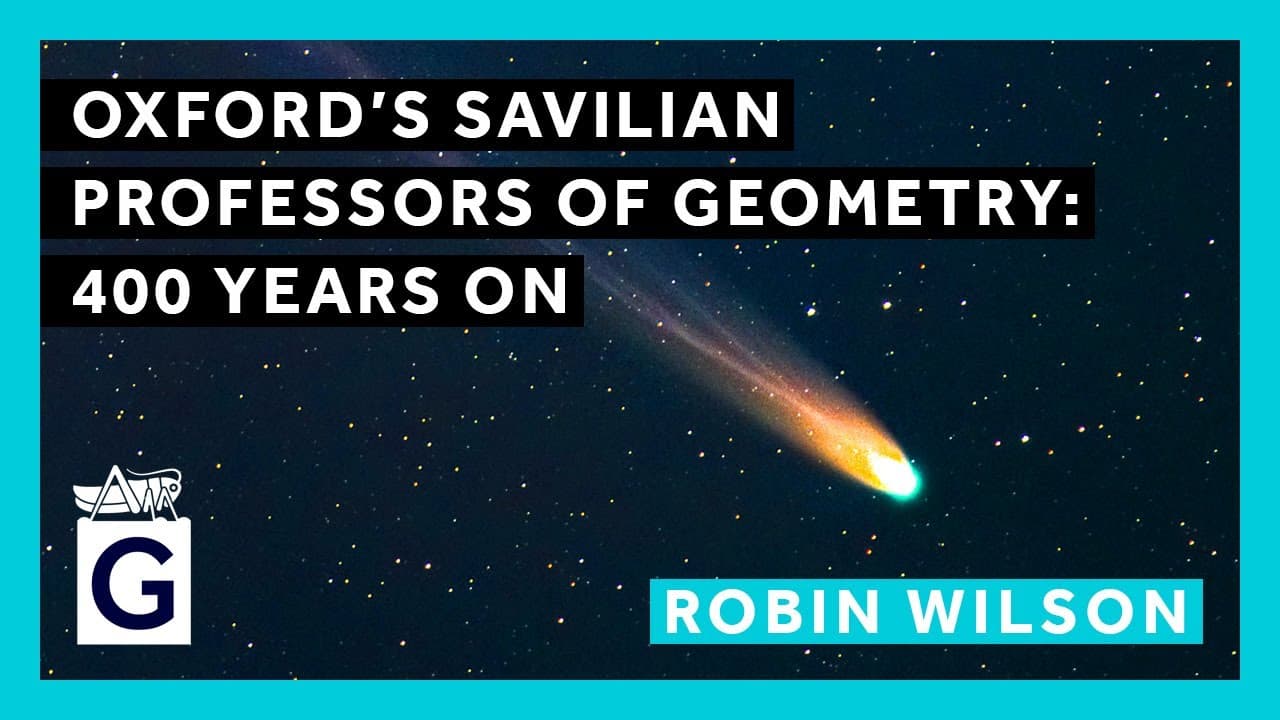
What Is the Legacy of Oxford's Savilian Professors of Geometry?
TL;DR
The legacy of Oxford's Savilian Professors of Geometry spans 400 years, from Henry Savile's founding of the chairs in 1619 to contemporary figures like Frances Kirwan. Key contributions were made by renowned professors such as John Wallis, Edmond Halley, and G.H. Hardy, significantly advancing mathematics and astronomy. Their stories highlight the pivotal role these chairs have played in the evolution of mathematical study at Oxford.
Transcript
- Well good afternoon, everybody. And welcome to this book launch of "Oxford's Savilian Professors of Geometry," both to those of you here at Barnard's Inn Hall, and those of you who are watching online. This book was published by Oxford University Press in January. Now I was wondering how many of these five professors, Savilian professors, can you... Read More
Key Insights
- 💋 The establishment of the Chairs of Geometry and Astronomy at Oxford University by Henry Savile in 1619 marked the beginning of a prestigious tradition.
- 👨🏫 John Wallis, Edmond Halley, and G.H. Hardy are among the most celebrated Savilian professors who made significant contributions to geometry, astronomy, and number theory.
- 🖐️ The Victorian period witnessed the contributions of Baden Powell, Henry Smith, and James Joseph Sylvester, who played influential roles in promoting mathematical studies and research.
- 🥺 Michael Atiyah's appointment as the Savilian professor marked a pivotal moment, leading to collaborations with Andrew Wiles and an eventual proof of Fermat's Last Theorem.
Install to Summarize YouTube Videos and Get Transcripts
Explore YouTube Video Summarizer or Get YouTube Transcript Extractor
Questions & Answers
Q: Who founded the Chairs of Geometry and Astronomy at Oxford University?
Henry Savile, who held positions as provost of Eton College and warden of Merton College, established the Chairs in 1619. He had a passion for mathematics and expounded on the works of Euclid and Ptolemy.
Q: Who succeeded John Wallis as Savilian professor and made significant contributions to the study of conic sections?
Edmond Halley, known for Halley's Comet, succeeded John Wallis in the Savilian chair. He was an astronomer and mathematician who produced the definitive edition of Apollonius' text on conic sections.
Q: Who were some of the prominent Savilian professors during the Victorian period?
Baden Powell, Henry Smith, and James Joseph Sylvester were notable Savilian professors during the Victorian era. Powell was known for his activism in promoting mathematical and physical studies, while Smith contributed to number theory and matrix algebra. Sylvester made significant contributions to invariant theory and received a Fields Medal in 1966.
Q: Who was the first woman to become a professor in the Savilian chair?
Frances Kirwan, the current Savilian professor of geometry, wrote about her doctoral supervisor, Michael Atiyah, and his successors. However, it is important to note that there were prominent women mathematicians who made significant contributions to mathematics at Oxford prior to Kirwan's appointment.
Summary & Key Takeaways
-
This book launch event celebrated the release of "Oxford's Savilian Professors of Geometry," which examines the history of mathematics through the perspectives of 20 professors over 400 years.
-
The authors of this edited book are renowned experts in the history of mathematics, and their research is accompanied by over 130 pictorial images.
-
The book covers the founding of the Chairs of Geometry and Astronomy, the contributions of prominent professors such as John Wallis and Edmond Halley, and extends into the Victorian and 20th-century periods.
Read in Other Languages (beta)
Share This Summary 📚
Summarize YouTube Videos and Get Video Transcripts with 1-Click
Try YouTube Summary with ChatGPT & Claude or YouTube Transcript Generator
Explore More Summaries from Gresham College 📚

Summarize YouTube Videos and Get Video Transcripts with 1-Click
Try YouTube Summary with ChatGPT & Claude or YouTube Transcript Generator