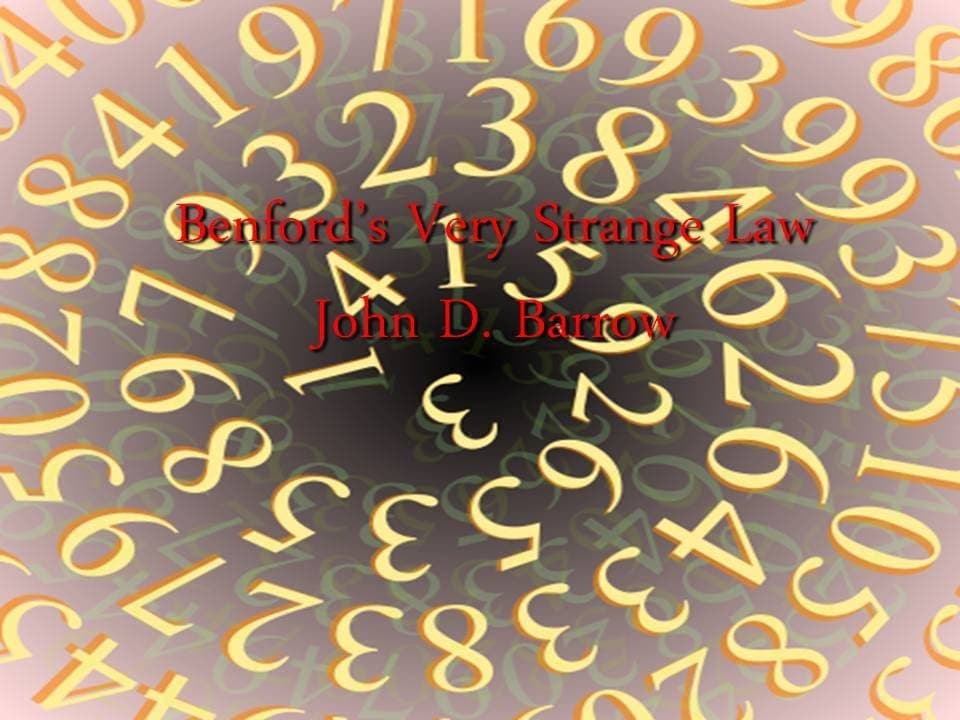
Benford's Very Strange Law - Professor John D. Barrow
TL;DR
Benford’s Law is an unusual probability distribution that describes how the first digit of numbers in various datasets is not equally distributed, but instead follows a logarithmic pattern.
Transcript
well today we're going to take a look at something rather unusual that always intrigues me whenever I return to look at it and we'll see how this unusual uh probability distribution that's sometimes known as benford's law how it arose uh why it's a reasonable thing to expect to be true about numbers that you encounter in real life uh and then some ... Read More
Key Insights
- 💝 Simon Newcomb first observed the unequal distribution of first digits in the late 1800s when using logarithmic tables.
- 📛 Benford's Law, named after Frank Benford who rediscovered it in 1938, describes the probability distribution of the first digit of numbers.
- 🛩️ The distribution follows a logarithmic pattern, with smaller digits occurring more frequently.
- 🥹 Benford's Law has been found to hold true for various datasets in fields such as geography, finance, and physics.
- 👮 The law can be used as a tool for fraud detection by identifying deviations from the expected distribution in financial data.
- 🥹 Benford's Law does not hold true for all types of datasets, and there are cases where the distribution deviates from the expected pattern.
- #️⃣ In addition to the first digit, Benford's Law can also be applied to the second and subsequent digits of numbers.
- #️⃣ The distribution of first digits in prime numbers does not exactly follow Benford's Law, but it exhibits a similar trend as the number of primes increases.
Install to Summarize YouTube Videos and Get Transcripts
Explore YouTube Video Summarizer or Get YouTube Transcript Extractor
Questions & Answers
Q: How did Simon Newcomb first observe the unequal distribution of first digits in numbers?
Newcomb noticed that logarithmic tables were more worn for numbers starting with smaller digits, indicating that those numbers were more frequently looked up.
Q: What is the probability distribution described by Benford's Law?
Benford's Law states that the probability of the first digit being D is equal to the logarithm of (1 + 1/D) divided by the logarithm of 10.
Q: How does Benford's Law apply to other datasets?
Benford's Law has been found to hold true for various datasets, including lake areas, baseball averages, lottery numbers, and financial data. It provides a pattern for the distribution of first digits.
Q: Can Benford's Law be used to detect fraud or false accounting?
Yes, Benford's Law has been used as a tool for fraud detection. Deviations from the expected distribution of first digits can indicate potential fraud or manipulation in financial data.
Summary & Key Takeaways
-
Simon Newcomb first noticed an unequal distribution in the first digit of numbers in the 1880s when using logarithmic tables. He observed that numbers starting with smaller digits appeared more frequently.
-
Newcomb's law, later known as Benford's Law, states that the probability distribution of the first digit of numbers is not uniform and follows a logarithmic pattern.
-
Frank Benford rediscovered and tested this distribution in 1938 with various datasets, finding that it held true for diverse fields like geography, finance, and physics.
Read in Other Languages (beta)
Share This Summary 📚
Summarize YouTube Videos and Get Video Transcripts with 1-Click
Try YouTube Summary with ChatGPT & Claude or YouTube Transcript Generator
Explore More Summaries from Gresham College 📚

Summarize YouTube Videos and Get Video Transcripts with 1-Click
Try YouTube Summary with ChatGPT & Claude or YouTube Transcript Generator